
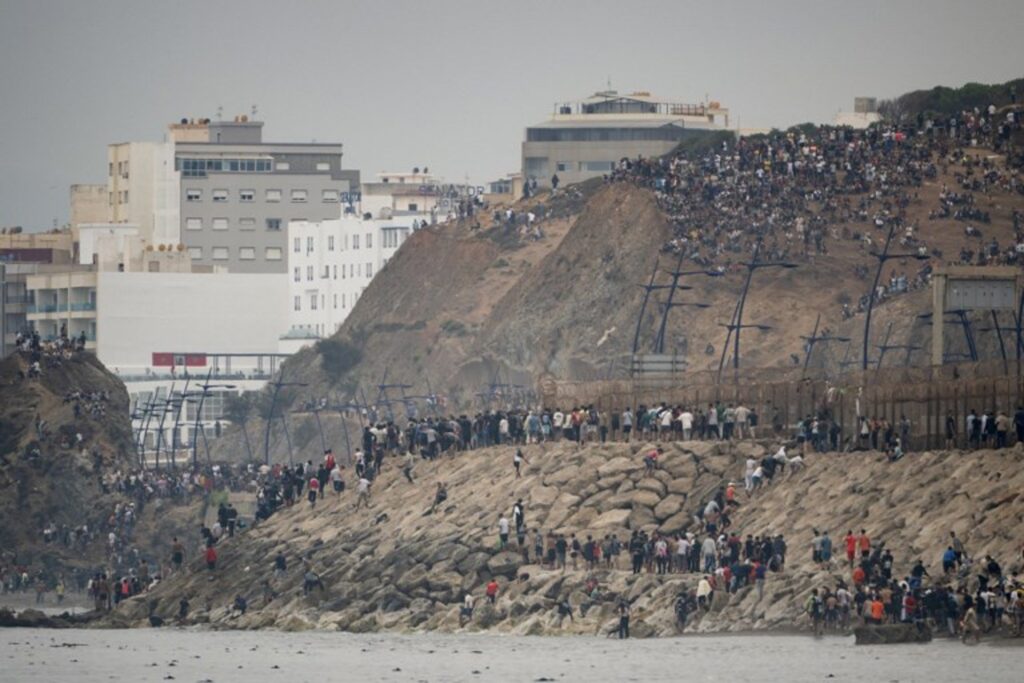
The sudden surge in irregular migrants from Morocco into the Spanish enclave Ceuta took the EU by surprise and was immediately condemned by the European Commission as unacceptable but it would take the EU until Tuesday, after almost all migrants had been returned, to get its act together and present a unified front.
Spanish Prime Minister Pedro Sánchez described the massive influx of illegal migrants as an "attack" and a "violation of Spain’s territorial integrity". He accused smuggling networks of "deceiving young people" and spreading disinformation about a recent Spanish Supreme Court ruling about the entry by sea to Spain which appeared to have triggered them to try to enter Spain.
Stopping short of accusing Morocco of instrumentalizing migration for political reasons, he lashed out against some EU Member States who had been quick to call for Spain’s suspension from the Schengen area with its open borders between EU Member States.
The vast majority of EU Member States were indeed concerned. In a letter, which was initiated by Italy and Denmark, 22 Member States expressed their concerns over the mass crossings and requested an extraordinary meeting. The letter, dated 1 August, was addressed to EU leaders von der Leyen and Costa, and the Irish Prime Minister representing the Irish EU Presidency.
“We are determined to prevent smugglers from challenging the integrity of the Union’s external borders,” the letter stated. “We recognise that the recent ruling of the Spanish Supreme Court has been used to trigger this attack and abuse our migration and asylum system.“
“We cannot allow uncontrolled mass crossings, the instrumentalisation of migration or other hybrid threats to create the perception that illegal entry into the European Union is possible. That a migrant’s illegal entry can turn into legal stay.”
After welcoming that Spain and Morocco were cooperating closely to ensure the swift return of the illegal migrants, the letter concluded that the current situation calls for unity, determination and urgency. “We count on your leadership to ensure that the European Union responds swiftly, effectively and in a coordinated manner.”
European Commission President, Ursula von der Leyen, did not visit Ceuta but sent a letter to the Spanish minister before the extraordinary meeting, saying that Spain and its people can count on the enduring support of the Commission. The letter, which has not been publicly released but was quoted by Politico, emphasized that protecting external borders is a shared responsibility.
Following a public mutual blame game, interior and migration ministers from all EU Member States held talks by video-conference in what Spain described as a constructive atmosphere.
After the meeting, the Commissioner for Internal Affairs and Migration, Magnus Brunner, debriefed journalists on the outcome and EU’s lessons learned from the tragic incident which had claimed the lives of at least 83 persons. He described the incident as a test of European resilience on the one hand and the security of EU’s external borders on the other hand – a test which the EU had passed.
Summarizing the known facts, he stressed that out of those around 72,000 persons, who had tried to cross the external border into EU territory, “fueled by criminal smuggling networks and also disinformation”, about 70,000 had already voluntarily returned to Morocco, which is included in the EU list of safe countries of origin.
Lessons learned
No- one had actually moved from Ceuta into the mainland of Spain and from there to continental Europe, he stressed. The Schengen area had therefore not been affected as those 22 EU Member States had feared in their letter. The integrity of the Schengen area was preserved and “that is the result of a close of a sustained cooperation between Spain, Morocco, and the Commission over the recent days”.
The EU is currently in the process of negotiating a strategic comprehensive partnership agreement with Morocco in with the topic of migration will be one of the core elements.
According to Brunner, illegal migration decreased by 55% in the last two years, another almost 40% so far this year. Just over 49,000 people crossed illegally to the EU across all our external borders. “But of course, the dramatic images from Ceuta beat the best statistics,” he added. As lessons learned, he summarized five points in von der Leyen’s letter.
- Prevention of illegal migration by stronger cooperation with EU partners (‘migration diplomacy’).
- Swifter returns of illegal migrants applying EU’s new return regulation.
- Further protection of EU external borders with reinforced Frontex support
- Implementing early warning systems to strengthen EU’s capacity to monitor disinformation
- Dismantling smuggling networks by adopting the global sanctions regime against them
When the situation was still evolving last Friday, senior EU officials declined to speculate about the causes. The situation has now been brought under control but Commissioner Brunner declined to address questions about the responsibility for the Ceuta crisis. Had Morocco ‘instrumentalised’ illegal migration to put pressure on Spain because of political disagreements?
“We saw there was instrumentalisation by human traffickers,” he claimed but cautioned that more clarity was needed before he could elaborate on what exactly had happened. While rumors and disinformation had been spread on social media, no smuggling networks had this time brought illegal migrants to Europe’s shores on unseaworthy, overcrowded vessels.
Had Spain itself triggered the crisis by a supreme court ruling which stated that migrants arriving by sea cannot be summarily returned as those breaching land perimeters such as climbing the Ceuta border fences?
Instead, Spain is required to use ordinary immigration procedure and assess individual asylum applications. According to the EU experts, there is a fast procedure for declaring applications inadmissible if they are manifestly unfounded (migrants from a country of origin or third country which is considered safe). To close the legal loophole, Spain plans to build sea barriers with EU support.
