

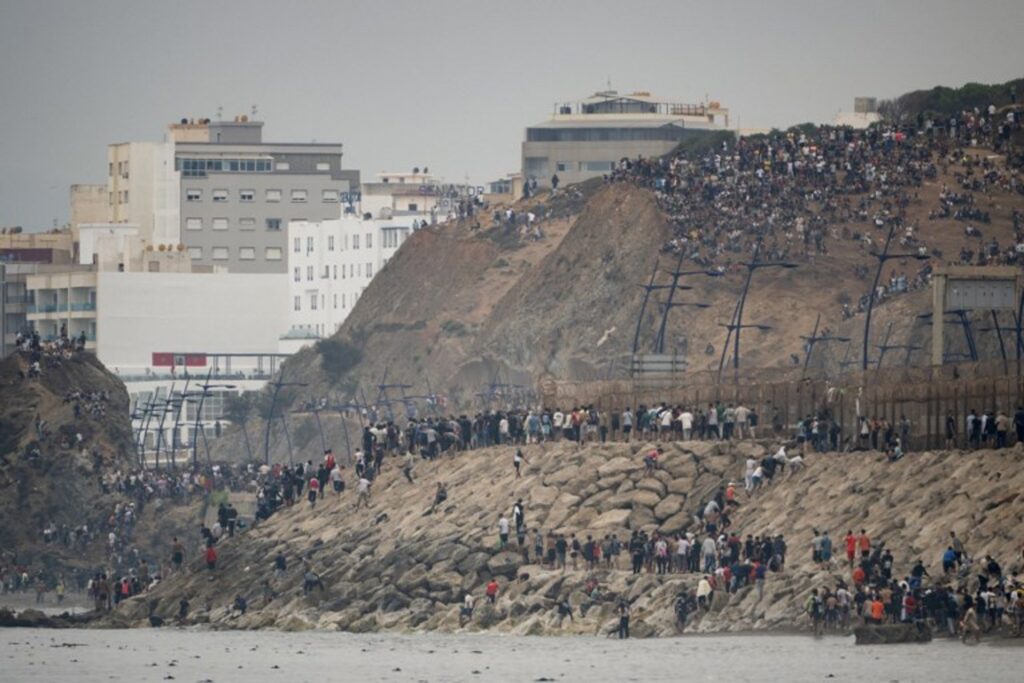
The events in Ceuta over the past week teach us that the newly reformed EU migration system is incapable of coping with shocks without member states turning against one another. Unless that changes, Ceuta will not be remembered as an exception, but as a preview of what is to come.
Ceuta, a city of roughly 83,000 people along the European Union’s only land border with Africa, has found itself again in the cusp of collapse when some 60,000 migrants entered from Morocco in a matter of days, a number equivalent to around 70% of the city's own population.
The whole of the EU saw its worst nightmare turn into reality. Hundreds of people, many of whom unaccompanied minors, were suddenly sleeping in car parks and wondering in the streets, faced with the total collapse of local migrant reception structures. As a result, Spain had to send troops to restore order.
Far-right groups in Spain and in the rest of Europe blamed Sanchez government’s migration policies for the crisis, even though those measures addressed a completely different demography who already lived in Spain. While they might be speaking the loudest right now, it is due to rightwing pressure that member states have turned against each other on migration.
Different explanations have been provided for what caused the sudden surge in young migrant arrivals in Ceuta. The truth is that Morocco’s youth unemployment has been high for years, standing at 37%, so much so that in 2025 young 'Gen Z protests' took to the streets, calling for accountability and social justice.
Half of Morocco’s population is under 35. They are increasingly disenfranchised by their government’s policies which do not prioritize their primary concerns, like the lack work, training and education opportunities. Young Moroccans who crossed the border last week are indeed citing discontent as a motive. European cooperation with the Moroccan government is not addressing these concerns, rather favoring trade and industrial relations.
Most young people who crossed into Ceuta and Melilla have returned. But the crisis has already broken the EU. Italy has suspended Schengen cooperation with Spain for a month, a move backed by other countries like Finland, Denmark and Austria. Twenty-two countries have written to Spain asking for a tougher migration policy.
Only France, Ireland, Portugal and Luxembourg refused to join the call, although France tightened its own border with Spain. Ursula von der Leyen’s statement seemed to give more credit to Morocco than Spain. Only Antonio Costa, a fellow socialist, expressed solidarity with Sanchez.
EU solidarity frays
Ceuta exposes the central weakness of the EU’s migration consensus, which recently culminated in the adoption of the EU Migration and Asylum Pact. The EU has spent years building it, precisely to avoid being unprepared in front of a crisis like Ceuta.
Spain resolved the crisis quickly, but only thanks to bilateral cooperation with Morocco, not EU support. Had it been unable to do so, however, the new measures would have involved moving circa 60,000 people into processing facilities akin to detention centres. The likely unfeasibility of such a scenario caused panic across the bloc. EU countries like Italy raced to put up fences.
This extreme reaction to events taking place far from its borders (and Italy itself hardly being a country migrants aspire to go to, given its acute economic problems) shows how thin the current architecture actually is. Ironically, when a similar episode affected Italy itself back in 2011, Rome vocally called for open EU borders.
Initial European reactions show the futility of efforts to come up with shared crisis response mechanisms in the current political climate. When US-Israel strikes in Iran began in late February, the EU looked largely unprepared to a possible mass influx of refugees and went into panic mode.
This points to a structural problem: the EU is increasingly fragmented and deeply vulnerable to external shocks. Every time a crisis hits, shared instruments prove to be too thin, resulting in national governments reaching for emergency unilateral measures. If Europeans want to succeed in addressing future crises, shared solidarity is critical. On migration, this means looking at the issue with a broader lens than what far-right parties want.
To be sure, Spain has emerged isolated from the Ceuta crisis. But one could argue that so has Italy: despite many EU states declaring support for the suspension of Schengen cooperation, only Rome moved forward. After a few days, the whole EU has softened its response. This shows that most Europeans are aware about the need to balance tough domestic rhetoric with some common sense.
Migration starts before the border
Responding to a sudden surge of migrants by sealing borders and deflecting the burden to others only gives right-wing parties a free pass to push for hardline measures, strengthening their prominence at a time of high collective emotional distress and fuels perceptions of migration as a threat to be repelled, rather than an inevitable human phenomenon to be managed by shared solidarity mechanisms.
Instead of focusing solely on returning people, one wonders why Spain has been left alone to cope with a sudden surge in migrant flows without adequate support, or without a clear route forward for these migrants, in either direction. Answering simply with security measures fails to acknowledge underlying problems – the lack of a partnership architecture that addresses economic and political conditions driving migration in transit and origin countries, and which shares reception and processing capacity across the bloc.
A comprehensive migration policy must begin long before the border. It means addressing demands, like those of Morocco’s 'Gen Z protests' group, for opportunity, livelihoods, good governance, and legal pathways for those who seek to explore life away from their home country – as many Europeans do.
Until that happens, Europe risks to keep moving from one Ceuta to the other, each time making the anti-solidarity narrative stronger than before.
