

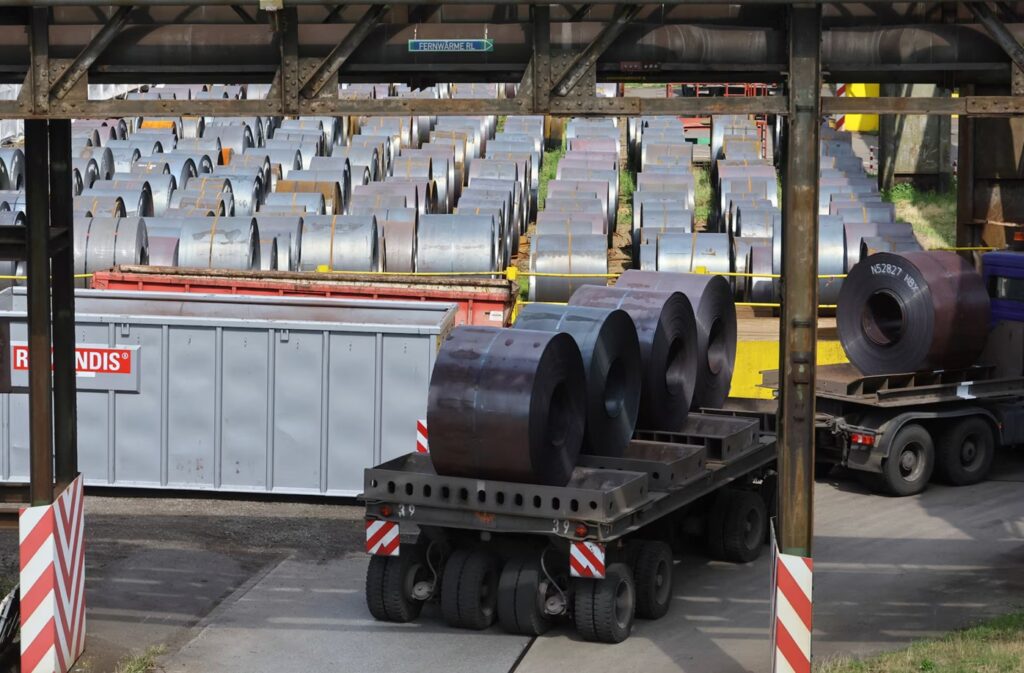
On 1 July, the European Union’s new steel import regime took effect. Its purpose is legitimate. Europe’s steelmakers support some 300,000 direct jobs and are essential to our defence industry, infrastructure and green transition.
With global excess capacity projected to reach 721 million tonnes by 2027, the EU is right to defend its producers against unfairly subsidised steel and trade diversion.
But a sound instrument has been applied too bluntly. The new system limits tariff-free imports to 18.3 million tonnes annually—about 47% below the previous quota—and imposes a 50% duty once the relevant quotas are exhausted, according to the Council of the EU.
Ukraine received somewhat better treatment than many trading partners, including access to quotas reserved for countries with EU free-trade agreements. Yet better does not mean adequate.
Ukraine’s guaranteed country-specific quotas total only about 1.05 million tonnes a year. That is less than half the 2.2 million tonnes of finished steel it exported to the EU in 2024. The EU now accounts for 79% of Ukrainian steel exports, according to the Kyiv Independent.
Ukrainian producers can compete for additional shared quotas, but those are allocated on a first-come, first-served basis against much larger international competitors. Beyond them lies a commercially prohibitive 50% tariff.
A month is too soon to count the resulting closures. It is not too soon however to recognise the policy’s category error.
Ukrainian steel is not the product of the state-subsidised global glut that Europe is trying to contain. It is produced under missile attack, disrupted electricity supplies and repeatedly damaged transport infrastructure. Metinvest has lost its Mariupol plants and access to its coking-coal mine near Pokrovsk. Its remaining mills are operating below capacity.
Those exceptional conditions are recognised beyond Ukraine. In April, European employers and trade unions represented in the EU’s Sectoral Social Dialogue Committee for Extractive Industries warned that “the Ukrainian mining sector is operating under unprecedented wartime conditions.” Steel production begins at the mine: attacks on extraction sites, electricity networks and transport links reverberate through the entire industrial chain. Applying peacetime trade assumptions to that chain risks compounding the damage Russia is already inflicting.
As Metinvest chief executive Yuriy Ryzhenkov told the Guardian, “Ukraine does not present a significant threat to the EU steel industry. It’s simply not big enough.” That is not merely a corporate plea. It is a warning about European security.
The Commission argues that Ukraine may retain access equivalent to roughly 70% of its historical trade once shared quotas are included. But the calculation is based on 2022–24—the very years in which Russia destroyed factories, blockaded ports and drove down Ukrainian production.
Using those years as the benchmark risks freezing Ukraine’s industry at a level imposed by Russian aggression. The uncertain availability of a shared quota is no substitute for reliable market access on which mills can base investment and production decisions.
This is indeed no longer a theoretical problem. Ukrainian industrial company Interpipe says it already used up a significant share of its quarterly duty-free quota for seamless pipes during the first 3 weeks of this month and expected the quota to be exhausted by August, after which a 50% duty would apply.
A strategic own goal
This is not simply a Ukrainian industrial problem. For Europe, it is a strategic own goal on three fronts. First, the measure weakens Ukraine’s capacity to finance its own defence. Steel exports sustain jobs, foreign-exchange earnings and tax revenue. When those revenues decline, Kyiv has fewer domestic resources for its war effort—and the funding gap facing European governments grows. We should be helping Ukraine remain economically self-supporting, not replacing with European taxpayers’ money income that our own trade policy has suppressed.
Karin Karlsbro, the European Parliament’s lead negotiator on the measure, put the principle plainly: “Ukraine must not be punished by EU measures while its steel industry is under direct Russian attack.” A policy that protects European industrial security while diminishing Ukrainian national security has not found the right balance.
Second, Ukraine’s industrial base is an asset for Europe. As Mauro Longobardo, chief executive of ArcelorMittal Kryvyi Rih, has argued, “Ukrainian and EU steelmakers are not on opposite sides of the table.” Both face high energy prices, unfairly cheap imports and the enormous cost of decarbonisation; Ukrainian plants must confront these challenges while enduring blackouts, damaged logistics and attacks.
Their interests are also joined through increasingly integrated supply chains: Ukrainian semi-finished steel flows west to European mills and processors, while European coke, coking coal, machinery and equipment flow east to keep Ukrainian plants operating. These are not rival industries but interdependent parts of an emerging European production system. Weakening its Ukrainian link therefore weakens the EU economy—and the industrial capacity of a future member already undertaking the work of aligning its laws and industry with Europe.
Its steel will be needed for weapons, railways, energy infrastructure and the enormous task of reconstruction. Allowing that capacity to wither now would leave Europe paying to rebuild it later. Strategic autonomy should mean developing a wider, resilient European industrial ecosystem that includes our future member Ukraine—not constructing a tariff wall between us.
Third, the decision damages the EU’s credibility. In June 2025, the Council extended Ukraine’s exemption from the previous steel safeguards because occupation and destruction had gravely impaired its ability to trade. One year later, the replacement regime effectively withdraws that lifeline.
Meanwhile, transitional arrangements still permit some Russian steel imports until September 2028, as the EU institutions themselves acknowledge. Rationing Ukrainian steel while only gradually eliminating Russian steel is strategic incoherence.
The EU should create a temporary wartime exemption for verifiably Ukrainian “melted and poured” steel, combined with an emergency brake if particular imports demonstrably threaten serious injury to an EU producer.
At minimum, Brussels should guarantee quotas reflecting 2024–25 trade rather than the war-depressed 2022–24 average, give Ukraine priority access to unused quotas and accelerate the replacement of remaining Russian supplies. Carbon-border costs should also be phased in alongside European financing for Ukraine’s transition to cleaner production.
Europe absolutely needs a strong steel industry. But Europe’s steel security and Ukraine’s survival are not competing objectives. Properly designed policy would reinforce both.
The European project began by pooling strategic industry in the service of peace. Today, we should extend that logic eastwards—not allow a defensive trade measure to do Russia’s economic work for it. The development will be closely watched in the months ahead as the risk of longer term damage to Ukraine and Europe’s industrial interests grows.
