
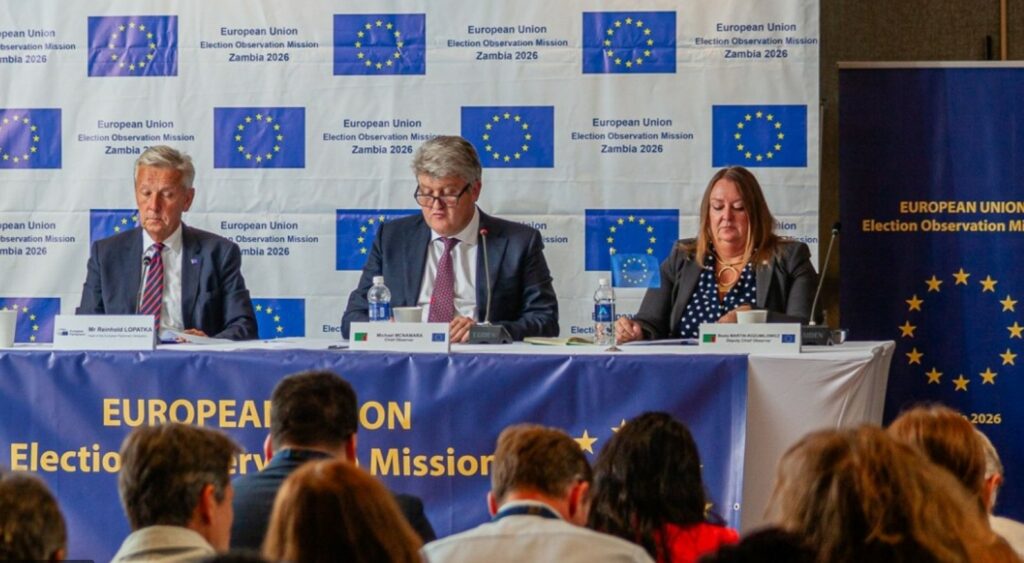
Zambia’s 13 August general election offered voters a competitive choice but took place in conditions that limited fundamental freedoms, the European Union Election Observation Mission (EU EOM) said on Saturday as vote tabulation continued.
The EU EOM presented preliminary findings in Lusaka on 15 August, stressing that key parts of the process — including the counting and tabulation of results — were still ongoing and that it would issue a final assessment after observing the remaining stages.
Election day was calm overall in the polling stations observed by the mission, with staff efficiently facilitating voting, but late legal changes, legal uncertainty and unequal campaign conditions distorted the playing field, Chief Observer Michael McNamara said.
Zambia’s legal framework provides an adequate basis for democratic elections, but significant changes — including to the electoral system — were adopted only three months ago, making it difficult to implement all changes and for stakeholders to be aware of them.
McNamara also referred to a “pause” in the process the previous day, saying transparency, clear communication and strict adherence to procedures were crucial for public confidence, and that disaggregated polling-station-level data should be made publicly available.
Campaign conditions and media scrutiny
The head of the European Parliament delegation, Reinhold Lopatka, called on political leaders to ensure supporters refrained from violence and said any disputes should be addressed peacefully through established legal procedures.
The mission noted that the Access to Information law and the repeal of criminal defamation of the president were positive legal steps, but said their impact was limited by implementation gaps and other restrictive measures.
Candidate registration was inclusive, transparent and timely, but women’s participation as candidates was minimal, the EU EOM said.
It also reported that advantages of incumbency blurred the line between state and party, while campaign-related violence and uneven law-enforcement responses contributed to an unlevel playing field.
Media operated with relative freedom, but recently introduced cyber laws and their application contributed to concerns among journalists and online users, while state-owned media coverage was heavily biased.
The mission said its preliminary statement reflected findings to date and was endorsed by a delegation of Members of the European Parliament led by Lopatka.
