
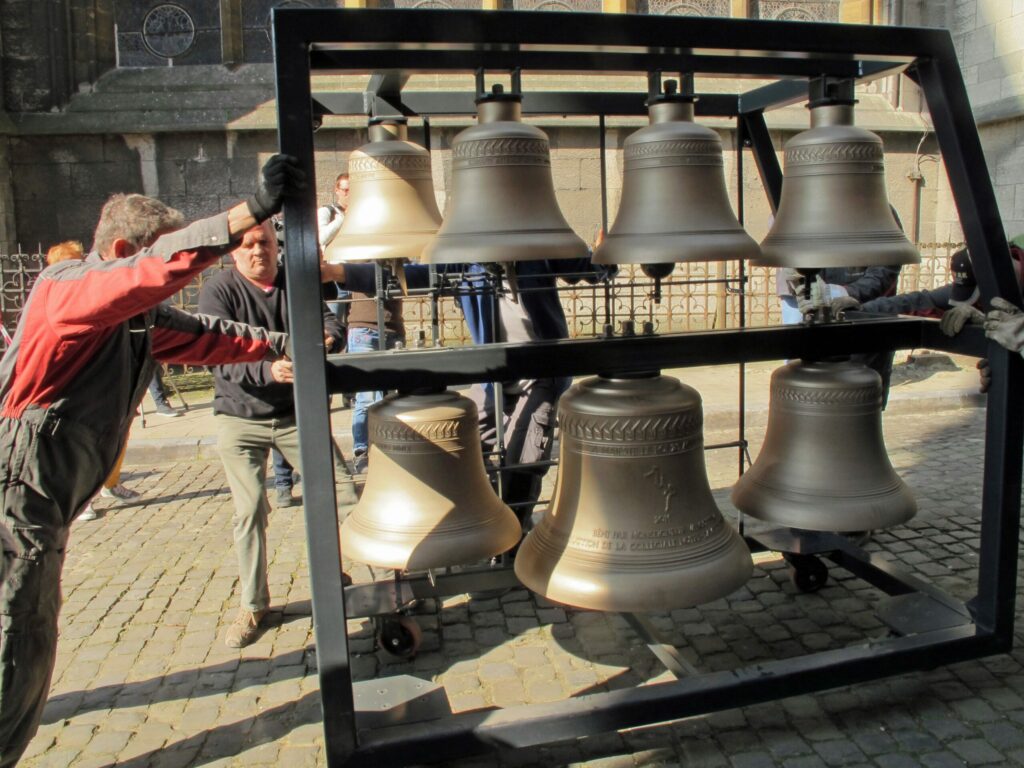
The Dutch bell foundry Eijsbouts has begun constructing the world's largest carillon, sources linked to entrepreneur Fernand Huts announced on Tuesday.
Just over a year ago, Huts first expressed his dream of installing a large carillon next to the headquarters of logistical company Katoen Natie in Kallo (Beveren-Kruibeke-Zwijndrecht, part of the port of Antwerp). As several new buildings there require a fire escape tower, Huts considered equipping a staircase, originally intended for evacuation, with a giant set of bells.
"At one point, we thought: why not hang bells at the top of that tower," he told Gazet Van Antwerpen in May 2025. "There are few things as Flemish as a carillon. Who does not have love in their heart for that bell sound?"
This week, the first bell is being cast at Koninklijke Eijsbouts in the Dutch municipality of Asten. In total, the instrument will comprise 81 bells, weighing approximately 60 tonnes.
"But this is not just about building an extraordinary musical instrument," Huts said on Tuesday. "It is about passing down heritage from generation to generation. Every historic carillon we admire today was once a new carillon. Someone had to have the courage to look beyond their own generation back then."
Katoen Natie aims to develop the so-called "Singelberg Carillon" into the most complete concert carillon in the world. The location is also intended to serve as a laboratory for research by carillonneurs, composers, and students from home and abroad.
"Ancient craftsmanship is being combined with contemporary research and international artistic ambition," the company said.
81 bells
The carillon, as an instrument, developed in Belgium from the late Middle Ages into a form of public musical instrument. The earliest known written reference to a keyboard with rods dates from 1510 in Oudenaarde.
Flanders and Brabant were among the early core areas, with the carillon culture further developing across the Low Countries during the 16th and 17th centuries.
Technically, the builders promise a remarkable example of custom craftsmanship: all 81 bells will be installed in a fully open arrangement within the new carillon tower at the Singelberg site in Kallo.
"At the heart of the tower will be a playing chamber with a six-and-a-half-octave keyboard. The bells, suspension, mechanism, acoustics, and architecture will be developed as a unified whole," Katoen Natie said. The tower will also be accessible to visitors.
The headquarters of Katoen Natie was once called "Burcht Singelberg", refering to a remaining fragment of the former Singelberg Castle, which was once the political centre of Beveren. According to tradition, that castle in 1585 was the site where the Antwerp mayor Marnix van Aldegonde and a Spanish commander negotiated the surrender of the city of Antwerp.
