
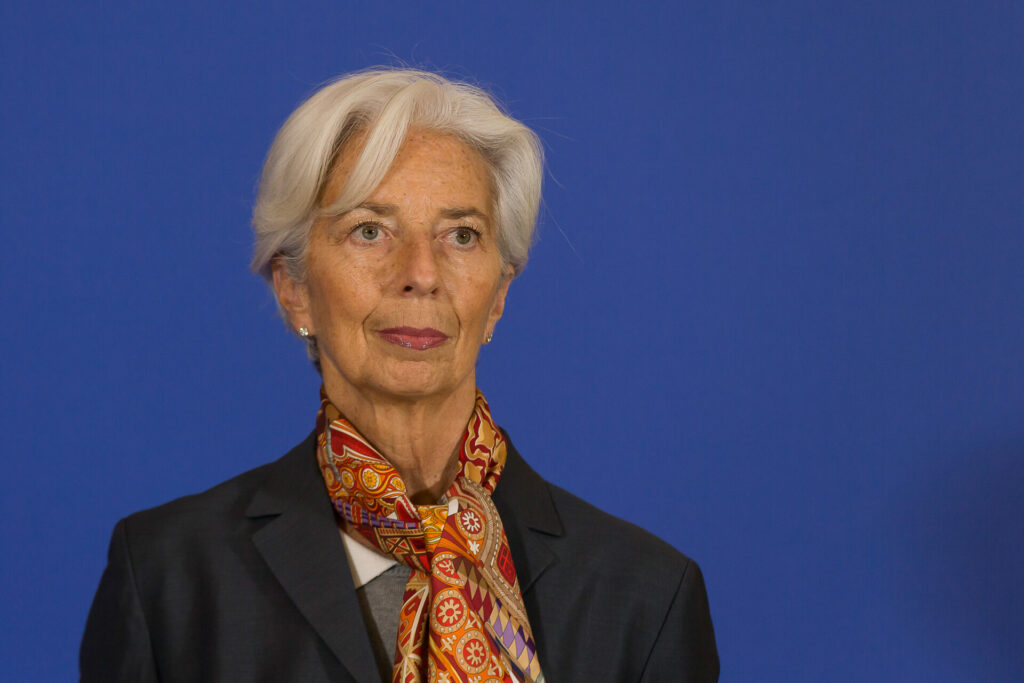
Europe’s post-war growth model is “eroding” as global trade slows, manufacturing advantages narrow and the international security environment becomes less stable, European Central Bank President Christine Lagarde told a World Economic Forum business gathering.
Europe built its growth on three “mutually reinforcing pillars” — expanding global trade, strength in mid-technology manufacturing supported by relatively cheap energy, and a stable rules-based global order underpinned by US security — but “all three are weakening”, Lagarde said on Wednesday in remarks published by the ECB.
More than 2,500 trade restrictions were implemented globally last year.
China now competes directly with the euro area in close to 40% of the sectors where the region has a comparative advantage, compared with around 25% in the early 2000s, Lagarde added.
EU electricity prices for energy-intensive industries were on average more than twice US levels last year and around 50% above those in China, including after the fading of cheap energy that European industry once relied on such as Russian gas.
Lagarde said geopolitical tensions were bringing “critical dependencies and chokepoints into sharper focus”, adding that when capital is seen as less safe, firms invest less, weighing on output and consumption.
Domestic demand and artificial intelligence
Despite the pressures, Lagarde pointed to “substantial strengths” including the EU’s trade agreements, an integrated market of 27 member states and 450 million consumers, and manufacturing capabilities in areas such as lithography and precision optics.
The euro area economy grew by 1.5% last year and growth was “driven entirely by domestic demand”, Lagarde noted.
Domestic demand also contributed positively to quarter-on-quarter growth of 0.4% in the second quarter of 2026, despite an energy shock, the ECB president said, adding that domestic demand is projected to remain the main source of growth for the euro area this year.
Lagarde warned that Europe “largely missed out on the first digital revolution” and said it could not afford to repeat that experience with artificial intelligence, or AI — a branch of computing that enables machines to perform tasks that typically require human intelligence.
Survey evidence suggests firms in the euro area expect to allocate an average of around 9% of their total investment to AI this year.
Two obstacles were highlighted: fragmentation in the Single Market, which can keep competition and technology adoption within national borders, and fragmented capital markets, which can make it harder for companies to raise money as they grow.
EU scale-ups raise broadly similar amounts to San Francisco-based scale-ups during their first five years, but by the tenth year EU scale-ups have raised roughly 50% less, according to figures cited from the European Investment Bank.
About 12% of EU scale-ups have relocated outside the EU, most notably to the United States.
One proposal under discussion is “EU Inc.” — an optional EU-wide corporate legal form allowing companies to incorporate once and operate under a single set of rules across the EU, Lagarde said.
EU leaders have also called for agreement on a market integration package by the end of 2026 to move closer to a single market for capital.
