
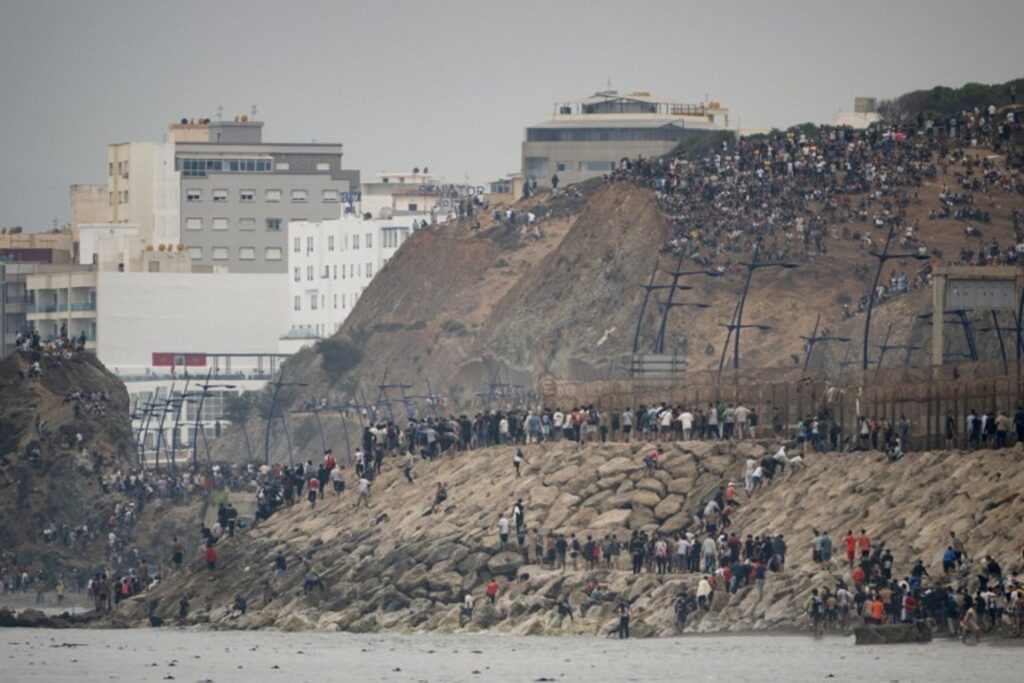
The Ceuta migration crisis has largely been brought under control but the European Commission continues to ignore the plight of the unaccompanied minors in Ceuta despite the rules on their protection in the EU Return Regulation which entered into force last June.
From the very start of the crisis, following the informal video-conference on 4 August of EU interior and migration ministers, the Commission has hardly mentioned them and deferred questions about their number and treatment to the Spanish authorities.
“We understand from the Spanish authorities that illegal movement onwards to mainland Spain and Europe has so far been successfully prevented,” a Commission spokesperson told The Brussels Times. “The expectation is that all those who remain in Ceuta illegally must be returned.”
While the vast majority of the illegal migrants who arrived in Ceuta have by now been returned to Morocco, figures differ about how may unaccompanied minors (under the age of 18) still remain there. The NGO ‘Save the Children’ in Spain warned last week about a ‘serious child protection emergency in Ceuta’.
According to records from social and community organizations working on the ground, approximately 4,000 children remain homeless, without adequate access to shelter and protection resources, the NGO said. With such a high figure, unaccompanied minors make up the majority of illegal migrants in Ceuta.
Asked about the rules in place for the reception and return of unaccompanied minors, the Commission replied that the EU Member States are bound by the EU Return Directive and the EU Return Regulation but did not clarify the rules.
“We have a clear expectation since the informal meeting that all those who remain in Ceuta illegally will be returned,” the spokesperson repeated at the Commission’s press conference last Thursday, without explicitly excluding minors. That said, he added that the EU expects from all its Member States that EU law is implemented.
The Pact on Migration and Asylum, including the Return Regulation, entered into force on 12 June 2026, requiring all Member States to apply it from that date. The Commission describes it as “comprehensive migration and asylum framework in place, with strong external border protection, fair and firm asylum rules, and a balance between solidarity and responsibility.”
However, according to the Commission, Member States will continue to adapt and finetune the new procedures in the coming months, with continuous support from the Commission and EU Agencies.
Safeguards for unaccompanied minors
The new rules are designed to make returns swifter and more effective but unaccompanied minors continue to enjoy special protection. “As in the previous EU Return Directive, they are excluded from accelerated asylum and return procedures,“ law professor Lena Riemer at the Central European University in Vienna, told The Brussels Times.
There a no loopholes in the new regulation which can be used at the discretion of the Member States, she confirmed. “Spain cannot summarily return minors – it would be against international, EU and domestic legislation. The overriding principle is to consider the best interest of children and minors. They have special protection according to all legislation in place.”
The 1951 Refugee Convention defines a refugee using the same standard regardless of age: a person who has a "well-founded fear of being persecuted". The 1989 UN Convention on the Rights of the Child introduced the "Best Interests of the Child" principle. It legally prevents states from executing immediate pushbacks without first conducting individual welfare assessments.
The new EU Return Regulation highlights this principle. “The best interests of the child shall be a primary consideration when applying the provisions in accordance with this Regulation” (article 18). They shall also automatically be provided with free legal assistance and representation. They cannot be returned to ‘return hubs’ in third countries. Detainment can only be used as measure of last resort.
Riemer explained that these are common EU standards. They imply that the Spanish authorities must identify the vulnerability of unaccompanied minors and move them from Ceuta, where shelters are overcrowded, to mainland Spain where there are resources to take care of them and carry out individual assessments.
She suspects that the Commission is reluctant to talk about the protection of unaccompanied minors because some Member States are slow in implementing the new Pact of even disregarding it. But that comes with a price.
According to the Missing Migrations Project by the UN Office of Migration (IOM), over 85,000 people have died since 2014 in the process of migration. The deadliest route is the Central Mediterranean Route where about 26,000 people have died since 2014. The IOM documented 3,700 children who died or went missing globally.
In an update in 2025, the European Parliamentary Research Service (EPRS) wrote that over 18,000 migrant and refugee children were reported as missing across Europe between 2018 and 2020. It is feared that many of these children may have been exploited and abused for sexual or labour purposes. The European Parliament has repeatedly stressed the need to address this issue.
