
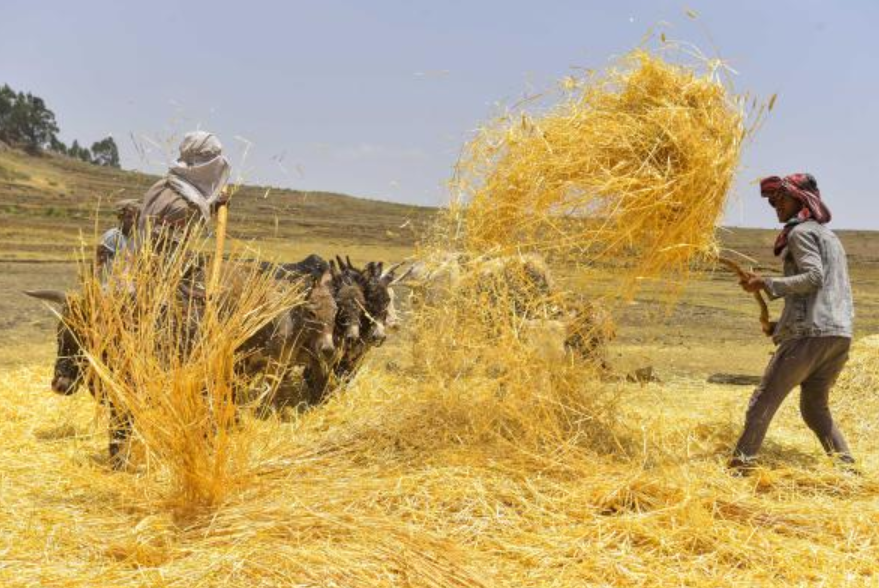
EIB Global is providing a grant of up to €4 million to the World Food Programme to develop and roll out climate-risk microinsurance for smallholder farmers in Ethiopia.
About 210,000 farmers are expected to be covered by adapted insurance products to protect against crop and livestock losses linked to adverse weather or natural disasters, the European Investment Bank announced on Tuesday.
The announcement was made at the United Nations Convention to Combat Desertification COP 17 meeting in Mongolia.
The grant will complement EIB Global’s €110 million credit line for the third phase of Ethiopia’s Rural Financial Intermediation Programme.
The lending is channelled through the Development Bank of Ethiopia and on-lent to eligible rural finance institutions.
Part of the work funded by the grant includes setting up a Premium Guarantee Fund to pre-finance insurance premiums, as well as training and support for the Development Bank of Ethiopia, rural finance institutions and farmers.
The fund is intended to help address borrowers’ liquidity constraints and provide a mechanism for lenders that contract insurance on behalf of borrowers if premiums are not paid.
Index-based payouts and private insurers
The World Food Programme said it will develop and pilot an index-based microinsurance scheme in partnership with private insurance companies. Index-based insurance typically pays out when a pre-agreed measure — such as rainfall levels — reaches a trigger, rather than after individual losses are assessed.
WFP will initially administer the Premium Guarantee Fund before transferring its management to the Development Bank of Ethiopia.
“Climate change remains one of the greatest risks to agricultural livelihoods in Ethiopia,” EIB Vice President Gelsomina Vigliotti stated.
“For millions of smallholder farmers in Ethiopia, climate shocks can quickly wipe out harvests, incomes and hard-earned progress,” said WFP’s representative and country director in Ethiopia, Zlatan Milišić.
