
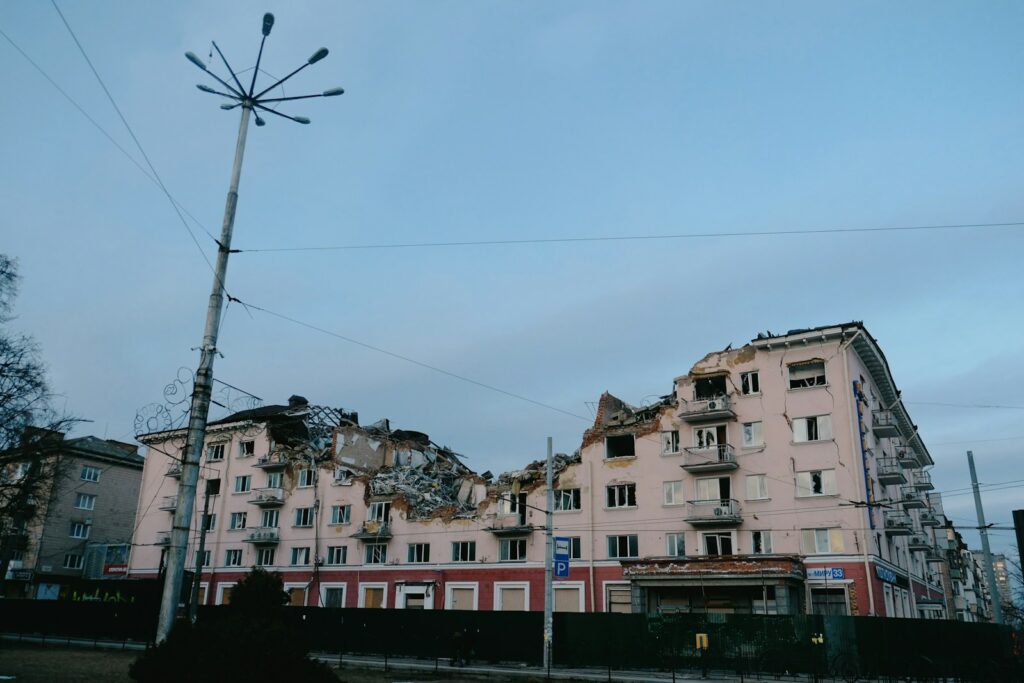
The EU has condemned Russia’s recent long-range missile and drone attacks on Ukraine, citing a steady rise in civilian casualties and renewed strikes on Kyiv and other cities, in a statement to the OSCE in Vienna.
Dozens of civilians were killed and many more injured — including children — in what the EU described as a Russian “double-tap” strike on a shopping centre in Kryvyi Rih last Friday, the EU pointed out in the statement, cited by the European External Action Service (EEAS) on Tuesday.
It said “double-tap” refers to a second strike hitting the same area shortly after an initial attack.
Civilian casualties in Ukraine have risen month by month and year by year, the EU said, citing the UN Human Rights Monitoring Mission in Ukraine (HRMMU).
Civilian casualties from long-range weapons such as missiles and drones increased by 60 per cent between January and June compared with the same period in 2025.
The highest number of civilian fatalities since May 2022 was recorded in July.
The EU also said critical infrastructure — including energy systems, healthcare facilities, housing and ports — continues to be targeted and severely damaged.
Humanitarian access remains difficult in frontline areas and in territories of Ukraine that Russia has occupied.
Calls on Russia to release detainees and return children
Russia was urged to release “immediately and unconditionally” all unlawfully detained civilians, including three OSCE staff members — Vadym Golda, Maksym Petrov and Dmytro Shabanov — the EU said.
It also called for the “immediate and safe return” of Ukrainian children it said had been deported or forcibly transferred.
The EU repeated its call for Russia to agree to a “full, immediate and unconditional ceasefire”, saying Ukraine has proposed this repeatedly.
It said it expects OSCE structures and institutions to continue supporting Ukraine and addressing the consequences of Russia’s actions.
The statement condemned what it called violations of EU member states’ airspace and said Russia “bears full responsibility” for the consequences of its military actions.
It referenced a naval drone incident close to critical infrastructure in the Black Sea in Romania on 20 August, saying the President of the European Commission had expressed the EU’s intention to scale up capabilities to respond to emerging threats.
The EU urged countries to cease any direct or indirect assistance to Russia’s war effort, “notably through the provision of dual-use goods and components” — items that can have both civilian and military uses — and condemned the deployment of North Korean military forces as well as military support it said was being provided by Iran, Belarus and North Korea.
It also said it would not recognise “so-called elections” held by Russia in temporarily occupied Ukrainian territories and called on countries not to recognise or take part in monitoring them.
Ukraine marked the 35th anniversary of its independence on 24 August.
