
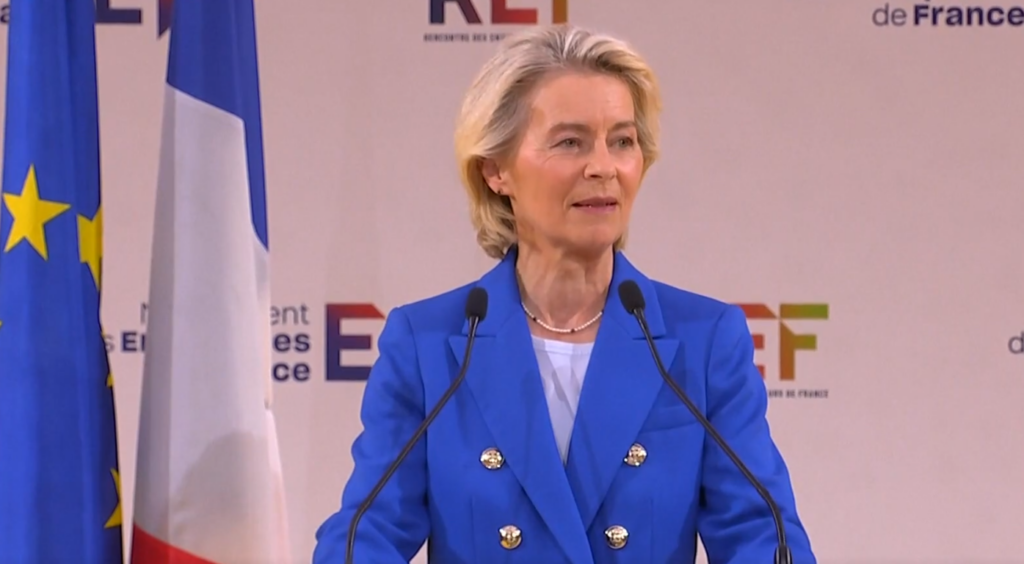
European Commission President Ursula von der Leyen told French business leaders the EU will cut red tape, step up trade defences and push reforms to make it easier for companies to grow, in a speech at the annual La Rencontre des Entrepreneurs de France conference hosted at Roland Garros.
Von der Leyen said the EU’s target is to reduce the administrative burden by 25% for all companies and by 35% for small and medium-sized enterprises (SMEs) by 2029, as cited by the Commission in a release on Thursday.
She pointed out that 12 “Omnibus” simplification packages would together deliver around €17 billion in annual savings, with six already agreed worth €6 billion.
She also said the Commission will review the “whole body” of EU law to remove duplication, cut reporting requirements and speed up permitting, and urged member states not to add extra national requirements on top of EU rules — a practice often called “gold-plating”.
China trade, supply chains and investigations
Von der Leyen said Chinese imports into the EU have increased by 45% in five years while EU exports to China are falling, adding that the EU’s trade deficit with China has reached nearly €1 billion a day.
The deficit rose another 10% at the start of this year and, for the first time, all EU member states now run a trade deficit with China, she added.
The Commission President noted that some Chinese companies receive up to eight times more in subsidies than comparable firms in the OECD, and said the EU is more than 80% dependent on China for many critical raw materials — basic inputs needed for technologies such as batteries and electronics — and 90% dependent for some rare earths.
She said the EU opened more than 30 new trade defence investigations last year, almost three times the historical average, and that measures already taken are protecting more than 600,000 European jobs.
On business financing, von der Leyen said €10 trillion in household savings are held in bank accounts and that proposals under a “savings and investment union” could unlock up to €470 billion in additional investment.
She added that the Commission wants an agreement before the end of the year, ideally among all 27 member states.
She also argued the EU single market remains incomplete in areas including services, energy, telecommunications, finance and the digital economy, and pointed to internal barriers that can have an impact equivalent to tariffs of up to 45% on goods and 110% on services.
Von der Leyen highlighted a proposal dubbed “EU Inc” under a “28th regime”, saying it would allow a business to be set up in 48 hours for less than €100, entirely online, with no minimum capital requirement, under a single framework valid across the EU.
On energy, she said prices in Europe are still two to three times higher than in the United States or China, and that more than half of the energy used in Europe still comes from imported fossil fuels.
Since the start of the crisis in the Middle East, that dependence has already cost Europe more than €50 billion extra without bringing “a single molecule” of additional energy, she added.
Von der Leyen said more than 70% of electricity in Europe is already produced from low-carbon sources, including renewables and nuclear, but that electricity represents only a quarter of final energy consumption.
She emphasised that the Commission has adopted an Electrification Action Plan, and argued taxes should not make electricity more expensive than gas.
She also said the EU installed more than 80 gigawatts of renewable capacity last year but that six times more is waiting to be connected to the grid, and that 10 terawatt-hours of renewable electricity were lost because of insufficient grid or storage capacity — an amount she said is equivalent to the annual consumption of three million households.
Von der Leyen said the Commission is mobilising €20 billion for artificial intelligence “gigafactories”, with a first call producing 77 proposals in 16 member states across 60 sites, and a second call launched this summer.
She also cited the EU’s trade agreement with Canada, saying that since 2017 French exports of goods to Canada have increased by 45% and exports of services have more than doubled.
