
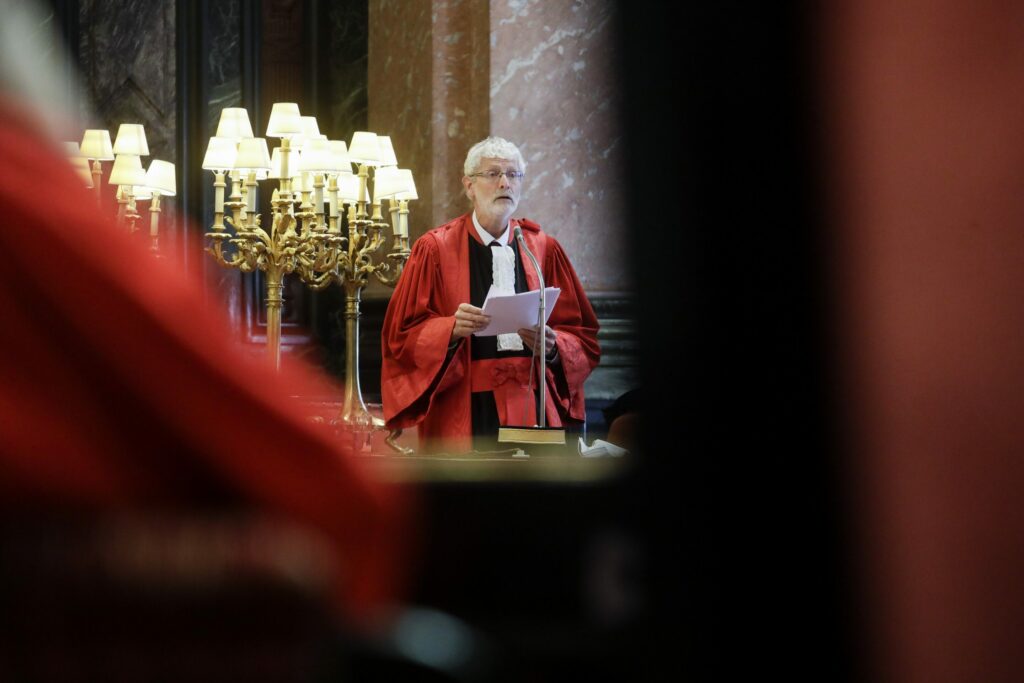
Belgium's new Criminal Code came into force on 1 September, replacing legislation rooted in the 19th century and marking a significant shift in the country's approach to crime and punishment.
The overhaul goes beyond a mise à jour of antiquated legal language or a reorganisation of offences. At its core, the new code rethinks the purpose of punishment.
Damien Vandermeersch, a magistrate at Belgium's Court of Cassation, is the mastermind who drafted the new code, with the aid of jurist Jeroen De Herdt and Joëlle Rozie.
Vandermeersch spoke to The Brussels Times about the philosophy behind the reform, prison, victims, repeat offending, financial crime, psychiatric treatment, psychological violence and ecocide.
The Brussels Times: What do you make of the new Criminal Code?
Vandermeersch: "I am hardly an impartial observer, but I am pleased that we finally have a new code replacing legislation from the 19th century. One major improvement is readability. The legislation has been rewritten, its language modernised and its provisions simplified.
Then there is the philosophy underpinning the code, particularly the objectives of sentencing. The legislator and those who promoted the reform sought an approach that does not revolve solely around imprisonment."
TBT: The new code defines the "moral element" of an offence. Why is that important?
Vandermeersch: "The moral element already existed, but there were almost as many definitions as there were university professors. Everyone had their own doctrine.
The Council of State told us that if we were drafting a new Criminal Code, we had to define the concepts within it. So we set about doing that. It is one of the most difficult concepts in criminal law, but it is now codified.
The Strépy-Bracquegnies case, for example, revolves precisely around the moral element: was there an intention to kill or not? Was there a failure of foresight or precaution? Under the new code, one question will be whether there was a serious failure of foresight or precaution."
TBT: The new code presents imprisonment as an 'ultimum remedium'. Is that a response to Belgium's chronic prison overcrowding?
Vandermeersch: "No. I prefer the expression 'ultimum non remedium', because prison is precisely not a remedy. Criminological research shows that imprisonment certainly neutralises an individual, temporarily preventing them from causing harm, but it can also undermine the positive capacities they need to move beyond offending.
There will always be circumstances where imprisonment is necessary to protect society. But lasting solutions are more likely to be found through rehabilitation and reintegration. Prison might sometimes be a necessary stage, but the solution itself does not lie within prison."
TBT: What does that mean in practice for sentencing?
Vandermeersch: "Whenever it is possible to avoid prison, it should be avoided. The best way to get out of prison is not to enter it in the first place. Longer sentences are not necessarily more effective. What matters is the coherence and certainty of punishment, rather than its length.
It is better for someone to leave prison earlier under appropriate conditions than to reach the end of their sentence and leave without any conditions whatsoever. We are seeing a growing number of people serving their sentences until the very end, and that is worrying."
TBT: On a philosophical level, what is the purpose of imprisonment?
Vandermeersch: "Traditionally, there was an idea of making somebody suffer because they had inflicted suffering themselves. It was about inflicting suffering to compensate for the suffering of victims. Unfortunately, it never compensates for the victims' suffering. That is the retributive approach we want to move away from.
The philosophy now places greater emphasis on restorative justice: encouraging offenders to take responsibility, question their behaviour and change their trajectory. Prison does not necessarily encourage responsibility. Quite the opposite: virtually everything is decided for you.
There are valuable initiatives in prisons, including education and training, but prison is not necessarily the best environment in which to carry out that work."
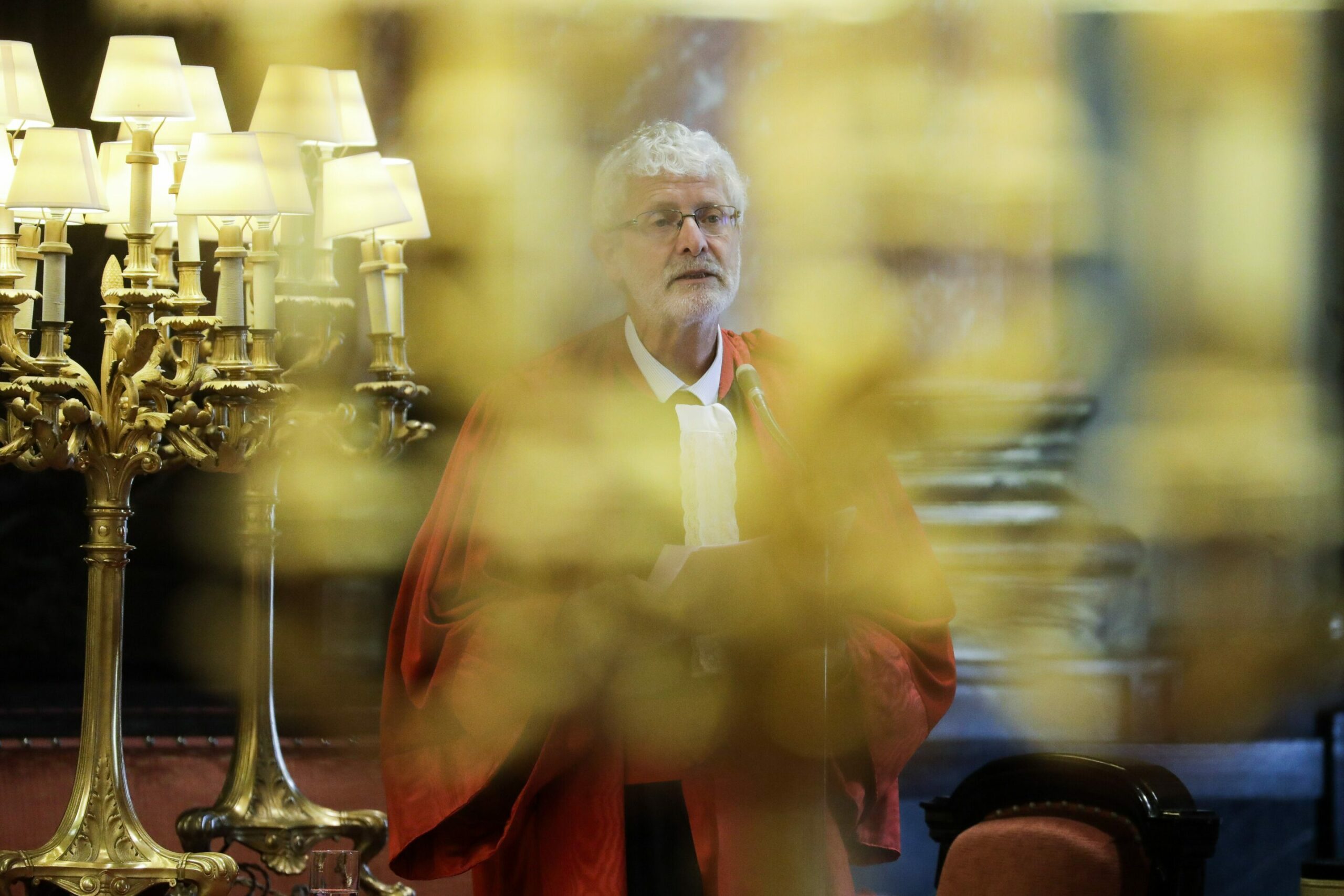
Damien Vandermeersch during a public meeting marking the opening of the judicial year at the Court of Cassation in Brussels on 1 September 2020. Credit: Belga / Thierry Roge.
TBT: Finland relies more heavily on education and employment to tackle offending. How can Belgium move towards that model?
Vandermeersch: "Apply the new objectives of sentencing and we should move in that direction. When the code speaks about restoring social balance and reparation, the aim is to encourage offenders to take responsibility, change their trajectory and abandon a criminal path.
Socio-economic circumstances are also a determining factor. The overwhelming majority of people in our prisons are poor. Poverty itself is violent. It creates conditions of exclusion that can contribute to offending and make reintegration more difficult.
The Finnish model essentially says that the solution lies outside prison. Finland still has prisons, but it resorts to them much less frequently. That is also the philosophy of the new Belgian Criminal Code."
TBT: But does Belgium have the resources for that?
Vandermeersch: "A prison place costs around €65,000 per year, and we have more than 13,000 prisoners. You can imagine the size of that budget. If you freed up 5,000 prison places, multiply that by €65,000. It is a considerable amount that could be invested elsewhere.
When discussing resources, we should consider shifting some of the money currently devoted to prisons and security towards measures that prevent imprisonment in the first place."
TBT: How do judges take into account someone's state of mind before an offence?
Vandermeersch: "We tend to believe that people think and calculate before acting. In financial or white-collar crime, perhaps they do. But with most violent offences, that calculation simply does not take place.
To prevent reoffending, we need programmes that help people recognise a situation before it deteriorates. There are programmes dealing with violence and frustration management, for example. That is the crux of the issue: how do we enable people to take responsibility so that it does not happen again?
Responsibility requires support. The Houses of Justice and justice assistants work extensively on this through measures including conditional release and probation."
TBT: What would you say to people who believe this approach is more concerned with offenders than victims?
Vandermeersch: "The new Criminal Code represents progress precisely in that respect. For the first time, it explicitly refers to restoring social balance and repairing the damage caused by an offence. That puts victims and society directly into the equation.
Sentencing must take account of their needs. We have to ask how a sentence can repair the harm caused and contribute to restoration, including symbolic reparation towards society. That is a fundamental change, a genuine shift in paradigm."
TBT: The code introduces a financial penalty based on the benefit sought from an offence. Is that aimed particularly at white-collar crime?
Vandermeersch: "Yes. The principle is that crime must not pay, particularly where offenders calculate the potential gains. It also applies to areas such as drug trafficking, where considerable sums can be involved.
Previously, illegally obtained money could be confiscated. But if you merely take back what someone should never have acquired, that is not really a punishment. The new financial penalty can reach up to three times the amount the offender hoped to obtain from the offence."
TBT: What about the new treatment involving deprivation of liberty for offenders suffering from psychiatric disorders?
Vandermeersch: "The problem is that its implementation has been postponed until 2035 because there were not enough places available to provide treatment.
That means convicted prisoners with serious psychological, psychiatric or medical problems who are not receiving treatment will unfortunately continue not to receive it. The purpose of this sentence was precisely to oblige the State to address those problems, particularly to prevent reoffending."
TBT: Repeat offending has not disappeared from the new code. What do you make of that?
Vandermeersch: "We were firmly opposed to that provision. An expert commission proposes, but political decision-makers decide and Parliament legislates.
The reasoning is somewhat simplistic: you have already been through prison, you committed another offence, so we will give you even more prison so that this time you understand. Unfortunately, it does not work like that.
When somebody leaves prison and subsequently reoffends, that is a failure for the individual, but also a failure of the system. It means the system failed to prevent reoffending. Simply adding another layer of imprisonment is contradictory to the objectives of sentencing. Sometimes we need to act differently rather than simply punish more."
TBT: The terminology of certain offences has also changed, including greater recognition of psychological harm. Why do those words matter?
Vandermeersch: "It is important to name things accurately. The new code uses clearer concepts such as 'acts of violence' and 'violations of a person's physical or psychological integrity'. Psychological trauma can constitute genuine harm, and the terminology now recognises that more explicitly.
'Incitement to suicide' is another example. It may also constitute harassment, but for parents whose child has died by suicide, describing what happened simply as harassment does not capture the gravity of the outcome. How society names conduct matters. The aim was not simply to modernise the language but to make it more precise and meaningful."
TBT: The new code also introduces "excessive self-defence". What does that mean?
Vandermeersch: "It concerns someone who genuinely finds themselves in a situation of self-defence but overreacts.
They are being attacked and have no other option but to defend themselves, but their response is disproportionate. They were initially the victim, but unfortunately overreacted. We considered that this should allow for a reduction in sentence."
TBT: Could that apply in cases of police violence?
Vandermeersch: "No. Police violence is dealt with through another provision: legitimate resistance to abuses of authority.
The distinction matters because the authorities are entitled to use force and are presumed to act lawfully. For resistance to be justified, the abuse therefore has to be manifest.
Take a night-time search. Someone might believe that a search at 01:00 is automatically illegal, but there are exceptions, including certain drug-related cases. Its illegality is therefore not necessarily manifest.
But if somebody is handcuffed, lying on the ground, unable to move and no longer capable of causing harm, and a police officer kicks them, to me that would appear to constitute manifestly unlawful violence. I myself would intervene in such a situation. That would be entirely gratuitous violence."
TBT: Belgium is also among the countries recognising ecocide. Why call it a 'crime of ecocide'?
Vandermeersch: "Because we wanted to emphasise its gravity and make it an international crime. When environmental damage is serious, widespread and long-term, we are approaching the gravity associated with crimes against humanity.
It follows the same logic as genocide, crimes against humanity and war crimes. Ecocide joins that framework as one of the most serious crimes under international law."
TBT: What happens to offences committed before the new code came into force on 1 September?
Vandermeersch: "Ordinarily, the law in force when an offence was committed applies. For earlier offences, courts will compare the previous legislation with the new provisions. If the new law is more favourable to the defendant, it applies. Otherwise, the previous law remains applicable.
It may sound complicated, but we went through a similar exercise when the sexual criminal code was reformed in 2022, and it worked well. I am fairly optimistic about the transition."
TBT: Finally, what would you say to people who argue that Belgium's justice system is politicised?
Vandermeersch: "I have always been independent, and as a commission we consistently asserted our independence. That was part of what gave us credibility.
Judges, magistrates and prosecutors live within society and can obviously have opinions. Diversity within the judiciary is part of its richness.
But if politicisation means politicians dictating what the judiciary must do, I would say the opposite is often true. There are sometimes tensions between political power and the judiciary precisely because the judiciary is independent.
The judiciary is committed to the rule of law, the separation of powers and judicial independence. But separation of powers does not mean there cannot be dialogue. In our role as experts, we engaged in extensive dialogue with Parliament during the process that ultimately led to the adoption of this code."
