

What happens when gunshots become part of your everyday life?
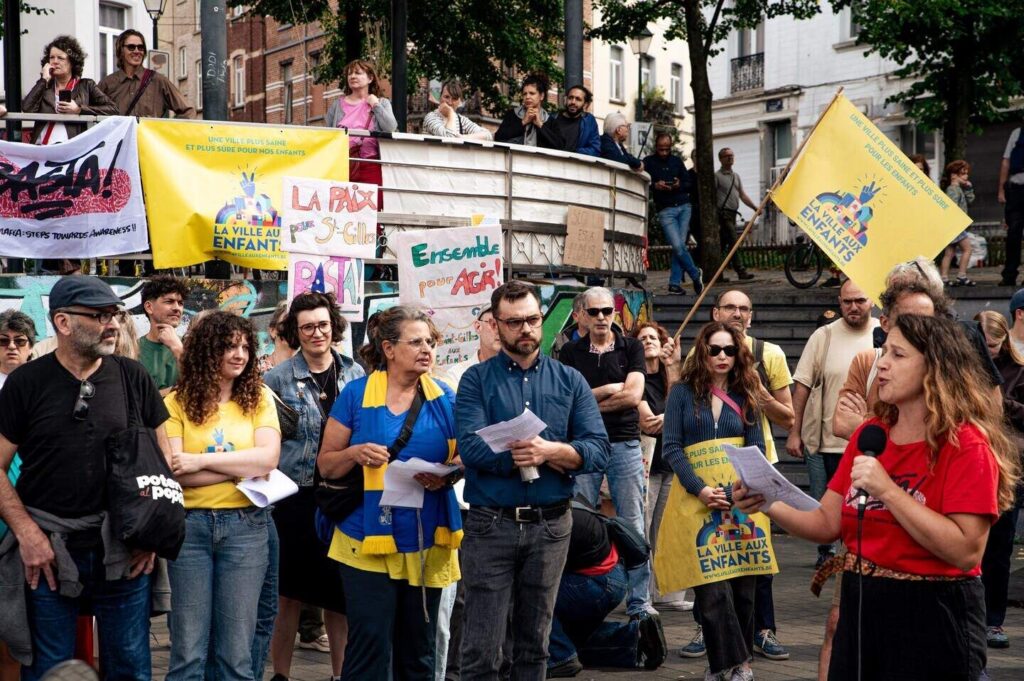
One day yes, one day no; another shooting punctuates the daily rhythm of those living in Saint-Gilles, reminding them that organised crime is no longer an abstract threat, but a reality that shapes their lives. Last Sunday, around 500 residents gathered in Bethlehem Square to say 'basta'.
But the demonstration was about more than just a ‘bo-bo’ moment. It was about refusing to give in to fear and powerlessness. At a time when federal institutions were perceived as absent, we created a space where residents could come together, talk, and find solidarity. Then we took that solidarity into the square, transforming a sense of helplessness into collective action.
Of course, we called on decision-makers to take responsibility. But we also called for collective and individual responsibility within the community. How do we ensure that people living and working in these neighbourhoods are not left alone? How do we create and sustain networks? We had many questions, but one thing was clear: civil society is not indifferent to organised crime. And although we were responding to a specific phenomenon – violence linked to organised crime in the drug market – we know that the problem is broader and interconnected.
The demonstration also marked a turning point in the public debate. Until then, the discussion had largely been reduced to political confrontation: the federal Interior Minister casting blame on the mayor, one level of government against another. Yet the urgency of the situation demanded something else: responsibility, presence and reassurance. As an association, we joined citizens in responding to the perception of institutional absence and brought together people working on the different dimensions of this crisis.
The square showed us what the solution could look like
Last Sunday, we were joined by organisations working with people experiencing homelessness, people affected by addiction, vulnerable women, young people and others living in situations of vulnerability, neighbourhood and parents' associations. Every person who arrived brought with them a new piece to the puzzle.
Each organisation sees a different part of the problem. But when these pieces are brought together, they create a mosaic of the situation. And if we look at the people who filled that square, perhaps we can also see an image of what the solution could look like. Those who gathered were not only demonstrating against organised crime. Collectively, they represented many of the tools we need to fight it.
You cannot fight organised crime without understanding its ecosystem
To understand organised crime, we cannot look only at drug trafficking. Drug trafficking is linked to arms trafficking and human trafficking for all manner of purposes, from sexual exploitation to recruiting people for different forms of criminal activity.
When the management of the migration crisis fails, simply handing people deportation orders does little to address the vulnerabilities that criminal networks exploit. Instead, we risk leaving people exposed to exploitation: victims of prostitution and sexual exploitation, children vulnerable to abuse, workers employed illegally in construction, and people recruited as extremely cheap labour. The list is long and grim.
Unaccompanied minors are particularly vulnerable. They can be easier for criminal networks to manipulate, have no accompanying adult to protect them and can too easily disappear from institutional attention. Criminal organisations exploit vulnerability wherever they find it, and a failing migration system can create exactly the conditions they know how to exploit.
Let's debunk the myth of the mafia
Removing weapons from our streets is urgent. But it is not enough. We must also address the situations of vulnerability, need and distress that can make people susceptible to recruitment and exploitation. We must work together to create a culture of peace and legality.
This means supporting a generation of young people – Belgian and otherwise – growing up in fragile environments where the ‘myth of the mafia’ can become a dangerous seed. The state must be present: listening, understanding and bringing together the economic, social and educational dimensions of the problem. Young people need opportunities to discover who they want to become, rather than being defined by the circumstances into which they were born. They need the possibility of imagining a different future.
The same principle applies when people leave prison. If they return to society with nothing but loneliness and without a network, a sense of belonging or a meaningful place in society, organised crime will be there to offer what society has failed to provide. The fight against organised crime therefore cannot stop at punishment. Prevention, repression and rehabilitation must be part of one continuous process.
And those working on the ground must be at the heart of that process. They already have the knowledge: they understand local needs, threats and opportunities, and they know the people affected.
Last Sunday, civil society came into the streets and showed that this experience exists and that people are ready to step up. The pieces of the puzzle are already there. Now it is time for the government to listen, bring them all together and act.
