
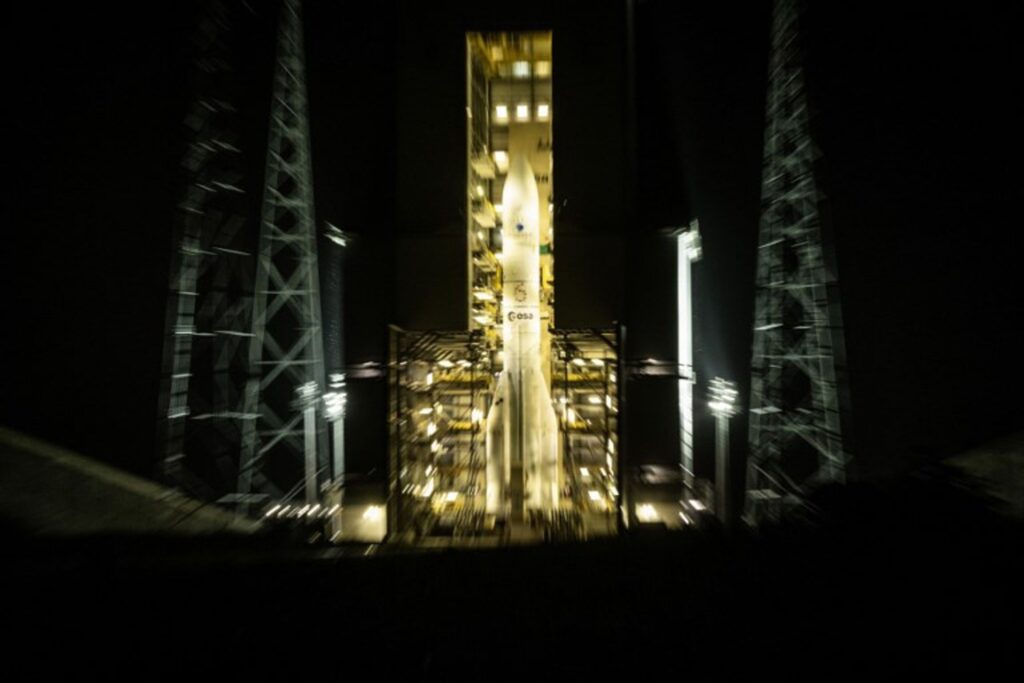
Europe’s heavy-lift Ariane 6 rocket could be adapted for crewed space missions, ArianeGroup’s chief executive said on Monday, as Europe rethinks its reliance on the United States.
“Technically, the Ariane 6 launcher is fully capable of carrying out crewed flights,” Christophe Bruneau told a news conference.
He said both the rocket and the launch pad would need to be modified to support astronauts safely, including systems that would allow a mission to be aborted in the event of danger.
Crewed spaceflight has not so far been a priority for the European Space Agency, which has relied on the United States to send its astronauts into space and to support part of its lunar exploration plans.
But Washington’s withdrawal from some programmes has prompted European officials to question that dependence and to reassess Europe’s role in future missions to the Moon.
Europe’s ability to send its own astronauts into space is expected to be one of the main issues at an international space summit in Paris on Wednesday and Thursday.
ESA Director General Josef Aschbacher said last week that Europe could develop human spaceflight at a “very reasonable” cost. He also warned of a potential shortage of European launch capacity by 2030.
Ariane 6 is expected to reach a launch rate of nine to 10 missions a year from 2027, but Bruneau said increasing production beyond that level was now being examined with ESA from an industrial standpoint.
He said ArianeGroup was working with partners and subcontractors to determine how far output could be expanded.
“Our challenge today is to move from haute couture to ready-to-wear,” he said.
Bruneau noted that scaling up would be complex because each launcher contains more than 300,000 parts and depends on 600 suppliers across 13 countries, making the production chain a puzzle that must be carefully aligned.
