
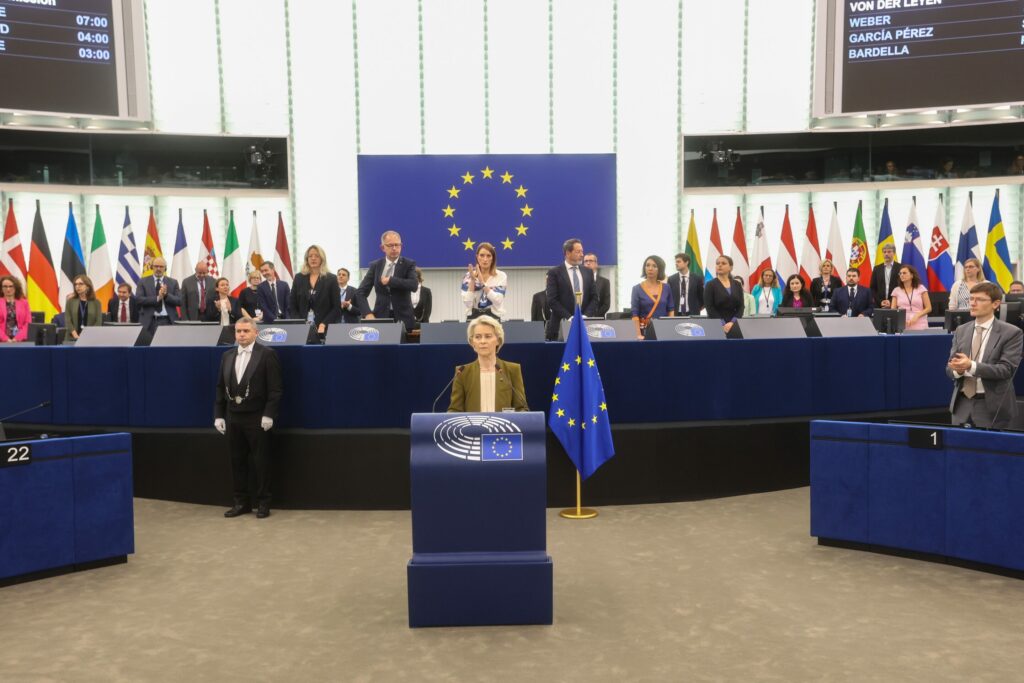
Next week, European Commission President Ursula von der Leyen will stand in front of MEPs and deliver a long speech about the State of the European Union. Here’s why.
Each year, the president of the Commission takes stock of the European Union and reveals what their administration plans to do over the next 12 months and beyond.
The practice began in 2010, following the signing of the Lisbon Treaty and the ratification of the relationship between the Commission and European Parliament.
It is heavily inspired by the United States’ State of the Union address, which the president is obliged to give to Congress on a regular basis. Unlike the European equivalent, the US address is constitutionally required.
Champions of the ‘SOTEU’ say that it helps democratise the EU and build interest among voters and citizens in what the institutions do. Before the Commission was considered a technocratic body, this speech is meant to humanise and politicise it to a degree.
It also makes the Commission publicly accountable for its work and what the institution plans to work on. The president is very much on the record when they deliver this speech so can be pulled up on any promises broken or ignored. So the theory goes, anyway.
The speech has spawned a number of traditions, particularly in the Brussels bubble, where different organisations have their own SOTEU bingo, where buzzwords or cliches are predicted ahead of time and marked off if the speech does stray into them.
This will be von der Leyen’s sixth address, extending her record as the Commission president to have given the most speeches. Her predecessors, José Manuel Barroso and Jean-Claude Juncker, both gave four each.
Von der Leyen’s first SOTEU in 2020 focused on pandemic recovery and subsequent addresses have been themed around digital skills, defence, the war in Ukraine, the energy crisis, the European Green Deal and competitiveness.
The only year in which she did not give a speech was 2024 during the last European election cycle.
In 2026, many of those previous themes are still relevant and driving what the Commission does on a daily basis, particularly the war in Ukraine and the energy crisis, as prices are still stubbornly high.
Von der Leyen will almost certainly use the speech as an opportunity to push the Parliament to complete its work on important legislative files like electricity grids and emissions trading, but also make another plea to national governments to back a more ambitious budget.
After a summer characterised by scorching hot temperatures, drought, wildfires and excess deaths, it remains to be seen whether the president will say anything meaningful about climate change and ho w the EU can help mitigate it.
There is also the open ongoing question about EU enlargement. Brussels was dealt a bit of a slap in the face when Icelanders voted not to restart membership talks, so how will von der Leyen shore up the process?
If you want to watch the entire speech live, then bookmark this link and come back next week to see all the action.
