
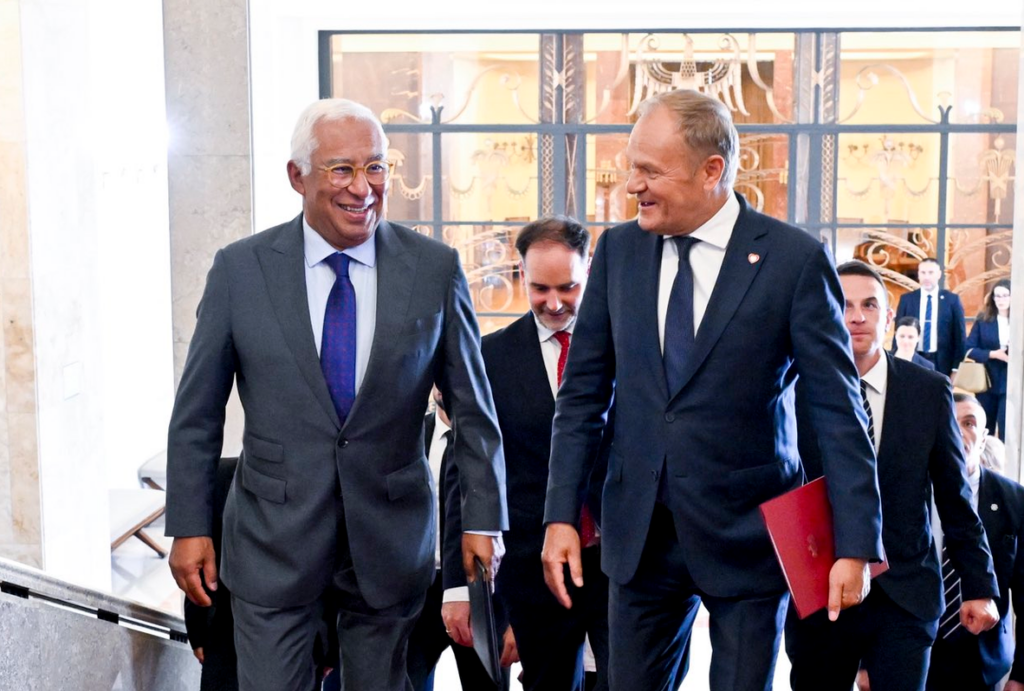
European Council President Antonio Costa said he discussed EU security, support for Ukraine and the bloc’s next long-term budget with Poland’s Prime Minister Donald Tusk during a meeting in Warsaw.
Costa stated that he is visiting EU capitals to hear directly about national priorities and to prepare for upcoming European Council meetings, according to his statement after talks with Tusk on Wednesday.
Poland, on the EU’s eastern border, faces security challenges and plays a role in shaping Europe’s response, he added.
He reiterated support for Ukraine, saying the country is defending its sovereignty and Europe’s security, and described Poland as a key supporter of Ukraine’s defence.
Strengthening support for Ukraine should go alongside improving the EU’s preparedness and protecting its borders.
Costa also referred to “Russian threats” and said the EU should strengthen its defence readiness and be prepared by 2030.
Budget talks and energy costs
Costa said he and Tusk discussed how the EU budget for 2028 – 2034 should address what he called new challenges, with defence and security listed alongside competitiveness, innovation and “strategic resilience.”
He added that the budget should continue to support agriculture and cohesion policy — EU funding intended to reduce regional disparities — in line with existing priorities.
Most of the EU budget is financed through member states’ contributions, and those contributions need to remain within “reasonable limits”, Costa said.
He declared that an agreement would require a “substantial package” of new “own resources” — EU revenue streams — as part of an overall deal.
He said an agreement should be reached by the end of this year to avoid interruption to EU support beginning in 2028 for farmers, businesses, students, researchers and innovators.
Costa also discussed the EU’s “One Europe, One Market” agenda, which he said focuses on creating better conditions for businesses and includes affordable energy.
He said the EU should work to reduce energy costs while continuing the clean transition and decarbonisation in a “technology-neutral” way, meaning options such as nuclear power or renewable energy.
