
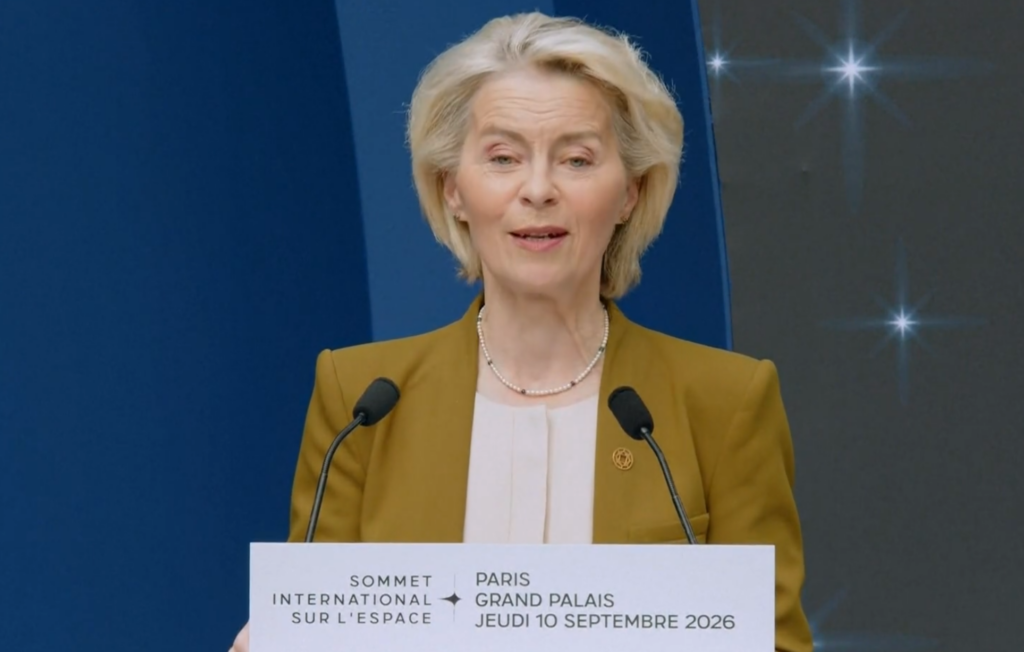
European Commission President Ursula von der Leyen has set out plans to expand EU-backed space programmes and investment, citing the growing role of satellites in everyday services and security, in a speech at the International Space Summit.
Copernicus, the EU’s Earth-observation programme, provided near real-time satellite data to help track wildfires and identify high-risk areas, which supported the prepositioning of 800 firefighters in high-risk locations, von der Leyen said in her speech published by the Commission on Thursday.
The same system has also supported responses to floods in Nepal in recent weeks, she added.
She stated that Copernicus data are free and open to the world, and are used to monitor climate change impacts from Arctic ice melt to Amazon forests.
The Commission President also said Galileo — the EU’s satellite navigation system — is used by more than 4.5 billion devices worldwide, providing location services and the precise timing used by financial systems and electricity grids.
Von der Leyen said the EU is strengthening Galileo with a constellation of satellites in low Earth orbit, and noted that cooperation was built into Galileo from the start so it can work with the US GPS system to improve reliability for users.
Investment, launches and a new secure network
Europe has its own launch capabilities through Ariane 6 and Vega-C, and a German start-up backed by €10 million from the European Innovation Council launched the first commercial rocket into orbit from continental Europe at the weekend, von der Leyen said.
The European Commission and the European Space Agency are committing to a “new European vision on access to space”, including bringing together demand and acting as anchor customers for European launchers.
The EU’s Cassini Investment facility is mobilising €2 billion in risk capital for European space companies, von der Leyen said, and she referenced a new €5 billion Scaleup Europe Fund that invests in strategic technologies including space.
She also said the Commission’s proposal for the EU’s next long-term budget includes a European Competitiveness Fund with €131 billion proposed for defence, security and space.
On communications, von der Leyen said the EU is building IRIS² — a “multi-orbit constellation” for secure connectivity — and that the bloc decided last month to accelerate it by expanding to more than 350 satellites. The first satellites are due to launch from 2029.
She also described an “European Space Shield” intended to bring together capabilities to protect satellites, including defences against jamming and spoofing — where navigation signals are interfered with or imitated — and work to fill gaps such as space-based early warning.
Von der Leyen said the Commission has proposed a “Single Market in satellite communications”, with spectrum assigned at European level, and an EU Space Act to create a common framework for safety, resilience and sustainability.
She also pointed to proposed updated EU Merger Guidelines, and cited a proposed joint venture called Bromo involving Airbus, Thales and Leonardo.
