
Belgian MEP Hilde Vautmans calls on Commission President Ursula von der Leyen to be bolder in her annual speech to the European Parliament
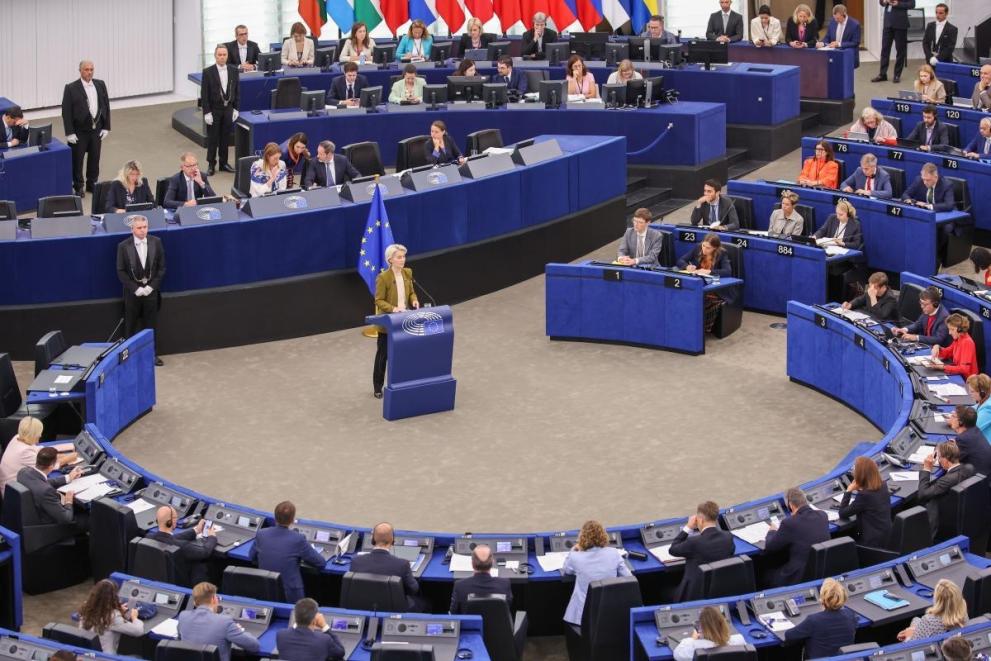
In the first half of September, the office of European Commission President Ursula von der Leyen will be inundated by appeals from policymakers and interest groups, all trying to influence her ahead of her State of the Union speech address to the European Parliament on Wednesday.
Traditionally, this speech tends to become a long shopping list in which every policymaker and interest group hopes to see their own box ticked — hence all the lobbying.
However, I do not want von der Leyen to present another list of box-ticking initiatives. I want to hear a story that rises above European bureaucracy. A story capable of inspiring not only the hemicycle, but also people at home. A compelling vision for our European society, backed by clear political choices.
Because Europe today faces a fundamental question: do we want an administrative Union that repeatedly reacts to crises, or a political Union that takes its future into its own hands?
In recent years, Europe has set many things in motion. Security, defence, competitiveness and strategic autonomy have rightly moved higher up the agenda. But the gap between ambition and implementation remains wide. The Draghi report on European competitiveness remains largely a dead letter.
The proposed multiannual budget may be exciting from an accounting perspective, but politically it lacks ambition. And because of political divisions and national obstruction, completing the Single Market seems further away than ever.
My first request is therefore straightforward: set clear priorities. We cannot do everything at once. Europe must decide where it can truly make a difference: security and defence, competitiveness, the Single Market, foreign policy and the digital transition. That also means having the courage to say what we will no longer do. These choices must translate into less regulatory burden and a greater focus on implementing and enforcing what has already been agreed.
Civil society wants fewer forms, less reporting, fewer overlapping obligations and, above all, rules that do not contradict one another. A Union that continuously adds new objectives and regulations without making clear choices will ultimately lose the trust of both citizens and businesses.
My second request is for an assertive and strategic Union on the world stage. Canadian Prime Minister Mark Carney will be listening closely to Ursula von der Leyen’s words as guest of honour. In recent years, the EU and Canada have grown closer in the fields of defence, international trade, and research and development. In my view, this partnership should be deepened and expanded more rapidly, including in critical raw materials, energy and artificial intelligence. This cooperation could then serve as a model for new partnerships with the United Kingdom, Norway and other democratic allies.
This strategic network must enable us to respond more effectively to the crises of our time. While Putin continues to mislead the Americans, our military support for Ukraine must be better coordinated and continue unabated. The ongoing violence by Israeli settlers in the West Bank must face tougher sanctions. And when it comes to China, we need to move away from our naïve economic dependence. The objective should not be decoupling, but de-risking: reducing strategic dependencies in raw materials, technology, energy and critical infrastructure, while protecting European companies against economic coercion and unfair competition.
But a third and even more fundamental choice is needed: we must reform Europe to prepare it for enlargement. The European Union is on the verge of a historic expansion. Ukraine and the other candidate countries deserve a credible perspective on membership. But a larger Union must also become a stronger Union — economically, geopolitically and democratically.
Enlargement without institutional reform, however, would be irresponsible. Icelanders voted against accession because they can see how the Union today becomes trapped in political deadlock. A Union of 30 or more Member States cannot function efficiently with decision-making rules designed for a much smaller Union.
The veto is one of the greatest obstacles, particularly in foreign policy. A single Member State should not be able to indefinitely block our common European interests.
We must therefore shift towards more decision-making by qualified majority. The European Parliament must become a fully-fledged legislative chamber, with its own right of initiative. And we must finally make real progress towards a European defence, including a European army.
This is not an attack on the Member States or on national democracy; it is an exercise in efficiency. In fact, it is a prerequisite for ensuring that a larger European Union remains governable, capable of acting and democratically accountable.
From Ursula von der Leyen, I want more than an acknowledgement that reforms are necessary. I want a clear path forward. A timeline. Concrete proposals. And, above all, the political courage to open the debate on Treaty change herself. Abolishing national vetoes must be firmly on the table.
Europe cannot continue waiting until the next crisis once again forces us to make difficult choices. We must decide now what kind of Europe we want to have in ten or twenty years.
My request for this State of the Union is therefore simple: fewer slogans, more choices. Fewer rules, more room to act. And a clear roadmap towards a stronger, larger and more effective European Union.
