

Belgium’s leading animal welfare and rights organisation, GAIA, resumed its long-stanning campaign against ritual slaughter without stunning with a protest action against slaughter of sheep in Brussels
By unveiling billboards in the center of the capital against the practice they want to draw attention to the political deadlock in Brussels regarding the adoption of a new Animal Welfare Code. Brussels-Capital Region is the only region in Belgium which still maintains an exemption for halal and kosher ritual slaughter without stunning.
“The texts are there,” commented Ann De Greef, General Director of GAIA. “The science is clear. The courts have ruled. Yet some MPs still refuse to allow Parliament to debate them.”
GAIA is particularly targeting MPs from the MR and Les Engagés. The controversy has affected several parties and dates back to 2022 when a ban on ritual slaughter without stunning failed to find a majority in the Environment Committee of the Brussels Parliament. Those opposing the ban advocate freedom of religion or fear a voter backlash.
A few years ago, Brussels banned the slaughter of sheep at home which was considered a major sanitary and animal welfare problem. “It’s still a problem because the law is not always respected nor properly enforced, especially during Eid al-Adha (Feast of Sacrifice),” Michel Vandenbosch, President of GAIA, told The Brussels Time in an interview in 2024 on slaughter with and without stunning.
“In Brussels, there is only one slaughterhouse where up to 30,000 animals are slaughtered without stunning each year. This place is going to be shut down in 2027 which would end the slaughter without stunning in the region. To replace it by another slaughterhouse for political reasons somewhere else in Brussels would be totally unacceptable. The pragmatic solution is to have a ban in place by 2027.”
Stunning of pigs
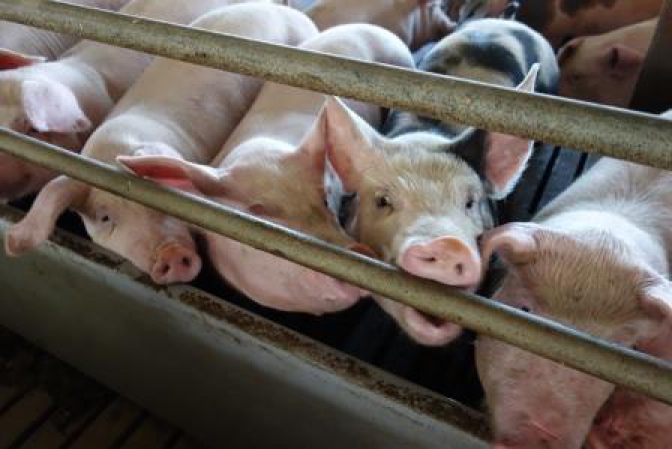
A wider issue concerns the slaughter of pigs in the EU. Since the interview, a project initiated and financed by the European Commission (PigStun) has tested and compared different methods with the objective of encouraging EU pig slaughterhouses to adopt more animal-friendly methods using non-aversive stunning.
The European Commissioner for Health and Animal Welfare, Olivér Várhelyi, recently told animal welfare NGOs that the Commission does not intend to ban or phase out the use of high-concentration carbon dioxide gas because the EU regulation already permits the use of the non-aversive alternatives identified in the PigStun project.
Belgium is among the major producers in the EU pork market (after Spain, Germany, France, Poland, Denmark and the Netherlands). High-concentration carbon dioxide is still the most dominant stunning method for pigs in the EU, used to stun an estimated two-thirds of all pigs slaughtered. In some countries, the figure is over 80-90%.
17 pig slaughterhouses are operating in Flanders. Asked about the situation in Flanders, a spokesperson of Ben Weyts (N-VA), the minister who is also responsible for animal welfare, replied that, “At present, there are no plans in the pipeline to phase out CO₂ stunning, but we continue to monitor all developments in the field”.
Asked about campaigning against the use of high-concentrations of carbon dioxide gas (CO2), Vandenbosch replied that it is a very serious animal welfare program which GAIA might tackle in the future. Some animal welfare NGOs have suggested joint visits to the pig slaughterhouses to inspect how they are applying the stunning method.
In the meantime, Animal Advocacy & Food Transition, has launched a campaign to raise awareness among retailers in the EU about the serious animal welfare concerns and business risks regarding the use of high concentrations of carbon dioxide (CO2) to stun pigs. The European Institute for Animal law & Policy has published a paper on the benefits of ending the cages for pigs and sows.
According to a Scientific Opinion in 2020 by the European Food Safety Authority (EFSA) in 2020, high concentrations of CO2 “is highly aversive and causes pain, fear and respiratory distress”. EFSA concluded that there are no preventive or corrective measures for the suffering “because these welfare consequences are inherent to the stunning method.
In the letter to retailers, seen by The Brussels Times, retailer demands are identified as one of the factors that can influence the choice of stunning method by slaughterhouses. “Continuing to sell products from pigs subjected to highly aversive CO2 stunning risks placing companies out of step with evolving consumer expectations and with competitors who move first.”
The retailers are asked to engage directly with the suppliers and slaughterhouses to encourage them to move away from high-concentration CO2 stunning and adopt less aversive, higher-welfare stunning methods.
