

Europe is entering an intensely political year.
What comes out of it will depend, in part, on whether pro-European leaders learn to talk about Europe differently – and can offer proof that Europeans are still capable of acting together to their mutual benefit. Will Ursula von der Leyen’s 2026 State of the European Union address make a difference?
European leaders face nothing less than a battle over Europe's future. But our new research suggests they may be underplaying the nature of that battle: failing to recognise the centrality of Europe in people’s minds, and missing a critical constituency that doesn’t fit into a neat division between pro-Europeans and Eurosceptics.
In May 2026, we conducted almost six thousand interviews with citizens of France, Germany, Italy, the Netherlands, Poland and the United Kingdom. And we invited people to talk – in their own words – about what Europe means to them, how it is doing and what they expect it to look like in twenty years.
The results reveal what we call Europe's 'imagination gap'.
Europeans have largely woken up to the geopolitical predicament confronting them. They understand that America is unpredictable, that Russia poses a threat and that Europe needs to become more capable of acting for itself. But recognising that Europe needs to become stronger or more united is not the same as believing that it can.
Only 12 per cent of our respondents spontaneously described today's Europe in terms of awakening or renewal. 68 per cent instead talked about deterioration and the loss of normality. And only 20 per cent thought Europe was dealing well with its greatest challenges – while 74 per cent were critical of its performance.
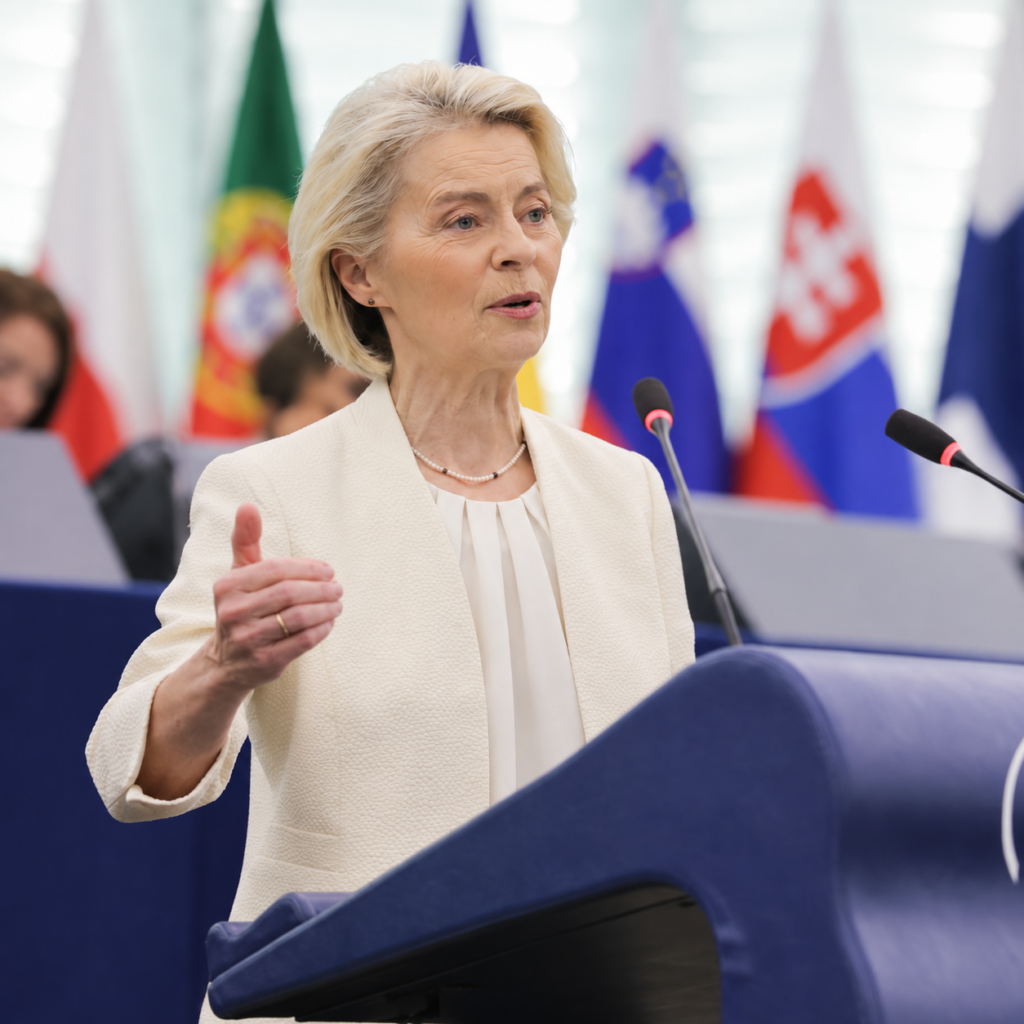
Ursula von der Leyen’s speech does not change this mood. Not only because few ordinary Europeans will have followed it directly, but because its often dry and technical catalogue of initiatives might have done too little to connect what Europe is doing today with the stronger Europe it promises for tomorrow.
Four groups
We identified four groups – the positive, the negative, the disconnected and the uncertain – based on how people imagine Europe’s future. Most revealing is a large group we call the 'uncertain', accounting for about a third of the public in the countries covered.
Just like the positive, they tend to identify strongly with Europe, and many want greater European unity and political integration. But they usually struggle to believe that the Europe they want will actually come to pass and, like the negative, tend to think Europe’s future is in danger.
A Polish respondent, born in 1960s, captures their predicament nicely. She imagines tomorrow's Europe as a place 'without wars, without chauvinism, with free movement of people and goods, more ecologically conscious, without poverty'. But when asked whether such a Europe will actually materialise, she replies: 'I'm afraid that it's just a beautiful idea that few will want to implement.'
This distinction matters politically because Europe's chief critics – from AfD in Germany to National Rally in France and the nationalist right in Poland – already offer easily intelligible futures. They promise restored national sovereignty, respect of traditional values and protected borders.
Their programmes may be backward-looking, but they provide direction. Europe's opponents may not be winning because the future they offer is more attractive. They may be winning because it is easier to imagine.
All too often, mainstream politicians have responded in one of two ways. One has been to polarise: to present political competition as a contest between those who are for Europe and those who are against it. This has sometimes worked electorally. But it risks treating legitimate doubts about Europe’s performance as evidence of insufficient European commitment – and thereby alienating precisely the “uncertain” voters who remain attached to Europe but doubt its capacity to deliver.
The other response has been accommodation: to adopt parts of the rhetoric, diagnosis or policy agenda of Europe’s critics in the hope of preventing voters from moving towards them. Responding to changing public preferences is, of course, part of democratic politics.
Accommodation becomes a problem when pro-European leaders allow their opponents to define what is wrong with Europe and what needs to be done about it. They end up competing on terrain chosen by Europe’s critics rather than offering their own account of what needs to change.
The other way
There is another way to politicise Europe. It starts by recognising that defending the European project does not require defending the European status quo. Pro-European leaders can acknowledge Europe’s slowness, inconsistencies and policy failures while remaining clear about the dangers of dismantling the capacity Europeans have built together.
They can draw sharp dividing lines over Europe’s direction, while accepting legitimate disagreement over its current shortcomings and how they should be corrected.
This approach would take the 'uncertain' as its central audience. These voters do not principally need to be told that Europe is good or that its critics are bad. Most of them already want a more united, sovereign and capable Europe. What they lack is confidence that today’s Europe can get there.
That requires not only different policies, but a change of temporality in European politics. Grand visions without visible steps become unbelievable; small steps without a destination look like yet more crisis management. Pro-European leaders need to reconnect the two: to show not only what Europe is doing today, but how today’s choices are moving it towards the Europe people would like to inhabit tomorrow. They need, in other words, to provide proof of trajectory.
Telling people to 'dream big' will not overcome these anxieties. Pro-European leaders need to govern the present in ways that make a better future imaginable and even exciting. The message emanating from EU institutions matters, which is why it will be worth watching what, if anything, the broader public remembers from von der Leyen’s speech.
But closing people’s imagination gap is largely the task for pro-European national leaders who need to make European action part of their practical account of how they intend to improve everyday lives. As Europe braces for elections in France, Poland, Italy, Spain and elsewhere, the time to do so is quickly running out.
