

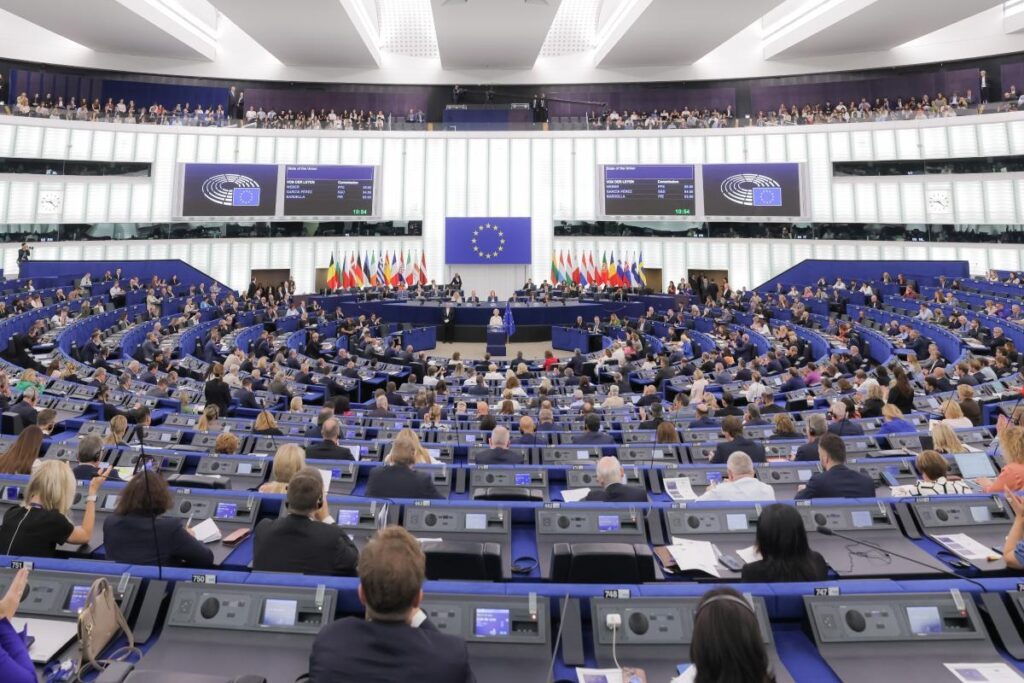
On 16 September, Commission President Ursula von der Leyen delivered her State of the Union address. Last year, she mentioned the competitiveness 4 times, this year zero. Does that mean that Europe is now more competitive?
From her speech one could get impression that everything is settled, the EU has plenty of plans how to help businesses to cope with high energy prices, with administrative burden, access to finance or even with internal market barriers. But these plans have hardly materialized and entrepreneurs are still waiting for a positive change.
While waiting, some closed their business, some delocalised outside of Europe. The EU is loosing its industry, cried out von der Leyen in her speech! But she wrongly assigns it to China.
China is only one part of many aspects leading to the deindustrialization trend in Europe. The industry is under siege from all sides. High energy prices. Geopolitical shocks. Disruption around the Strait of Hormuz. Decarbonisation. And on top of all that, an ever-growing pile of European rules.
The numbers back this up: two-thirds of EU companies view complex and excessive regulation a major long-term barrier to investment, particularly for SMEs, which singled out red tape as their single biggest challenge — ahead of financing, ahead of hiring, ahead of everything else.
Europe needs regulation: high standards, a level playing field, protection for workers and consumers. But regulation should never become an obstacle to doing business.
A company doesn't grow because Brussels passes a law. It grows because someone has a good idea: an entrepreneur who spots an opportunity, takes a risk, and builds something from it. To succeed, that idea needs finance, skills, infrastructure, market access, and something we chronically underrate: a legal framework that lets companies actually act.
Europe is too often prescriptive. We don't just define the goal, we dictate the method. That kills innovation. Take climate: Europe should set the destination, as it did for climate neutrality, and let entrepreneurs find the fastest route there.
Mario Draghi warned in his report "decarbonisation leading to de-industrialisation in Europe – including of industries that can support the green transition – could politicaly endanger the European Green Deal.
Is that also the reason why von der Leyen did not mention the Green Deal even once this time? Or she feels sorry that in her previous mandate she forget to preserve the competitive position of European industry when engaging on Europe´s decarbonisation path?
Regulation becoming the risk
This time, She proposed to cope with energy prices via investment in more homegrown low-carbon energy and double the share of electricity by 2040. But from where this electricity will be produced ? How will we build new installations when it requires more money and time? All what Draghi said – need for capital market union and speedy permitting is still valid but not reality. This still needs to be delivered.
She mentioned the administrative burden but was very shy on tyding up the house as promised. She reminded 12 omnibus proposals that should reduce the administrative burden by around €17 billion a year but this could be turned around by saying this money could have been saved if regulated better!
Instead of reducing the burden, the Commission keeps writing rules that are nearly impossible to comply with. The new packaging regulation is a textbook case: businesses are drowning in red tape just trying to sell across the single market. Guidance arrives too late — or not at all — while companies are stuck trying to plan investments, sign contracts, and train staff in the dark. The result is that some of them end up by stopping their sales to another EU Member States anymore.
When companies can't get clear answers, regulation stops being a rulebook and becomes a risk. And risk has a price:
It delays investment. It kills risk-taking. It eats management's time. It can strangle a good idea before it ever becomes a business. It destroys single market.
Europe needs legislation that is: clear, understandable and enforceable. And we can do something very practical to achieve this: The entrepreneur's backpack. Picture every entrepreneur hauling a regulatory backpack stuffed with reporting requirements, deadlines, paperwork, inspections. Before adding one more item to that pack, policymakers should ask three questions: Is this necessary? Does it duplicate something that already exists? Can the administration just use the information it already has?
Europe's competitiveness depends on understanding every day realities of European entrepreneurs - 99,8% of them are SMEs.
According to an Austrian survey by Market Institute, Austrian SMEs spend 2.5 working days per week on bureaucracy. Two and a half days! This isn't abstract red tape, it's real money that doesn't go into hiring, taxes, R&D or expansion. If entrepreneurs spend their time navigating bureaucracy instead of developing their business, we are using some of Europe's most valuable resources in the wrong way.
The EU laws should be therefore drafted through the lens of SMEs and incentives growth. The rules should allow entrepreneurs spend their time on customers, innovation, and jobs, not deciphering a rulebook that changes under their feet.
The freedom to conduct a business is written into the EU Charter of Fundamental Rights. It's time to put it in practice, and for the first time in years.
This State of the Union was full of buzzwords but proposed only few things for entrepreneurs in areas of trade and innovation. But Europe doesn't lack ideas, neither resources. If we want the growth and a healthy economy, we have to understand the state of European companies and create a regulatory environment in which they can concentrate on building their business.
