
Ottawa is a federal capital with about 1.2 million inhabitants and two official languages, where two linguistically distinct education systems coexist. It is bound to face challenges very similar to those facing Brussels. Not quite, it turns out.
Philosopher Philippe Van Parijs reflects on current events and debates in Brussels, Belgium and Europe
Between the two cities, there are some major historical and institutional differences. Brussels dates back a thousand years; it emerged as the capital of the Burgundian Low Countries around 1460 and was subsequently confirmed as the capital of independent Belgium in 1831. Ottawa, on the other hand, was not founded until 1826; it became the capital of the British province of Canada in 1857 and was not confirmed as the capital of the independent federal state of Canada until 1931.
Furthermore, the Brussels-Capital Region is a federated entity with its own government and parliament, whereas Ottawa is a municipality within a federated entity, the province of Ontario. In 2001, this municipality had a population of just 337,000. However, the provincial government then decided to annex 10 other municipalities to it, thereby increasing its population by a factor of 2.3 and its surface area by a factor of 25. Previously smaller than Brussels, Ottawa suddenly became larger than Flemish Brabant, despite fierce resistance from rural local authorities, who were not keen on the idea of being absorbed by a city in financial difficulty.
The populations of the two cities are now of a similar order: Brussels has just over 1.2 million inhabitants, Ottawa slightly less, with both growing rapidly (+31% in Brussels, +44% in Ottawa since 2001), mainly due to the increase in the proportion of families of recent foreign origin. Canadians with at least one parent born abroad make up 42% of Ottawa’s population, whilst Belgians with at least one parent born abroad account for 41% of the Brussels population.
But there is one major difference: over 37% of Brussels residents do not hold Belgian nationality, while fewer than 10% Ottawa residents are not Canadian. Consequently, nearly half of Ottavians are “Canadiens de souche”, whilst the “Belgo-Belges” now account for hardly more than a fifth of the Brussels population.
An even more unequal competition between languages
This sets the scene for understanding the linguistic situation. The relative importance of the two official languages in Ottawa and across Canada as a whole can be accurately estimated thanks to a five-yearly census. These census data can be compared with the less reliable survey data from the Vrije Universiteit Brussels' Taalbarometer for Brussels and the European Commission’s Eurobarometer for Belgium.
| EN | FR | ||
| Canada (2021) | Native language | 57% | 20% |
| Language known | 87% | 21% | |
| Ottawa (2021) | Native language | 63% | 14% |
| Language known | 97% | 39% | |
| NL | FR | ||
| Belgium (2024) | Native language | 51% | 39% |
| Language known | 59% | 66% | |
| Brussels (2024) | Native language | 12% | 64% |
| Language known | 22% | 81% |
The comparison must be made with caution, due to differences in the wording of the questions. As regards “native languages”, for example, the Taalbarometer asks ‘Which language or languages do you speak with at least one of your parents and/or do your parents speak between themselves?’, whereas the Canadian census asks ‘Which language did this person first learn at home as a child and still understands?’, with the option to ‘mention more than one language if they were learnt simultaneously and are still understood.’
These figures nevertheless give a good idea of the fundamental differences between the two situations. In Brussels, the majority native language at local lever is not the majority native language at national language. In Ottawa, English is not only the most common native and known language at local level but also at national level — in addition to being the language of the large North American neighbour and the global lingua franca. Consequently, competition between languages can be expected to be far more uneven in Ottawa than in Brussels.
The Francophone’s right to be served in their native language
Being a provincial decision, the massive 2001 merger could only take place with municipalities, located in Ontario and not with the large adjacent municipality of Gatineau (population 300,000) located in Québec. Consequently, it significantly increased the anglophone majority and fuelled mobilisation among Ottawa’s francophones. It was not, however, until 2017 that the Ontario parliament granted Ottawa the official status of a bilingual municipality. This formalized the right of its francophone citizens to access all public services in their own language — analogous to the right conferred on the Dutch-speaking minority in Brussels by legislation dating from 1966 and monitored by its beneficiaries with the same meticulous attention.

Ottawa’s city centre seen from the bridge that connects it with Gatineau, its Francophone suburb
A very recent study covering the whole of Canada has lent further weight to the claims of Ottawa’s francophones (and by analogy to those of the Dutch-speaking Brussels population): mortality rates among francophones rise by 11 per cent if the healthcare they receive is in English and not in their own language.
Note, however, that the same study showed that this excess mortality rate when healthcare is not accessed in one’s own language stands at 27 per cent among speakers of other language than French. It is worth noting that in Ottawa, public services are not only allowed but encouraged to use, as far as possible, languages other than the official languages if doing so can improve the quality of care. In Brussels, Belgium’s 1966 legislation dating from 1966 prohibits this in principle — but is wisely often transgressed.
No lack of native French-speaking children
Like the survival of Dutch in Brussels, the survival of French in Ottawa depends far less on its use by public services than on its presence in education. Dutch-language schools in Brussels face colossal challenges; 75% of their pupils speak no Dutch at home, and many classes do not have a single Dutch-speaking pupil. Furthermore, teachers are becoming increasingly difficult to recruit and keep. One might expect the situation to be even more difficult for French-speaking schools in Ottawa. Surprisingly, this is not the case.
As with Dutch-language education in Brussels, the market share of French-language education in Ottawa is increasing : from 13% in 2002 to 23% in 2023. Where do these pupils come from? Very few are francophone “Canadiens de souche”; the birth rate among these families is low and many are moving to the Quebec hinterland. Similarly, in Brussels, Dutch-speaking “Belgo-Belge” families do not procreate much and many move to the cheaper, greener and safer Flemish periphery.
In Brussels, this shortfall is largely offset by the appeal that Dutch-speaking schools hold for families from the majority language community. (There are four times as many pure native French speakers as pure native Dutch speakers in Brussels’ Dutch-medium schools.) This is not the case in Ottawa.
To start with, knowing French does not have the same economic importance as knowing Dutch in Brussels. Furthermore, Ottawa’s French-medium schools are far more anxious to protect themselves from the ‘invasion’ of English than Brussels’ Dutch-medium schools from the ‘invasion’ of French: among Canadians, only children with at least one French-speaking parent are eligible for admission. (In Brussels, children with at least one Dutch-speaking parent are given priority for 65% of the places in the Dutch-medium school they apply for, but there is no linguistic condition for admission to either the French- or the Dutch-medium education system.) No symmetric restriction applies to admission to Ottawa’s English-medium schools, which preserves the right to education of children whose parents are neither French nor English speakers.
What, then, ensures that French-medium schools in Ottawa do not run short of pupils? The influx, often via Quebec, of immigrants from French-speaking countries, mainly Haiti, West Africa and North Africa. As a result, in contrast with Brussels’ Dutch-medium schools, the school language is the mother tongue of most of the pupils attending these schools.
Admittedly, in addition to these pupils, there are some children from families of foreign origin whose mother tongue is neither French nor English: the law gives them the choice between the two school systems. However, most opt for the English-speaking system, and their presence is not enough to displace French as the lingua franca within French-medium schools.
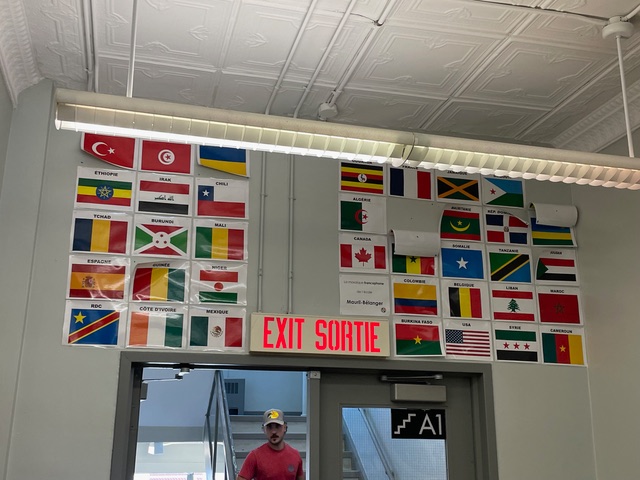
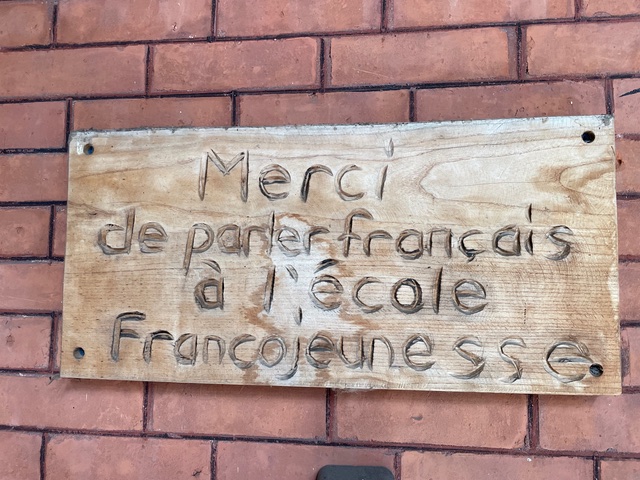
Flags representing the origins of pupils in a Francophone primary school in the city of Ottawa
Nonetheless concerned
Next, what about teacher recruitment? No major problem either, it would seem. Firstly, the entire education system is organised and funded at provincial level, and teachers’ salaries in Ontario are up to 30 per cent higher than in Quebec. Secondly, wearing the hijab is prohibited in Quebec’s state schools. As Ontario imposes no such restriction, this further swells the recruitment pool for Ottawa’s French-language schools.
There is a Canada-wide scarcity of teachers of the French language, but Quebec’s proximity and its policies seems to shelter Ottawa’s French-medium schools from this shortage — perhaps only precariously. No analogous difference between Brussels and Flanders comes to the help of Brussels’ Dutch-medium schools in their effort to recruit and keep teachers. As soon as they start a family, these are drawn to Brussels’ Flemish periphery for the same reasons as any other Dutch-speaking family.
Is there nonetheless a cause for concern for French-language education in Ottawa? Yes, there is. It is called ‘retention’. Efforts are needed to ensure that children who attend a French-medium school at primary level continue to do so at secondary level. These efforts have been successful so far: the market share of French-language education is higher at secondary level than at primary level. However, most pupils who go on to higher education do so in English. Hence the fear that, ultimately, they will not strengthen the community of French-speaking Canadians — one of the explicit objectives pursued by French-medium education in Canada’s predominantly English-speaking provinces.
Does Dutch-language education in Brussels pursue an analogous objective? Perhaps. “Gemeenschapsvorming” (community formation), is how some Flemish politicians referred to it when asked about the main purpose of Brussels’ Dutch-medium education system now that it could no longer be described as giving Flemish children living in Brussels the right to be educated in their mother tongue. But given the differences noted above, Brussels’ Dutch-medium education system is undoubtedly even less likely, indeed far less likely, to achieve this objective than Ottawa’s French-medium system. Should it simply give it up?
