
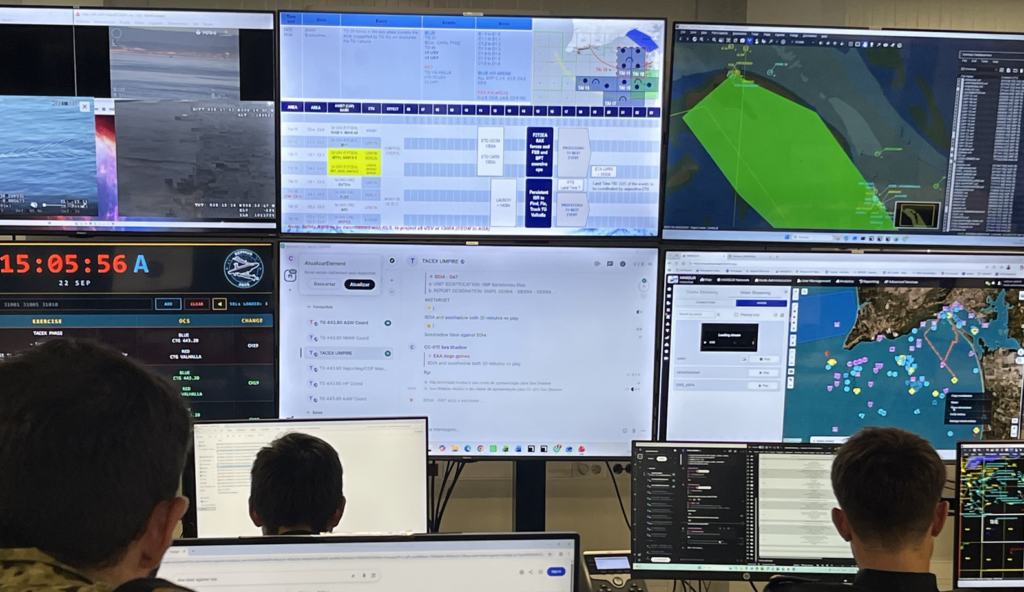
The European Defence Agency said it had shown that MARSUR, the EU’s maritime surveillance network, can exchange data in real time with national command systems and NATO during a test off Portugal in September 2026.
The test was carried out during REPMUS — Robotic Experimentation and Prototyping using Maritime Unmanned Systems — which ran from 31 August to 25 September and was hosted by the Portuguese Navy alongside the agency and NATO, according to details released by the European Defence Agency on Wednesday.
MARSUR is a “federated” network, meaning participating countries keep their own systems but share selected information to create a common picture of maritime activity, the agency said.
Information from participating nations and systems — including data originating from unmanned systems as well as national and NATO sources — was taken in by MARSUR and then distributed across the network using a data-exchange standard implemented for the exercise.
Jürgen Scraback, head of the Maritime Domain at the European Defence Agency, said the REPMUS results marked “the first time this level of multi-domain integration has been proven live, rather than just on paper”.
Plans for an upgraded, higher-security network
The exercise involved 23 participating EU nations, many of which also tested standard operating procedures for MARSUR and ran national scenarios, including protection of underwater infrastructure and monitoring of “shadow fleet” vessels used to evade sanctions, the European Defence Agency said.
Portugal’s President António José Seguro received a briefing during REPMUS, as did Sweden’s Chief of Navy, Rear Admiral Johan Norlén.
The results are being used to support a funding request to upgrade MARSUR to an “EU Secret” security classification level, with plans to modernise 18 network nodes and connect the system with the European External Action Service’s secure operational network.
Work would begin in 2027 and a fully classified network would be operational by 2028 if the European Council approves the plan later this year.
