

Last summer made it clear to Europe that global warming does not stop at national borders. It is obvious that a shift to renewable energy to reduce EU’s carbon footprint is inevitable. Recent fluctuations in oil prices have made this shift a matter of urgency.
To ensure the 'green transition,' the EU needs car batteries, solar panels, and wind turbines, which require critical raw materials. A country that is rich in such materials is the Philippines. Having the fourth largest copper and cobalt reserves, and the fifth largest nickel deposits, the Philippines have become a strategically important partner for the EU.
Located at the heart of the Indo-Pacific region, the island country has gained geopolitical and geo-economic significance in the past years, putting it at the forefront of competition between global players.
The Philippines has a deep-rooted 'culture of impunity' but this has been overshadowed by the current government’s willingness to deepen economic and security ties with other countries, including the EU Member States.
After three years of negotiations, the EU Commission announced on Tuesday that it has reached a 'substantial agreement' on a free trade agreement (FTA) with the Philippines. If concluded, the EU will follow Chile and the United Arab Emirates, which signed similar trade deals earlier this year.
FTAs are not new to the Philippines or the EU. But in comparison to other trade blocs, the EU has argued – ever since the signing of the 2009 Treaty of Lisbon – that its trade policy promotes human rights, democratic values, decent work, and international environmental standards.
Sadly, a reality check shows that EU’s 'value-based trade policy' is little more than flowery rhetoric on paper. None of the proposed mechanisms – such as the 'trade and sustainable development' (TSD) chapter or the much lauded 'human rights clause' – have prevented human rights violations. The regulations are not worded clear enough and only enforced half-heartedly, if at all.
The TSD chapters include commitments to international labor and environmental standards. In the event of a breach of obligations, the agreements provide for consultations. But this mechanism is considered ineffective as it cannot lead to trade sanctions.
The 'human rights clause' provides for the suspension of the agreement in response to breaches of, for example, human rights treaties or the Paris Agreement. However, it is not only very broadly worded but has so far only been invoked in 'exceptional cases' such as a coup d’état and in EU partner countries of minor economic significance. Notably, trade preferences were never suspended.
As many FTAs as possible
Despite these obvious shortcomings, the EU appears not to be willing to tighten the human rights mechanisms in its trade policy. On the contrary, fueled by growing global uncertainty and pressured by US’ tariff policy, the EU has rushed to conclude as many FTAs as possible. With the new FTA with the Philippines, the EU will have signed agreements with over half of the world population.
The EU appears determined towards diversifying trading partners and securing new markets regardless of a country’s political situation.
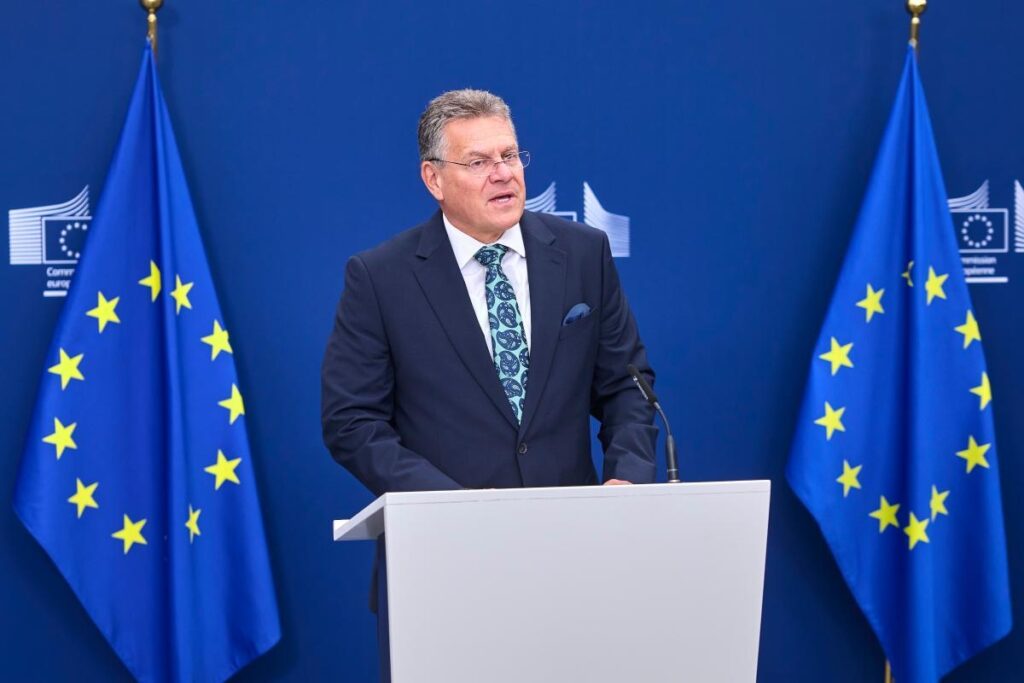
The joint press statement of European Commissioner for Trade and Economic Security Maroš Šefčovič and Philippine Secretary of Trade and Industry Ma. Cristina A. Roque on the 'substantial' FTA reached now does not even mention human rights and other commitments.
Despite systematic killings under the previous government of President Rodrigo Duterte, the EU continued to grant the Philippines preferences under the Generalized Scheme of Preferences (GSP+). The lack of clear, timebound, robust, and legally binding commitments to human rights and environmental standards is concerning.
But so also the potential negative impacts of the FTA. The agreement could worsen labor conditions and exacerbate land conflicts in the mining sector. Increased demand from the EU would lead to a massive expansion of mining activities at the expense of local communities.
It is estimated that more than 50 percent of Philippines’ mineral deposits are located on Indigenous Peoples territories. Many of these areas are already affected by concessions for exploration or extraction of raw materials. Mining activities on Indigenous Peoples’ territories generally proceed without 'Free, Prior, and Informed Consent' (FPIC).
Local communities are often consulted only to a limited extent, if at all. Corruption undermines transparency about planned mining projects. The razing of forests and mangroves for mining activities further exacerbates the impacts of extreme weather events. Given these conditions, it is unlikely that obligations to carry out environmental impact assessments will be properly implemented.
Civil society protests
Instead of addressing these issues, President Ferdinand Marcos Jr. simplified the procedures for issuing mining permits in 2023 in order to increase foreign investment (Executive Order No. 18), following his predecessor’s lifting of a 2021 moratorium on the issuance of new mining permits and the ban on open-pit mining.
In the Philippines, civil society groups have been skeptical about the FTA from the very beginning. They know that EU’s bar for what constitutes a 'serious breach of international human rights standards' is set very low.
Opposition to mining activities comes not only from indigenous rights defenders and environmental activists but also from local governments that have adopted local ordinances banning further mining.
Philippine human rights defenders, journalists, indigenous leaders, unionists, and environmental activists are regularly subjected to harassment, intimidation, criminalisation, and even killings. Access to legal remedies, justice, and state protection remains very limited for the majority of the population in the Philippines, while perpetrators of human rights violations overwhelmingly enjoy immunity from prosecution.
As the EU is the Philippines’ fourth largest trading partner, accounting for 8.3% of the country's total trade in goods in 2025, the FTA is of great significance. It will attract investment from the EU to the Philippines and therefore have an impact on the human rights and environmental situation.
And that’s why it matters how and if the FTA can respond to human rights violations. EU civil society calls, pointing to the ongoing and well-documented human rights violations in the Philippines, have unfortunately been disregarded by the European Commission so far.
In a recent letter to the Commission, Human Rights Watch urged the EU to make clear to their counterparts in the Philippines that concrete legislative and policy measures are needed for a positive conclusion of the FTA. Others such as Trade Justice Pilipinas reject the FTA outright because it has not been negotiated on an equal footing.
The bottom line is that by concluding the FTA as it emerges now with the Philippines, the EU will undermine its credibility as a global actor for human rights and environmental protection. It would be disheartening if the agreement will be finalised with the ends justifying its means.
