
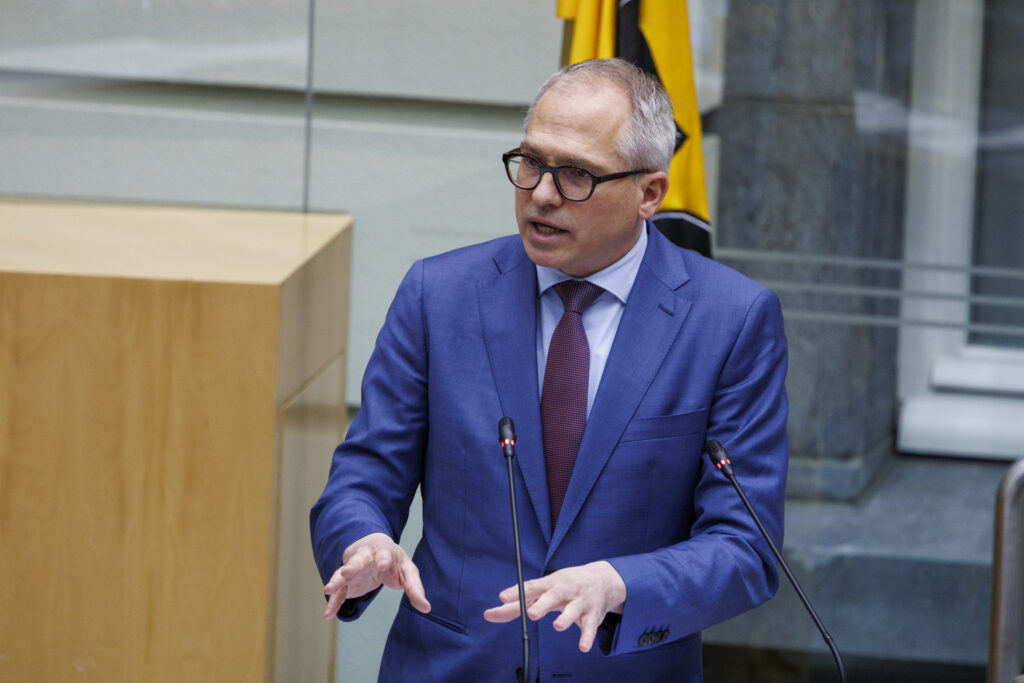
The Flemish government, led by Minister-President Matthias Diependaele (N-VA), still has no agreement on its budget for next year. This Monday afternoon, Diependaele is supposed to present the plans to the Flemish parliament.
On Sunday, Diependaele of the Flemish nationalist N-VA held bilateral discussions with his coalition partners. CD&V (Christian Democrat) ministers Hilde Crevits and Jo Brouns were the first to kick off the discussions. According to Crevits, bilateral talks are a good thing, but she does not deny that the negotiations are very challenging.
"It is definitely difficult, and it will remain so for a few more hours, but we are diligently working on it," said Crevits.
On Sunday evening, Diependaele presented a new budget table — the fourth version so far — to the governing parties. Earlier versions of this table did not receive approval from the coalition partners and were described as "unbalanced" and "an N-VA table." There still appears to be tension, particularly between N-VA and Vooruit (socialists).
Consensus is emerging on some issues, such as increasing the price of service vouchers (likely from €10 to €12), additional savings in government operations, and a significant cut in subsidies.
However, there are still many other issues under discussion. This includes the proposal to raise the registration duties on homes above 500,000 euros back to 3%. The same applies to the (Vooruit) proposal to abolish the healthcare premium in exchange for an increase in personal income tax surcharges, as well as to Diependaele's own proposal to abolish the birth grant of approximately €1,300 for babies and replace it with an investment in a Flemish Growth Fund.
According to various sources, there is also a proposal on the table to limit the age for the Growth Package, the former child benefit. Currently, children under certain conditions (for example, when they are studying) remain eligible for the Growth Package until age 25.
Given that most students have graduated by that age, child benefits could be limited to age 24. There is certainly no consensus on this proposal yet.
The increase in the drinking water bill would be off the table, although an alternative is still being sought.
The question also remains about what will happen to the promised reduction in inheritance tax. The government pledged to phase it out by 2029, reducing it to €350 million per year.
And what about expansion policies in areas such as Welfare? Will there also be partial cuts there?
