
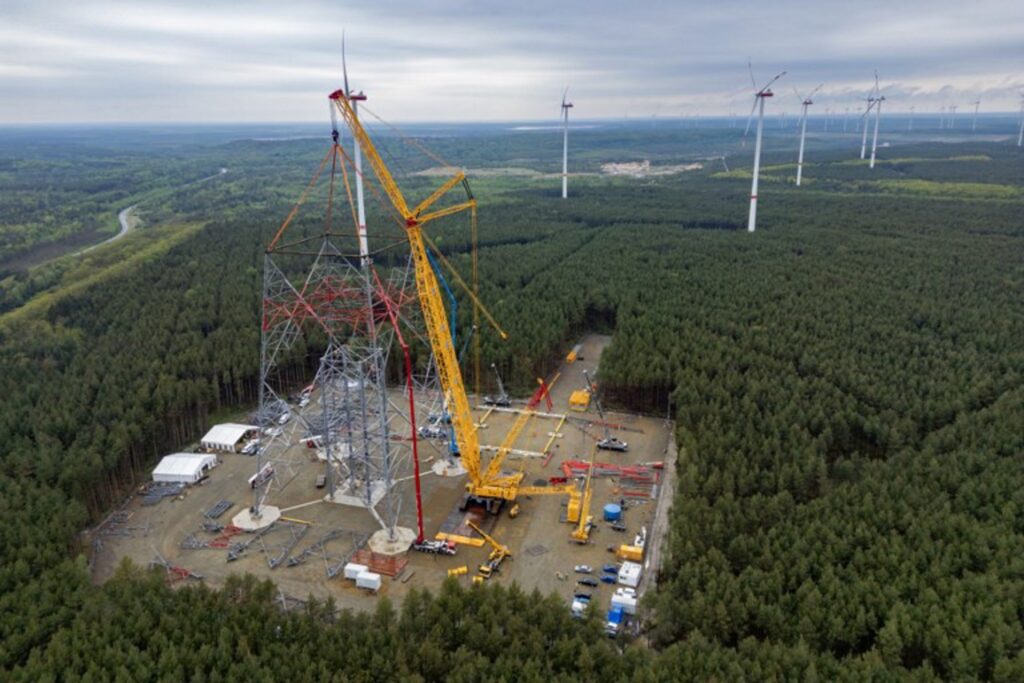
A giant wind turbine in eastern Germany reached its full height of 365 metres on Tuesday, making it the tallest in the world, with official commissioning planned for November.
Its developer, Gicon, said the decisive stage was completed at the site in Schipkau when the inner section of the tower was extended upwards to its final position.
The company said this was achieved using a cable-lifting system, in a process similar to extending an antenna, allowing the structure to reach great height without the use of cranes.
Gicon said the lifting operation required careful co-ordination and that final completion work would take a few more days before the turbine enters into service in November.
At 365 metres, the turbine is now the second-tallest structure in Germany, just three metres shorter than Berlin’s television tower.
According to its developer, the turbine’s hub stands at 300 metres, enabling it to capture stronger and more consistent winds and generate twice as much electricity as a conventional wind turbine.
Built among around 50 turbines in the Schipkau wind farm, which was launched in 2000, the steel structure is expected to supply electricity to 7,500 households over a full year.
The project has received between €20 million and €30 million in state funding through Germany’s Agency for Disruptive Innovation, known as SPRIND.
It is located in a former coal region where open-cast mines are due to close gradually by 2038 under Berlin’s climate targets.
Gicon said the pilot project is intended to test the viability of “second-storey” wind farms, which could significantly increase power generation without the need to build new sites.
