
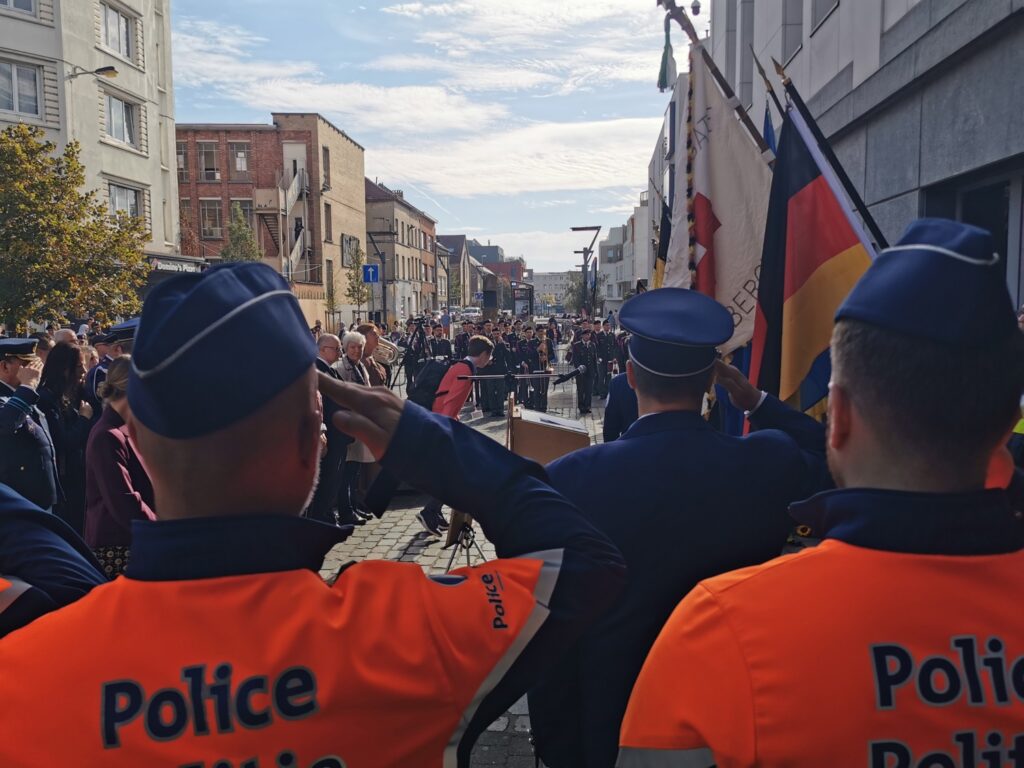
A commemorative plaque honouring World War II hero André Van Den Heede, who died in deportation in 1945 after joining the Resistance, was returned on Tuesday to the outside wall of the central police station on Rue du Facteur in Molenbeek.
The ceremony took place in a solemn atmosphere and bright sunshine, attended by officials, family members and local schoolchildren. The Royal Symphonic Band of the Guides, made up of around 60 musicians, accompanied the tribute.
“It is very emotional to be here. He is my grandad’s father,” Van Den Heede’s great-granddaughter said. She said she was proud to honour him and “all the men who had the courage to defend our country.”
Van Den Heede joined the municipal police in 1938 and entered the Resistance in 1941 as part of the Castor & Pollux group, which was linked to the Réseau Zéro network. He was arrested in 1943, imprisoned in Saint-Gilles and then deported to Germany.
He died on 9 March 1945 at the Hersbrück Kommando, a subcamp of the Flossenbürg concentration camp.
The plaque was originally unveiled in 1946 by then Mayor Edmond Machtens in the presence of Prince Regent Charles. It later disappeared in unknown circumstances before being found at MOMUSE, the municipal museum.
Its reinstallation was driven in particular by pupils from the Aux Sources du Gai Savoir municipal school, the Van Den Heede family and the association Mémoire, Culture et Transmissions.
“Education and passing on memory are our best weapons against forgetting, intolerance and all forms of hatred,” current Mayor Catherine Moureaux said.
Moureaux said the pupils had studied the Resistance fighter’s life and presented his family with comic strips they had created about his story. She described the ceremony as the result of ongoing remembrance work carried out with schools, where the history of the Second World War continues to be taught.
The plaque was secured so it could leave the museum and be displayed in public again. Moureaux said she wanted it to be accessible to everyone.
According to the mayor, Van Den Heede’s story is a reminder that any citizen, including a public servant, can choose to resist in defence of democracy.
