
The situation in Ukraine continues to be difficult. Among others the building of the National Academy of Science of Ukraine was hit by a Russian missile and started a fire.
Multiple missiles and drones struck Kyiv overnight amid a multi-day attack by Russian forces on the capital, The Kyiv Independent reports.
Ukrainian universities continue to work under difficult conditions as Russia’s unprovoked war of aggression continues for the fifth year with no cease-fire and peace agreement in sight. Since Russia’s full-scale invasion on 24 February 2022, Ukraine has shown remarkable resilience and military innovation, reconquered territory and is striking back deep into Russia.
Amid a relentless war of attrition, Ukraine continues also to make progress on its path to EU membership. It was given a European perspective in June 2022 and the accession negotiations were opened in December 2023. The screening progress of the acquis was completed in September 2025.
In this short period, Ukraine met the conditions to open three clusters, including the fundamentals cluster. According to last year’s annual enlargement package, the Ukrainian government has signaled its objective to provisionally close accession negotiations by the end of 2028 – an ambitious objective, which the Commission supports.
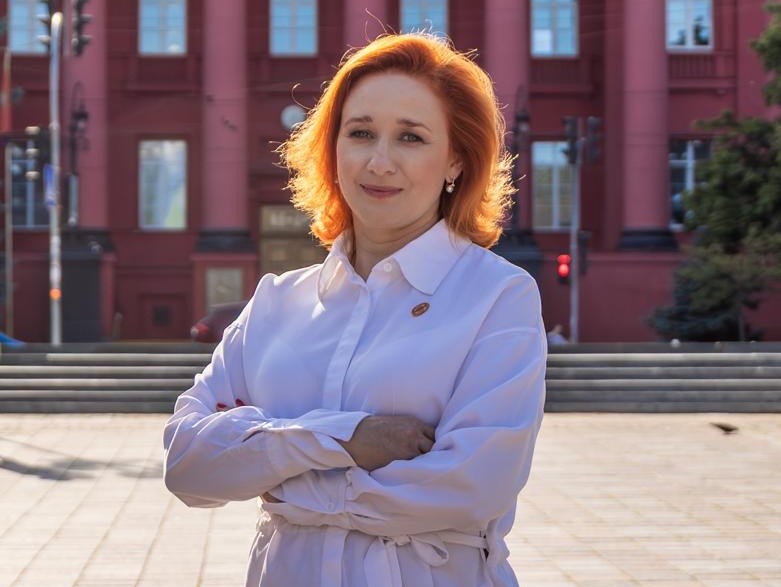
Professor Ganna Tolstanova is a scientist specializing in biochemistry and experimental medicine at Taras Shevchenko National University of Kyiv. The Ukrainian socio-political magazine Focus ranked her this year among the Top 10 Most Influential Ukrainians in this category ‘Education and Science’ for her achievements as a scientist and support to the management of scientific research in Ukraine.
In a recent op-ed, she wrote that Russia's invasion has tested every part of Ukraine's higher education and research system. Instead of postponing reform, Ukraine has accelerated the modernisation of research governance and its integration into the European knowledge ecosystem.
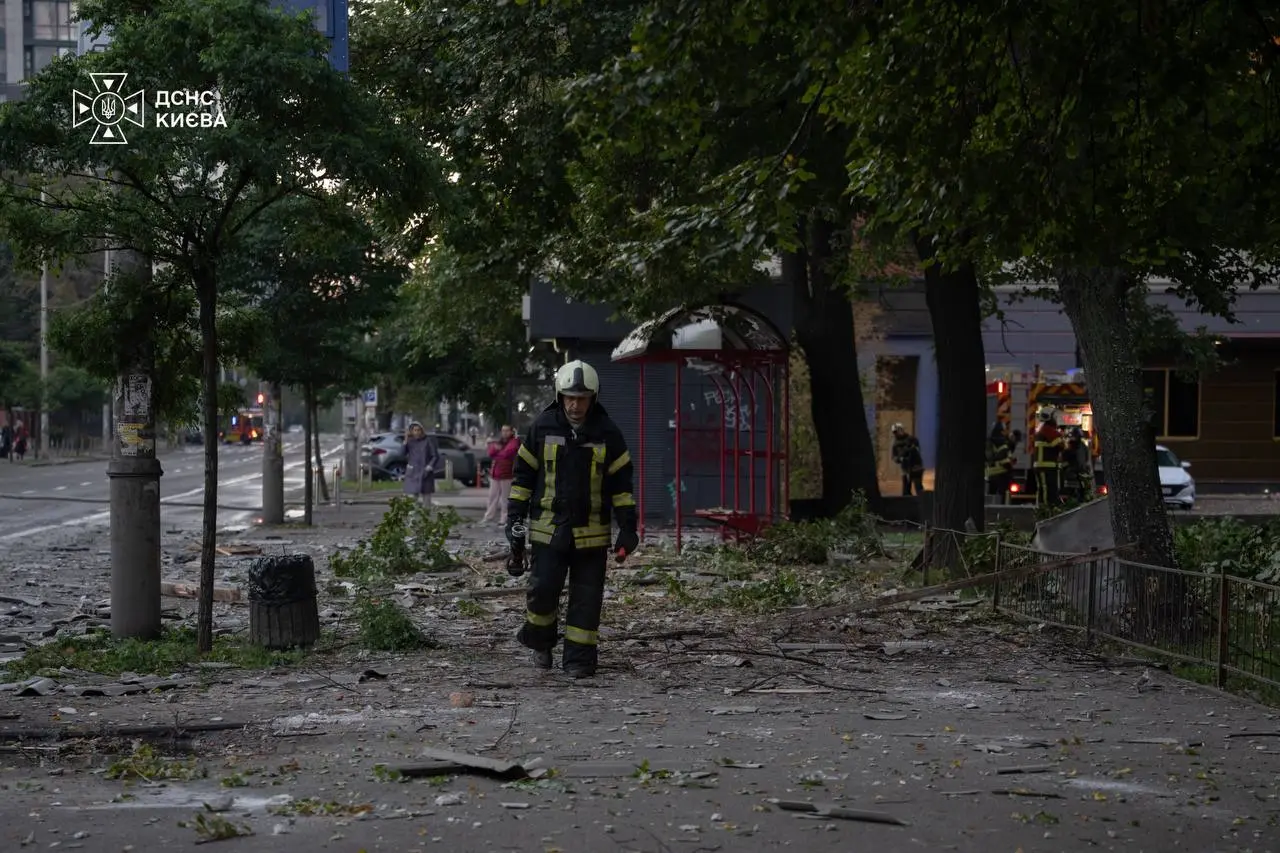
A Ukrainian rescue worker walks down a street following Russia's overnight attack on Kyiv on Sept. 29, 2026, credit: Ukraine's State Emergency Service
Passion for science
We decided to ask her about her thoughts about EU-Ukraine scientific cooperation but started with her passion for science.
The Brussels Times: What made you decide to study physiology, anatomy, and biology (biomedicine)? Was it difficult for a girl to enter this field?
Ganna Tolstanova: My interest in biomedicine began at High School, where I studied biology and chemistry in depth. I enjoyed both, as well as mathematics. I never wanted to become a medical doctor but understand how the body works. So I chose to study biology at Taras Shevchenko National University of Kyiv.
In my first year, I was fortunate to join a research laboratory led by Professor Semen Groysman, a leading researcher in gastrointestinal physiology, and later by Professor Tetiana Beregova. Students were encouraged to develop their own research projects. That freedom changed everything for me. I fell in love with science.
The laboratory worked closely with surgeons treating patients with gastric and duodenal ulcers. We studied how different operations affected the recovery of digestive function and investigated potential new medicines. It was a lively place to learn. I could see that our work mattered - findings from the laboratory were put into clinical practice.
Women were the majority at our biology faculty, so I did not feel that being a girl limited my opportunities to enter the field.
Q: How would you describe your research results and discoveries in simple terms and their importance for our health?
A: The digestive tract does far more than process food. It is home to a vast community of microorganisms, known as the gut microbiome. These microbes help turn dietary fibre from vegetables, fruit and pulses into compounds that provide energy for cells lining the intestine. Some can break down oxalate (a plant-based compound), which is associated with kidney stones. Others influence how medicines are processed in the body.
This creates a delicate balance. The intestine must provide a home for these microorganisms while maintaining a barrier that keeps them from entering the bloodstream and causing inflammation.
My postdoctoral research at the University of California, Irvine, was a turning point for me. It shaped the question to which I have devoted my scientific career: How does the intestinal barrier protect us while allowing us to benefit from the microbes living on the other side of it? My research examines what happens when that barrier is disrupted and how those changes affect health.
Q: One of your initiatives has been a project (the #NAUKAPROSTO project) to popularize science. How do you make complex research understandable for a wider public?
A: #NAUKAPROSTO is one of my favourite projects. I developed it with a team of young lecturers from our university’s Institute of Journalism. We asked ourselves: How could we get people curious about the research being done by our chemists, physicists, astronomers, biologists and medical scientists?
The name carries a play on words in Ukrainian. Prosto means “simply”, but it can also be read as pro sto—“about one hundred”. Our ambition was to turn 100 scientific discoveries into 100 posters that would catch a passer-by’s eye.
We invited each researcher to explain a discovery in plain language. Our journalism colleagues then transformed that explanation into a poster with the visual appeal of an advertisement. A QR code led readers to the scientist’s account of the research.
The researchers were delighted when they saw the results. To me, the project showed what happens when scientific rigour meets creative storytelling—and when people from different disciplines work together.
Lessons learned from EU cooperation
Q: During your carrier, you participated in collaborative research projects funded by the EU. What are your lessons learned from these projects?
A: The greatest lesson I have learned from EU-funded projects is that collaboration begins with people. Working with colleagues from different countries has broadened my understanding of how universities approach research and solve problems. It has also helped our European partners get to know Ukrainian universities through direct experience: our expertise, commitment and ability to deliver.
After Russia’s full-scale invasion, several initiatives made it possible for Ukrainian universities to join EU projects that had already received funding. For us, that was an unprecedented opening. OTH Regensburg (Germany) invited our university to join a consortium. We did not have to start by building a consortium from scratch; we could begin by working together.
When this project ended, the relationships continued. We went on to submit several new proposals with the same consortium to the European Institute of Innovation (EIT) and Horizon Europe. That is what I value most about these projects. A grant has an end date, but the trust built through working together can lead to opportunities long afterwards.
Q: You have also been engaged on both national and EU level in creating new models for launching start-ups linked to the university. What are the conditions for commercializing applied academic research?
A: A university cannot simply tell researchers to “commercialise” their work and expect start-ups to appear. People need a place to test an idea, access to equipment and advice, and the freedom to learn from early failures. The first EIT-funded project helped us build the foundations for a start-up school at Taras Shevchenko National University of Kyiv.
We learned from our Belgian partner, VIVES University of Applied Sciences, about social entrepreneurship: how an idea can create value for a community as well as become a viable venture. OTH Regensburg showed us what a physical innovation hub can offer students who need to turn an idea into a first working prototype, or minimum viable product.
We brought those lessons home. Colleagues across the university formed teams, and we secured several national projects to develop facilities for advanced optical materials, nanomaterials and a fabrication laboratory. For me, that is how commercialisation begins: give researchers and students the people, tools and space to see whether an idea can work beyond the laboratory.
Transforming research management
Q: You are also disseminating European research management practices as co-founder of the "Professional Network of Research and HE Managers of Ukraine (PNRM)”. Can you elaborate on their implementation in Ukraine?
A: The idea of creating the PNRM of Ukraine came from my experience with colleagues at the International Office of Leibniz University Hannover. They invited our university to take part in a training programme for Ukrainian higher education administrators in 2019-2024.
Through our conversations, I saw how well developed the culture of exchange between European university managers is. They share their experience across institutions and invest in their own professional so they can provide better services to their universities and researchers. That made a strong impression on me.
Together with like-minded Ukrainian colleagues from different universities, I decided to create a similar organisation in Ukraine. We founded the network in June 2022, when we felt even more strongly how much we needed to stand together to preserve our institutions.
In 2026, this initiative received support from the European Commission through the ’FRAME-UA — Framework for Research Management Excellence in Ukraine’ (Erasmus+ Capacity Building in Higher Education). These projects are designed to support structural reform at national level with the support from Ministry of Education and Science of Ukraine.
Q: In June 2022, Ukraine became associated with Horizon Europe, the EU R&D programme (2021 – 2027). The agreement applies retroactively from January 2021. How would you describe Ukraine’s participation so far? What is the success rate? Which countries do you collaborate with most?
A: Ukraine’s participation in Horizon Europe is growing despite Russia’s invasion. As of July 2026, Ukrainian research teams had recorded 428 participations across 293 signed grant agreements, securing €72.6 million in EU funding. They also coordinated 16 projects.
The success rate for Ukrainian applications was 11.8%, up from 9.2% under Horizon 2020. The average rate for participating countries is 11%. Our five strongest collaboration links are with Germany, Italy, Spain, France and Greece. For me, these figures show more than resilience. Ukrainian researchers are contributing to European consortia and increasingly taking responsibility for leading them.

The Red Taras Shevchenko National University building in Kyiv with black details on its columns. The colours are linked to Saint Volodymyr who united Kyivan Rus and converted it to Orthodox Christianity 1000 years ago.
Challenges during the war
Q: Ukraine was ranked 45th globally in the recent PISA 2025 assessment with an overall mean score slightly below the EU average. Science remained the strongest subject but the results are below pre-war levels and the global baseline. How can Ukrainian universities contribute to improving the scores and attract talented science students despite the war?
A: This is a painful issue for Ukrainian education. Air-raid alerts repeatedly interrupt school lessons, and children are learning under constant psychological pressure. Universities cannot make those conditions disappear, but we can help pupils recover learning time and discover that science is still a future they can pursue. Many universities organise subject-focused schools during the holidays.
Our lecturers also work with talented pupils, help them prepare for academic Olympiads and introduce them to university laboratories. Ukrainian businesses are increasingly supporting these efforts by funding pupils’ participation in competitions and offering enhanced scholarships to first-year university students who choose to study science or mathematics.
The Junior Academy of Sciences of Ukraine is another important partner. It gives schoolchildren opportunities to undertake research projects and present their findings, often in cooperation with universities. These experiences strengthen reading, mathematics and science together: a young researcher must understand a question, work with evidence and explain a result.
Q: You wrote in your op-ed that Ukraine faces the challenge of researcher mobility (‘brain drain’) because of the war. How does Ukraine deal with this problem? Are researchers who left prepared to return if the war continues?
A: That is a difficult question, and there is no single answer for every researcher. Some have already returned, particularly to universities in western Ukraine, farther from the front line. Others remain abroad but keep their affiliation with a Ukrainian institution and work remotely where their field allows it, for example in theoretical research or the humanities.
We also have to be honest: while the war continues, we cannot assume that everyone is ready to return. What we can do now is make it possible for researchers abroad to remain active members of Ukraine’s scientific community.
In April 2026, an initiative involving Ukraine’s Ministry of Education and Science and the Ukrainian Science Diaspora established the ’International Scientific Ambassadors Network’. It is intended to connect Ukrainian researchers abroad with institutions at home and help build international research partnerships.
I also believe Ukraine’s leaders must start planning now for the return of researchers who have gained experience at universities and research institutions abroad. They will need the conditions to put that experience to work: opportunities to lead research, build teams and develop partnerships. Their return could become another form of Europe’s investment in Ukraine’s recovery.
This prolonged mobility was forced by war, but it has given many Ukrainian academics experience they might otherwise never have gained. If they can bring it back to their home institutions—especially regional universities—it could be a turning point for those universities and for Ukraine’s integration into the European Research Education Area.
Q: Your university is going to appoint a new rector in October. As a candidate to the post, what are the main goals you want to achieve in the short and medium term?
A: In Ukraine, we face the pressures of war, the demands of European integration and profound changes in who our students will be. My immediate priorities are safety and energy independence: shelters where learning can continue and reliable power for our classrooms and laboratories. These require investment, and I see securing that investment as a central part of the rector’s job.
I want the university to be ready with credible, budgeted projects when public investment, European funding or business partnerships become available. That means knowing what each faculty needs, bringing strong teams together and being able to show partners the results their support will achieve. It also means reducing routine bureaucracy with AI tools so that our people can spend more time on teaching and research.
In the medium term, I want to attract funding for talented researchers and modern facilities, while widening our educational offer. Ukraine needs specialists for reconstruction, and adults—including veterans—need flexible routes to new qualifications.
The rector I aspire to be is someone visible beyond the campus: building trust, making the case for the university and turning partnerships into opportunities for its people.
