
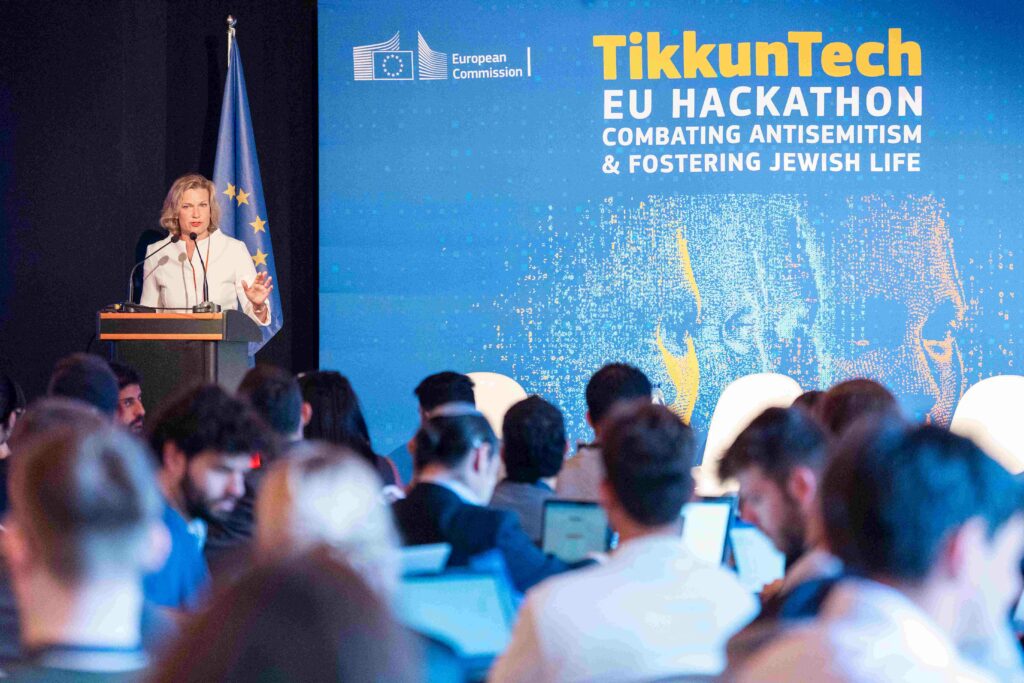
A two-days hackathon was hosted last week by the European Commission in Brussels to develop innovative solutions on-line to combat antisemitism and foster Jewish life. TikTok and Meta have committed to support the development of three awarded projects.
The event brought together more than 120 participants from over 20 countries in Europe and beyond, including government officials, civil society organisations, and tech specialists.
The participants worked in teams to build a working prototype for a specific problem in a short amount of time (‘hackathon’) – in this case tools to address among others antisemitism in content moderation and remove antisemitic bias in AI models.
“In Europe, we believe innovation must serve people,” Magnus Brunner, Commissioner for Internal Affairs and Migration. “TikkunTech follows the Jewish principle of ‘Tikkun Olam’—repairing the world— by offering solutions to repair digital spaces to stem hate where it proliferates.”
The hackathon was called ‘TikkunTech’, referring to the ancient religious-mystical concept ‘Tikkun Olam’ where human beings are called on to improve the world by their actions or even become partners of the Creator.
The Commission’s Coordinator on combating antisemitism and fostering Jewish life, Katharina von Schnurbein, described the TikkunTech as “an important milestone in implementing the EU Strategy on Combating Antisemitism and Fostering Jewish Life (2021–2030)”. The strategy was adopted in October 2021 against the backdrop of rising antisemitism in EU Member States.
The Commission underlines that antisemitic speech, including public condoning, denial or gross trivialisation of the Holocaust, – both online and offline – that incites violence and hatred is criminalised under the EU Framework Decision on combating racism and xenophobia.
For the online dimension, the EU has a legislative framework with the Terrorist Content Online Regulation and the Digital Services Act (DSA). The DSA obliges very large online platforms to take appropriate risk mitigations measures to prevent the dissemination of illegal and harmful content that can pose a threat to public security. Often this applies to antisemitic content.
Three of the final projects in the hackathon were shortlisted and assessed by a jury presided by von Schnurbein. The first prize was awarded to the ‘4Sight App’. The application was developed by a team of four people using AI to scan hundreds of thousands of posts on niche and fringe on-line platforms.
“It usually starts in those platforms,” Sophie, one of the team members, told The Brussels Times. “We want to alert the main platforms in time before antisemitic jargon and narratives migrate to them. Our application will facilitate experts and trusted DSA flaggers in the Member States to identify suspected content. It’s an alert to human checkers to decide if the content should be deleted.”
The second prize, the ‘L’chaim App’, was developed to enable Jewish community members to meet safely and find events of common interest. The third prize, Kavannah Browser Extension, is based on user experience of on-line platforms and empowers users to analyse their content. It does factchecking, interpret posts and shows a score.
“Coalition-building is key to implementing TikkunTech’s projects,” concluded Katharina von Schnurbein. “We brought together the Commission with civil society and the platforms, and secured TikTok’s commitment to continue developing the winning project in Dublin, while Meta will work with the second- and third-placed teams in London.”
Sophie is hopeful. “We don’t have yet all the practical details of the support but we are sure that the cooperation is going in the right direction of detecting early threats and hateful content.”
On Friday (2 October), the EU Justice and Home Affairs Council adopted by unanimity conclusions on combating racism and related forms of hatred and discrimination in the EU. The conclusions, which target all forms of racism, emphasizes making it significantly easier for victims to identify, report, and prove algorithmic and AI-driven discrimination.
The strategy from 2021 on combatting antisemitism remains the primary EU policy document for the fight against antisemitism. In line with their previous commitment, the Commission and all Member States are encouraged to continue to use the International Holocaust Remembrance Alliance (IHRA) non-legally binding working definition of antisemitism.
Under the DSA, platforms are required to prioritise the review of notices of illegal content from trusted flaggers appointed by national Digital Services Coordinators. The Commission is currently analysing the responses to a public consultation on drafting updated guidelines on trusted flaggers.
The school attack last August at a secondary school in Sweden raised questions as to why the perpetrator managed to fly under the radar and underlined the importance of the role of trusted flaggers in the DSA framework.
