
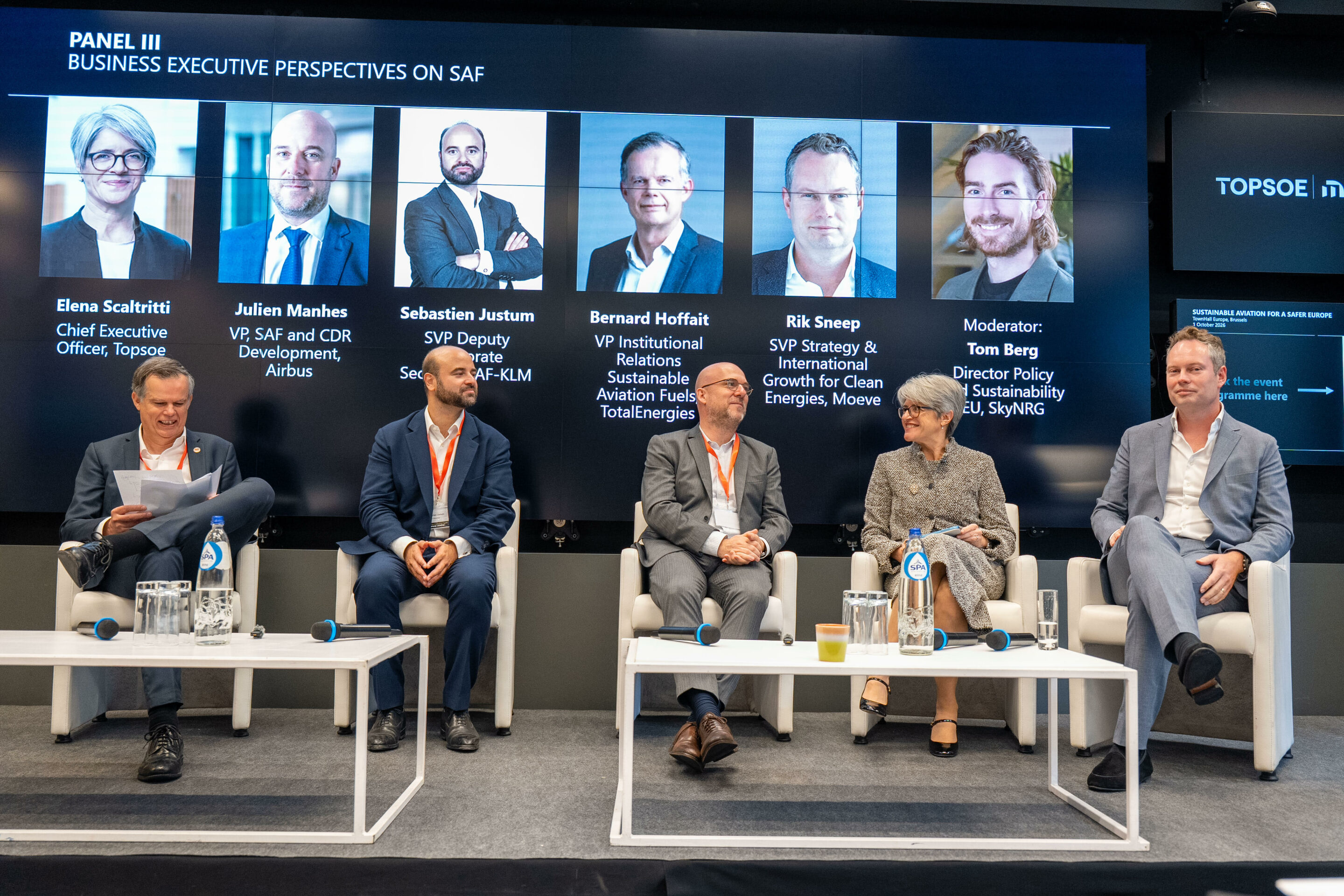
The cost of sustainable aviation fuel, the risks attached to new production projects and the need for a more coordinated European approach were among the main concerns raised by business executives in Brussels during the Sustainable Aviation Fuel for a Safer Europe conference in Brussels on 1 October.
Making sustainable aviation fuel (SAF) commercially viable will require more than technological progress. For the companies working across the sector, the challenge is also about securing feedstocks, attracting investment, sharing risks and creating enough certainty for projects that can take decades to pay off.
Those issues were at the centre of discussions at the Sustainable Aviation Fuel for a Safer Europe conference in Brussels on 1 October, where executives from Air France-KLM, Airbus, TotalEnergies, Moeve and Topsoe shared their views on the development of the SAF market.
While the discussion often focused on decarbonization, participants repeatedly returned to another theme: industrial competitiveness and resilience. Europe may have established ambitious SAF targets, but achieving them will require creating conditions that allow projects, technologies and supply chains to scale commercially.
For airlines, one of the immediate difficulties is that buying SAF is fundamentally different from purchasing conventional jet fuel. Sébastien Justum, Deputy Corporate Secretary at Air France-KLM, said fuel has historically been treated as a relatively transparent commodity market, with procurement decisions often taken within a one- or two-year horizon. SAF, however, requires airlines to think more like investors.
Air France-KLM considers three main criteria before committing to SAF procurement. The first is operational constraints: in the absence of a fully functional book-and-claim system, Justum said the airline needs to procure SAF “as close as feasible” to its main hubs in Paris and Amsterdam. The second is compliance and certification, while the third is affordability.
That last consideration is particularly important for an industry operating on narrow margins. Unlike in a conventional commodity market, Justum said airlines have to be particularly careful about their long-term financial exposure when entering SAF agreements. “We need to find a sweet spot between being still able to be credible in our
decarbonization path and, at the same time, to keep our CFO teams and investors happy with the financial exposure,” he said.That balancing act is one reason Air France-KLM now carries out extensive due diligence before committing to SAF projects. Justum also argued that policy measures and market mechanisms will also be needed to help create conditions for investments across the value chain.
Who pays for the SAF premium?
The scale of that financial exposure becomes clearer when looking at the difference between conventional jet fuel and the SAF price premium.
Justum said Air France-KLM is already paying two to three times more for some SAF, while early e-SAF contracts can reach eight to ten times the price of conventional fuel.
Airlines can absorb part of that additional cost, he said, and ultimately some of it could be passed on to business and leisure customers. But there are limits to how much European carriers can charge without affecting their competitiveness.
Passengers travelling from Europe can choose alternative routes through non-European hubs. That makes it difficult for European airlines to transfer the entire additional cost to customers while remaining competitive.
The issue is therefore not only how much SAF costs, but how that cost is distributed between producers, airlines and customers.
For Rik Sneep, SVP Strategy & International Growth for Clean Energies at Moeve, the bigger question is how and where production can be scaled up.
In the case of HEFA, Sneep said the technology itself is not the main obstacle. Feedstock availability and competitiveness are more pressing concerns. Used cooking oil illustrates the complexity of the supply chain, he said, with material passing through several stages of collection, aggregation and certification before reaching a compliant facility. “The asset needs to be fundamentally competitive in its operations and efficiency,” Sneep said. Commercial arrangements can be adjusted, but they cannot compensate for a project that is fundamentally uncompetitive.
Sneep also highlighted that the industry’s 2030 ambitions for e-SAF is achievable but highly challenging.
Bridging the investment gap
Julien Manhes of Airbus pointed to the fact that one of the industry’s biggest challenges is connecting long-term supply investments with a customer base accustomed to short-term purchasing decisions. Airlines are accustomed to buying fuel on a market where prices fluctuate, while SAF production requires long-term investment.
The comparison with aircraft financing has its limits, he argued. “Fuel doesn't have a residual value. And fuel is quoted as a spot price,” Manhes said during the panel. Committing to a ten-year SAF offtake agreement is therefore a significant financial decision. For projects requiring billions in investment, Manhes said mechanisms such as contracts for difference and other forms of revenue certainty could help bridge that gap.
Those mechanisms, he argued, need to be designed by the public sector to provide enough certainty for private investment to follow.
The question of risk runs through the entire SAF value chain. Sneep argued that risks should not simply be divided equally between all the companies involved. Instead, they should be carried by the actors best able to hedge, diversify or control them. “You need to look at the risk and say: who is best placed to take that risk?” he said, arguing that putting risk in the hands of an actor unable to control it ultimately makes projects more expensive.
Fuel suppliers may have significant balance sheets, but producing SAF still creates significant challenges.
As an example, Sneep explained that producing one tanker of SAF could require the blending with roughtly 19 tankers of conventional jet fuel creating additional working-capital requirements that smaller developers may struggle to finance.
Europe needs a competitive market
For Bernard Hoffait, Vice President of Institutional Relations for Sustainable Aviation Fuels at TotalEnergies, the conditions in which European companies operate are equally important. “If we don't have level playing field, forget about producing in Europe,” he said.
For Hoffait, companies can manage many of the risks involved in developing projects, from financing to construction and operation, but investment decisions still depend on confidence in the technology, location and ability to scale. “You need to convince your management that the technology you’re selecting is the right one, that the location is the right one, that the scale-up will be right,” he said.
TotalEnergies is already transforming existing infrastructure as part of its approach.
Hoffait said the company is converting a second refinery into a bio-refinery, describing the process as complex but necessary to make the platform viable for the future.
For technology providers, the conversation has evolved beyond whether SAF technologies work.
Elena Scaltritti, CEO of Topsoe, said the company has seen a dramatic shift in the structure of the market. Rather than working primarily with a limited number of established customers to dealing with a much larger number of project developers looking to deploy its technologies.
That evolution has changed how projects are assessed. According to Scaltritti, Topsoe looks at the economics, financing structures, available feedstocks, the location, the developer’s ability to work across the value chain and the regulatory environment.
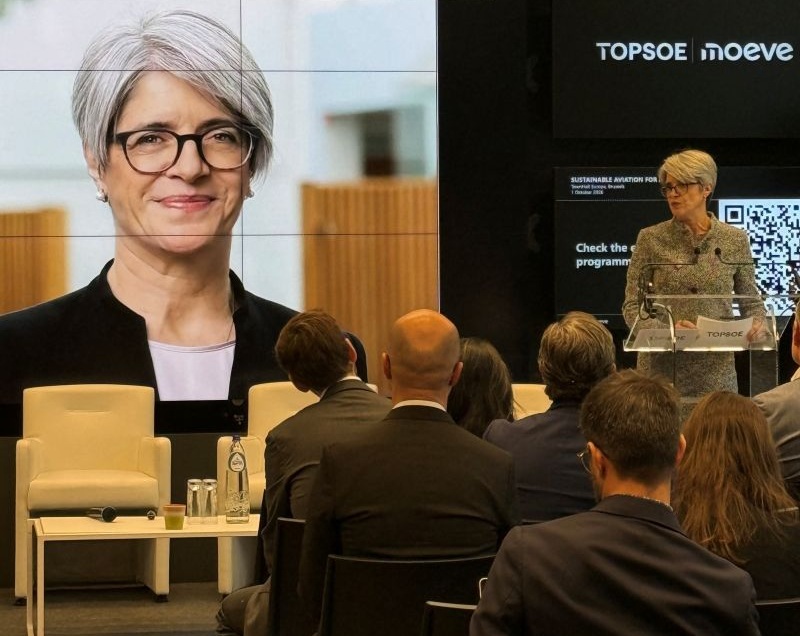
Elena Scaltritti, CEO of Topsoe
Flexibility is also important, and projects capable of switching between different feedstocks or outputs can offer greater flexibility as market conditions change. "The question is not only whether the technology works. The question is whether the project itself can succeed," she indicated during the discussion.
The level of technological maturity matters too. Scaltritti noted that HEFA projects benefit from decades of operational experience, allowing companies such as Topsoe to provide extensive performance, design and catalyst guarantees. Topsoe technologies, she noted, currently support roughly one-third of global HEFA production.
But e-SAF remains at an earlier stage. Sneep similarly distinguishes between the risks facing different SAF technologies. For HEFA, the main concern is securing feedstock, while e-SAF projects face greater risks linked to technology and electricity prices. “The technology scale-up risk and the power price are still a concern,” he said of e-SAF, while stressing that Moeve continues to invest in the technology.
These differences, speakers argued, suggest that policymakers may need to adopt different approaches to supporting the two pathways.
A European question with global implications
The executives also stressed that Europe cannot consider SAF only as a domestic market. Justum called for producers, developers, airlines and policy makers to identify a common European agenda around the regulatory and commercial issues affecting the sector. “We are all in the same boat,” he said, arguing that the different parts of the value chain should concentrate on a limited number of regulatory and commercial priorities rather than working against each other.
For Airbus, Europe’s ability to turn its ambitions into actual industrial projects will also matter. “The world is watching us,” Manhes said. He called for the development of first-of-a-kind plants in Europe for key technologies as a way of turning Europe’s ambitions into concrete projects, while arguing that different ways of reaching those ambitions may need to be considered.
Hoffait also warned that Europe cannot build the market entirely on its own. He also argued that demand needs to develop outside Europe if SAF is to reach significant scale at an affordable price.
Scaltritti summed up her priority simply: “It needs pragmatism, it needs alignment, it needs conviction,” she said.
Sneep, meanwhile, warned against waiting for complete certainty before moving forward. “There’s a massive opportunity for Europe, and for the world,” he said. Rather than asking others to eliminate every risk before acting, he argued, companies should ask a different question: “What would it take to make this happen together?”
Ultimately, the discussion revealed broad agreement on the destination but continued debate about how to get there. The technologies exist, regulatory targets are in place, and demand is beginning to emerge. What remains unresolved is how to finance and scale projects fast enough to create a competitive European SAF industry.
