

European Commission President Ursula von der Leyen recently shared images on Instagram telling the story of one of her hens and chicks.
They were intimate, ordinary images, offering a glimpse of life beyond the office of Europe’s powerful political leader: a hen scratching in the garden, pecking at the ground, exploring her surroundings and caring for her young.
For many, there is something deeply soothing watching a hen behave this way. For those of us who have spent years advocating for farmed animals, the images raise another question: what about the millions of hens we don’t see?
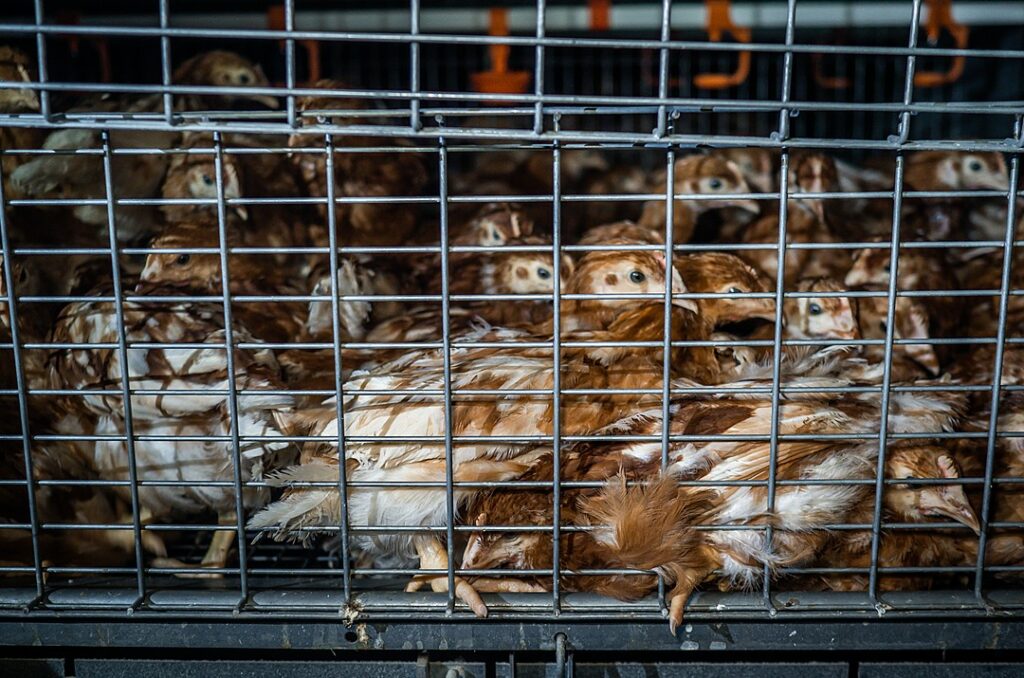
Across Europe, around 143 million laying hens, more than one in three, are still kept in cages, according to the European Commission’s own figures. The industry calls them “enriched cages”, a phrase that obscures the reality. A hen in one of these cages has a minimum legal space of 750 square centimeters, only slightly larger than a sheet of A4 paper.
Within that space, she spends her short life laying eggs. Walking, exploring, foraging, dust-bathing, perching and other natural behaviors are severely restricted.
This is the reality that is rarely seen. The vast majority of hens in industrial egg production are treated as egg-laying machines. They will never raise their chicks or experience the ordinary social life of a mother hen caring for her young, because commercial egg production separates hens and their offspring.
The hen in the President's garden, tending to her chicks, reminds us of what has been taken from the lives of millions of other hens. Those hens though have not lost their instincts because they live behind the walls of an industrial farm. They are the same sentient animals, with the same behavioural needs and capacity to experience the world.
In 2023, the European Food Safety Authority assessed the welfare of laying hens and identified significant welfare consequences associated with current housing systems, including restricted movement and the inability to perform important behaviours. EFSA recommended that laying hens should be kept in cage-free systems.
It is interesting and cynical at the same time how we choose to see the same animal very differently. When we see a hen in a garden, we see the individual animal, a living creature with preferences, curiosity, social relationships and a capacity to experience the world. When we see the same hen inside an industrial farm, she becomes production unit, an egg-producing machine. The hen hasn't changed though. Only our view of her has.
That is why the hens in President von der Leyen’s garden are significant because they’re ordinary animals. They remind us that the animals behind farm walls are not a different kind of hen. They are simply hens we don't see.
The Commission’s unfulfilled commitment
Five years ago, Europe appeared ready to move forward and fulfill its responsibility as guardian of the Treaties which recognise animals as sentient beings. The European Citizens’ Initiative End the Cage Age gathered almost 1.4 million signatures from European citizens, supported by 170 organisations across Europe.
In June 2021, the European Commission responded positively and, under President von der Leyen’s leadership, committed to proposing legislation to phase out and ultimately prohibit cages for the animals covered by the Initiative.
This commitment was not just another political promise. It was a powerful demonstration of European democracy. Citizens organised across borders and brought their concerns directly to the EU institutions. And the Commission listened and agreed to act.
The years passed but the legislation did not arrive by the end of 2023, as expected. We are now approaching the end of 2026 and another moment of decision. The Commission is expected to propose a revision of animal-welfare rules for laying hens, with a focus on phasing out cages.
For a laying hen who may live for around 20 months before being sent to slaughter when her productivity declines, that delay has a very different meaning. Since the Commission made its commitment, several generations of hens have already lived and died under the system Europe said it intended to change. That is what political delay looks like when viewed from the perspective of an animal.
The forthcoming legislation is actually a test, not only of EU commitments to animal welfare but of whether promises made to citizens still mean something and whether citizen participation can still lead to meaningful political change. At a time when trust in institutions is fragile and civic space is under pressure; citizens need to know that their voices are heard. They need to know that citizen engagement and democratic participation can still produce meaningful change.
As the next animal welfare law is being prepared, President von der Leyen now has an opportunity to confront a simple contradiction: if we would not accept a life in a cage for the hen we can see, why should we accept it for the millions we cannot?
The opportunity is there: the delivery of a full and clear phase-out of cages for laying hens, alongside progress for other animals covered by the Commission’s commitment, without another unnecessary delay.
The upcoming legislation could become one of the defining achievements of her presidency: a moment when Europe finally begins to close the gap between the way it says it values animals and the way millions are actually treated. Ultimately, the ambition should be clear: farmed animals should not spend their lives confined by systems designed around production rather than their basic behavioural needs.
The hens in the President’s garden offer us a glimpse of what is possible. Hundreds for millions of other hens are waiting for the same chance.
