

'Humane slaughter' is a comforting term. It reassures us that animals are treated with compassion when their lives are brought to an end. But for pigs and chickens the notion of humane slaughter serves to hide a world of pain and suffering.
Slaughterhouses are places of clanging noise and disturbing smells. They reek of fear and pain. Pigs and chickens are pushed through them at great speed.
In high throughput operations over 800 pigs an hour are slaughtered. That’s 13 per minute. Large poultry slaughterhouses have throughputs of 10 000 or more chickens per hour which is over 160 each minute. At these speeds it is almost impossible to care for the welfare of individual animals.
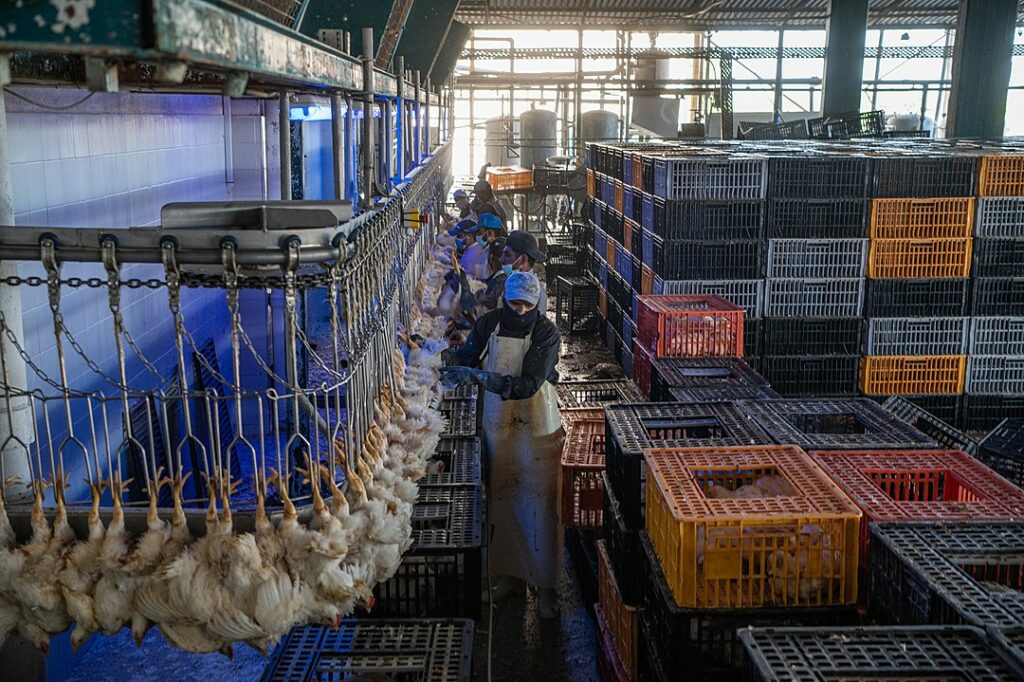
Chickens exposed to electrical water bath stunning
In the EU just over 50% of broilers are stunned in the electrical water bath system even though its inherent welfare failings have been well documented for over 20 years. Operating at great speed, workers pull the chickens out of the transport modules and thrust their legs into tight metal shackles.
This leaves the birds hanging upside down. Inversion causes pain and fear. Forcing their legs into the shackles compresses the metatarsal bones which also hurts the birds. The pain inherent in inversion and shackling is worsened for those many chickens who, due to selection for rapid growth, are suffering from leg disorders.
The shackles are on a moving line which takes the birds to an electrically-charged water bath through which their heads, necks and upper thorax are dragged. This is designed to stun them but some receive painful pre-stun electric shocks, while others are not properly stunned and remain fully conscious as the line takes them to the automatic neck cutters.
After neck-cutting the birds enter the scald tank (water at about 55°C), which is designed to loosen their feathers to ease plucking. Some chickens may still be conscious when going into the scald tank.
The suffering entailed in electrical water bath stunning has been well known since at least 2004 when the European Food Safety Authority (EFSA) published a highly critical Scientific Opinion. In this Opinion EFSA recommended that 'Since welfare is poor when the shackling line and water bath electrical stunning method is used, the method should be replaced as soon as possible'.
Over twenty years on, around three billion broilers a year are still slaughtered in the EU in this inhumane system.
The main alternative for broilers is the use of carbon dioxide (CO2) in two phases. In the first phase a maximum of 40% CO2 is used to produce unconsciousness, after which a much higher concentration of CO2 is applied to kill the birds. While this system is preferable to electrical water bath stunning, it is not without welfare problems.
Recent studies show that chickens suffer problems such as hyperventilation, breathlessness and mucosal irritation during induction to unconsciousness and can exhibit distress behaviours such as gasping, headshaking, high-pitched/shrieking vocalisations, and manic/strenuous escape attempts.
Also, broilers are at risk of remaining conscious when the CO2 concentration is increased in the 2nd phase; this is known to cause severe pain. So, this system too cannot be regarded as humane.
The least bad system for stunning broilers appears to be the use of the inert gases argon or nitrogen. Broilers do not have an aversive reaction to inhaling these gases. However, after loss of consciousness, the chickens may experience severe muscle spasms resulting in wing fractures and causing injuries to near-by birds that are still conscious.
Slaughterhouses are reluctant to use argon or nitrogen as they are more expensive than CO2 and take longer to produce unconsciousness thus lowering throughput.
Pigs exposed to high concentration of carbon dioxide
Around 67% of pigs slaughtered in the EU are stunned by being lowered into a container with high concentrations of CO2 of 80% or more. In 2023, Philip Lymbery, global CEO of Compassion in World Farming, totally dismissed gas stunning of pigs.
The European Food Safety Authority stresses: 'Exposure to CO2 at high concentrations is considered a serious welfare concern, because it is highly aversive and causes pain, fear and respiratory distress'. One can see the pigs hyperventilating and struggling to escape from the chamber containing the CO2. This method is profoundly inhumane.
Here too the problems have been widely recognised for over twenty years. In 2004 EFSA concluded that at concentrations above 30%, CO2 'is known to be aversive and cause hyperventilation and irritation of the mucous membranes that can be painful, and elicits hyperventilation and gasping before loss of consciousness'.
The Commission has recently funded the PigStun project which identified the use of argon and improved electrical stunning systems as alternative stunning methods to high CO2 concentrations as both are more humane.
Despite this, the Commission has refused to remove high concentrations of CO2 from the list in the EU Slaughter Regulation that sets out the stunning methods permitted for pigs.
The Commission argues that the Regulation already permits the use of the more humane alternatives identified by the PigStun consortium. But this misses the point that pig slaughterhouses are unlikely to switch to more humane alternatives as long as EU law allows them to continue to use high concentrations of CO2.
Despite the overwhelming evidence that electrical water bath stunning for chickens and the use of high concentrations of CO2 to stun pigs cause immense suffering, the Commission and the Member States refuse to phase these systems out. Perhaps consumers could now take the lead and refuse to buy chicken, pork and ham until genuinely humane slaughter practices are introduced.
