

"When I first moved to Luxembourg for work, I spent weeks looking for a room from Spain," says Salvador Reynés, co-founder of Roomie-Radar.
"Every reply was either ‘sorry, it’s already taken’ or ‘can you come and see it tomorrow?’ That’s when I realised how fast the market moves, and how much it matters to actually be there. I ended up taking the only room left: the one next to the kitchen, in a house with twelve people. As you can imagine, I didn’t stay very long."
Brussels is no different. Every year, thousands of students, EU trainees and young professionals arrive needing somewhere to live, and housing in Brussels moves fast. Finding a room you can trust, at a fair price, is harder than it should be.
"We knew the rooms were out there," says Javier Geisseler, who co-founded Roomie-Radar with Salvador. "The hard part was knowing which listings were real, and dealing with the landlord directly instead of paying an agency a cut."
These are the main reasons the two friends founded Roomie-Radar. It lists verified rooms and shared flats across Belgium and Luxembourg for expats and students. Anyone comparing options directly can browse Roomie-Radar's verified rooms in Belgium.
Here's the advice the Roomie-Radar team gives friends who are about to start looking.
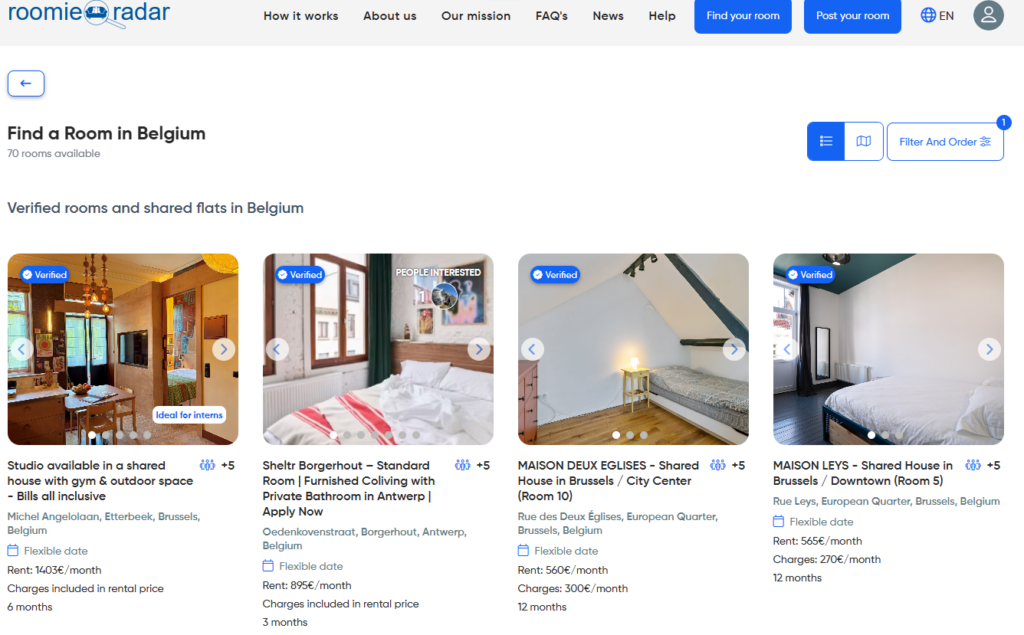
Click the graphic about to visit their website
Start earlier than you think
Finding cheap rooms in Brussels comes down to timing as much as budget. The market has two rush periods: July to August, as students and EU trainees arrive for the September intake, and January to February, ahead of the spring semester and March traineeships.
In those weeks, a good room in Ixelles or Saint-Gilles can be gone within a day or two.
Start six to eight weeks before you arrive if you can. Do viewings by video, and have your documents ready: ID, work contract, payslips, and a university or traineeship letter. If you can, spend a few days in Brussels before moving: landlords tend to choose people who can visit in person, a lesson Salvador learned in Luxembourg.
 What you'll pay
It depends a lot on the area. Based on the rooms listed on Roomie-Radar, a furnished room in a shared flat in Ixelles, Etterbeek, or around the European Quarter usually costs between €650 and €900 a month. Saint-Gilles, Schaerbeek and Anderlecht tend to be cheaper.
Coliving costs more, but you get more for it: a room with all bills, Wi-Fi and cleaning included, often with a gym, coworking space or terrace, and events that help when you don't know anyone yet. Many coliving operators also offer short leases of three to six months, which helps if you want time to get to know the city before committing.
Wherever you look, check what's included in the rent. Heating, electricity and internet can add up quickly if they're billed separately.
Much of this demand is student housing, so expect ads to mix languages: a kot (the Belgian word for a student room), a colocation (French for flatshare), a studentenkamer or koten in Dutch, or a chambre à louer. It's not just Brussels either: Namur, Ghent, Antwerp, Leuven and Liège all have their own student housing markets.

Javier Geisseler and Salvador Reynés, co-founders of Roomie-Radar
Six red flags
Most scams look alike. Be careful if:
- Someone asks you to pay before you've seen the room, either in person or on a live video call.
- You’re asked for a "reservation fee", often around €100-200, to hold the room before you’ve visited or signed anything. We’ve seen this one again and again in Luxembourg.
- The landlord is "abroad" and will post you the keys once you’ve paid.
- The price is much lower than similar rooms nearby.
- They won't do a video call, or dodge simple questions about the flat.
- They want a copy of your passport or your bank details before anything is agreed.
A real landlord won't mind waiting until you've seen the room. Don't send money to someone you haven't met or can't verify.
Before you sign
- Read the lease, and check the length fits your plans.
- Ask how the deposit will be held. In Brussels, you have the option of placing it in a blocked bank account in your own name, rather than handing it over in cash to the landlord.
- Ask for a detailed check-in inventory (état des lieux) with photos. It saves arguments when you move out.
- Make sure you'll be able to register your address at the commune for your residence paperwork; without it, you can't get your residence card, and opening a bank account gets harder.
- Get the rent, charges, notice period and house rules in writing.
Where Roomie-Radar comes in
Javier and Salvador started Roomie-Radar to make expat housing in Brussels and Luxembourg easier for students, trainees and young professionals. Rooms are listed by landlords, agencies and coliving operators, and the team reviews both listings and applications. Verified rooms carry a badge, and tenants build a profile before applying, so landlords know who they're dealing with.
For tenants, Roomie-Radar is free: no agency fees, no subscription. Filter by budget, area, and length of stay, then apply online. Once accepted, you'll get the landlord's contact details by email, and the team recommends reaching out straight away, since popular rooms draw plenty of applications.
"People moving here should be thinking about their new job or their studies, not whether a listing is real," says Salvador. "That’s what we’re trying to fix."
You can see the rooms currently available in Brussels at roomie-radar.com.
Javier Geisseler and Salvador Reynés are the co-founders of Roomie-Radar, a platform for verified rooms and shared flats for students, trainees and young professionals in Luxembourg and Belgium.
