

More than three decades of national referendums on European integration have provided the EU and pro-European political leaders with valuable lessons about political communication.
Yet the same weaknesses keep coming back, like a serious disease whose symptoms are repeatedly treated while its underlying causes remain unaddressed. Iceland's recent 'No' vote is the latest example of a much older problem.
From Denmark's rejection of the Maastricht Treaty in 1992 to the defeat of the European Constitution in France and the Netherlands in 2005, Ireland's rejection of the Lisbon Treaty in 2008, Brexit in 2016 and now Iceland, pro-European campaigns have repeatedly struggled to translate complex arguments about European integration into persuasive political messages.
These referendums took place in different countries, under different political circumstances, and concerned different questions. Their outcomes cannot be attributed to communication failures alone. Nevertheless, they reveal strikingly similar weaknesses in how pro-European political leaders (mis)communicate, fail to address citizens' concerns and fail to build large enough public support.
At a time when enlargement has returned to the European political agenda, these lessons are particularly relevant. If the EU is preparing for another phase of enlargement and political integration, have its institutions and political leaders learned how to bring citizens on board?
A familiar pattern: the 'Yes' camp starts too late
Despite their different political contexts, these campaigns have one important feature in common: pro-European leaders often enter the debate at a disadvantage of their own making.
They offer abstract arguments and struggle to formulate messages that do not sound elitist. They focus on institutional procedures that few people understand, while their Eurosceptic opponents speak in plain language and use short, emotionally powerful messages about sovereignty, identity, national control and issues people genuinely care about.
Pro-European national leaders have also contributed to the problem by allowing the EU to become a scapegoat, a tactic usually associated with Eurosceptic parties and movements. They have too often failed to acknowledge the EU's role in successful initiatives and achievements, while allowing Brussels to be associated primarily with unpopular decisions.
The EU's reputation cannot be rebuilt overnight, and years of negative narratives cannot suddenly be reversed during a short pre-referendum campaign. By the time the campaign begins, the 'Yes' camp must defend an abstract political project from scratch, while the 'No' camp can draw on narratives that have already taken root.
Putting complex questions on European integration to a referendum is a bold but risky political choice, particularly when sufficient public knowledge and debate have not been built beforehand. Citizens cannot be expected to master the technical details of European integration during a short campaign, nor should they have to. Political leaders must explain how the choice relates to their everyday lives and their country's future.
Whether referendums are the right way to decide such complex matters, when they are not constitutionally required, is itself debatable and deserves a separate discussion. However, once political leaders choose to put these matters directly to citizens, they have a responsibility to ensure that voters have the knowledge needed to make an informed decision.
France and the Netherlands: when voters answered a different question
The defeat of the European Constitution in France and the Netherlands in 2005 illustrates how a referendum on European integration can become a vote on wider national concerns.
The debate became dominated by immigration, sovereignty, identity, economic insecurity and enlargement, with many voters using the referendum to express dissatisfaction with their national governments rather than to judge the Constitution itself.
In France, the referendum became closely tangled with domestic political dissatisfaction. Many citizens treated it as a 'sanction vote', making it difficult to separate their judgment of the Constitution from their opinions about the government.
In the Netherlands, concerns about national influence and identity overshadowed the provisions of the Constitution. The pro-European political elite failed to translate the complex institutional text into a persuasive case that resonated with Dutch citizens.
These results demonstrated that when political leaders fail to define what a referendum is really about, other fears, grievances and preoccupations can define it for them.
Why simple messages defeat complex arguments
In Ireland, the 'No' campaign connected the Lisbon Treaty with threats to taxation, workers' rights, neutrality, public services and national identity.
When the vote was held again in 2009, a better organised and more convincing 'Yes' campaign helped secure a different result. The Treaty had not become simpler, but the political communication had changed for the better.
Brexit again demonstrated the power of a short and emotionally charged message. 'Take back control' captured concerns about sovereignty, borders and national identity in three memorable words.
The 'Remain' campaign focused on the economic risks of leaving, including lower growth, job losses, reduced investment and damage to trade. However, it struggled to explain in an equally memorable and positive way the benefits of the United Kingdom remaining in the EU.
The lesson is not that complex political questions should be reduced to simplistic slogans. It is that facts and economic arguments, however important, cannot substitute for a clear, convincing political narrative that people can understand and relate to.
Iceland: the latest communication test
The referendum in Iceland offered another opportunity to assess whether the EU and pro-European national leaders had learned from previous experience.
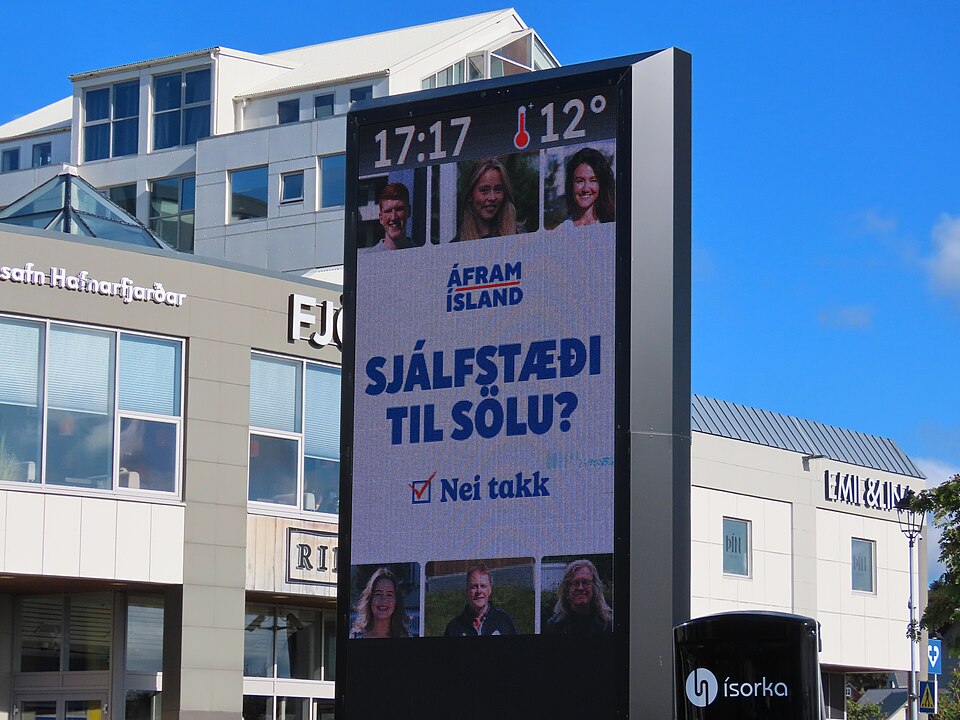
Icelanders rejected reopening accession negotiations, demonstrating that the pro-European campaign had not convinced a majority that taking even the first step towards possible EU membership was in their country's interest.
The 'No' campaign told an emotional story: Iceland must protect its fishing waters, natural resources and independence. Its message was connected with the country's history and identity.
The 'Yes' campaign framed its message around 'Yes to see', reflecting its argument that a 'Yes' vote would reopen accession negotiations and allow Icelanders to see what terms could be secured.
While this captured the procedural purpose of the referendum, it did not provide an equally persuasive political narrative. Icelanders were asked to support a negotiation process whose outcome was uncertain, while their opponents offered the simpler promise of retaining national control.
Iceland's situation is, of course, different from that of many other countries considering EU membership. Through the European Economic Area, it already enjoys significant benefits of European integration. For many Icelanders, the existing relationship may appear preferable to the uncertainties of accession.
Precisely for that reason, the 'Yes' camp needed to make a stronger case for what additional benefits membership could offer and why reopening negotiations was worth considering.
Information is not communication
Icelanders needed to know that opening negotiations would not amount to joining the EU and that they would have the opportunity to vote again on any final agreement.
But explaining the procedure was only part of the challenge. The pro-European case also needed to address concerns about fishing, natural resources and sovereignty, while showing what Iceland could gain.
Through the European Economic Area, Iceland already implements many EU rules without having representatives in the European Parliament, a vote in the Council or a Commissioner.
The 'Yes' campaign missed an opportunity to use this contrast to present sovereignty not only as the ability to preserve national control, but also as the capacity to have a seat at the table, shape the European rules that Iceland already implements and defend the country's national interests from within the decision-making process.
This illustrates a fundamental distinction between information and political communication. Providing facts and explaining procedures may help citizens understand a choice, but winning their support requires something more: a compelling argument about why that choice matters.
As Bono put it back in 2018, 'Europe is a thought that needs to become a feeling.'
The lessons for the EU's next enlargement
Iceland's experience should also serve as a warning for the EU's future enlargement.
Accession is too often presented bureaucratically, through negotiating chapters, technicalities and EU jargon, from an institutional ivory tower that speaks little, if at all, to most citizens.
None of this answers the most important political question: why should people want their country to join the EU?
Technical progress in accession negotiations does not necessarily translate into public support. Governments in candidate countries must prepare their citizens for the responsibilities and opportunities of EU membership, rather than assuming that the fulfilment of accession criteria will be enough to convince them.
And the challenge does not concern candidate countries alone.
European institutions and political leaders in the current member states must also explain why enlargement is in their own citizens' interest and how it can make Europe more secure, influential and resilient.
Enlargement needs a political narrative that connects with people's lives and addresses concerns about security, prosperity, identity, sovereignty and Europe's future. It cannot be presented merely as an institutional process or a succession of negotiating chapters.
Above all, European and national political leaders must recognise that public support for European integration cannot be taken for granted or built in the few weeks preceding a referendum. It requires continuous political engagement, active listening and the willingness to address difficult questions long before citizens are asked to cast their votes.
From Maastricht to Iceland, the warnings have been remarkably consistent. More than three decades of experience should be enough to recognise the underlying problem and finally do something about it.
The question now is: will the EU finally learn these political communication lessons, or will it once again hit the snooze button and sleepwalk towards its next crisis of public support?
