
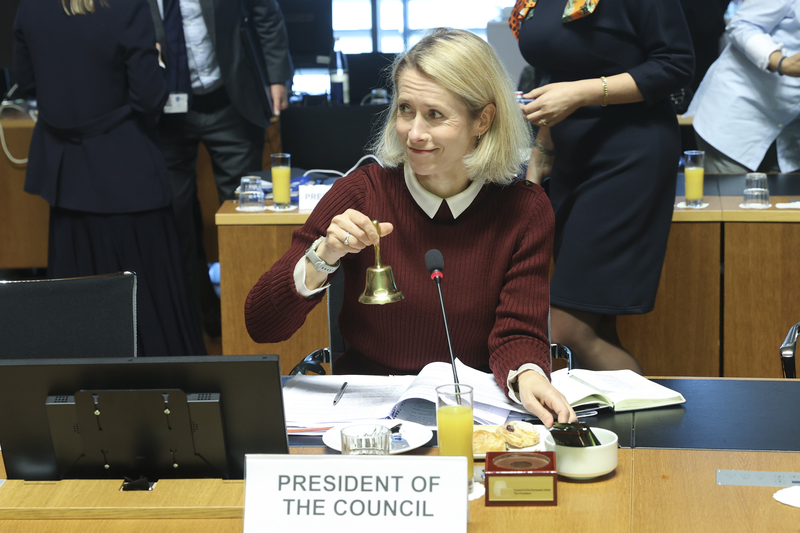
Russia’s war of aggression against Ukraine and the situation in the Middle East dominated the foreign affairs council meeting on Monday with the discussions and most important decisions focused on the war in Ukraine.
“There was support today among ministers for truce on striking energy infrastructure between Ukraine and Russia, provided Moscow adheres to it,” commented Kaja Kallas, High Representative for Foreign Affairs and Security Policy, in her press remarks after the meeting. "But ceasefire cannot work if only one party honours it."
In the past week alone, Russian strikes killed more than 150 Ukrainian civilians. Russia struck Kyiv's bridges, Black Sea grain ships, hit power stations, and bombed Kyiv's National Academy of Sciences. “These are not the actions of a country seeking peace.”
There was a clear understanding that now is not the time to ease pressure on Moscow, she added. The council adopted the largest-ever package of listings targeting almost 1600 individuals and entities in Russia’s military-industrial complex, and 77 additional listings against those involved in the illegal so-called 'elections' for the Russian State Duma, in the occupied territories of Ukraine.
The agreed listings include 826 Russian companies and 743 individuals serving as CEOs of these companies. They specifically target mid-level suppliers that represent the “core” of the Russian military industry, generating an annual turnover of at least €20 billion and employing more than 250 000 people.
The listed companies are suppliers of key components to some of Russia’s most advanced weapons systems including missiles, UAVs and aircrafts. They include electronics, including semiconductors, microcircuits and computers; communication equipment including radars, antennas and transceivers; aviation, satellite and missile systems; explosives and ammunition and optics and navigation systems.
More than half of the listings target the production chain for ballistic missiles. “We are making it significantly harder, slower, and more expensive for Russia to produce weapons it uses to kill Ukrainians.”
The pressure on Russia will also be maintained through more sanctions — including through the upcoming 22nd package of restrictive measures, sanctions enforcement, actions against the shadow fleet, the attribution of and collective reaction to hybrid attacks, and better intelligence sharing. “Pressure on Moscow, not concessions, is the fastest way to end the war.”
“This is the single largest expansion of our sanctions list since Russia's war started,” Kallas explained. “Europe has shown a united front today. Of course, it is complementing already the sanctions packages we have done, and it does not really substitute the work that we need to do with the 22nd sanctions package, and the work is continuing.”
According to Kallas, the sanctions have deprived Russia of around 1 trillion euros – double the figure attributed to the French foreign minister. Kallas said that that her number was based on the intelligence services account and that she did not know exactly how it was calculated. “We will definitely share this information with other Member States that the numbers are all correct.”
The High Representative also welcomed Ukraine’s decision to pass the necessary laws that will allow for opening negotiations on two additional enlargement clusters. On the following day, the accession conference with Ukraine decided to open negotiations on clusters 2 - internal market and 3 – competitiveness and inclusive growth.
Uncertainty in the Middle East
As regards the Middle East, the discussion focused on the latest developments in Iran and the Gulf region, notably the issue of freedom of navigation in the Red Sea and the Strait of Hormuz, following the recent strikes by the Houthis in Yemen against airports in Saudi Arabia. The situation in Lebanon and the Israeli-Palestinian conflict was also discussed.
“The Houthi attacks on Riyadh Airport were appalling acts of terror. There can be no justification for indiscriminate attacks on civilian infrastructure,” Kallas said. She did not elaborate if and how the EU could support Saudi Arabia against Houties’ missile strikes.
Several ministers welcomed the EU-led “no fees/no tolls” pledge to protect international shipping lanes and oppose unlawful, unilateral fees, tolls, or restrictions that hinder freedom of navigation. The pledged is currently supported by all EU Member States and 33 countries from around the world.
The foreign ministers underlined the need to restore freedom of navigation in accordance with international law, including through the EU’s maritime security operations, notably EUNAVFOR ASPIDES, and discussed the need to strengthen its capabilities.
“In the Red Sea, escort operations by Operation ASPIDES are becoming even more crucial given the Houthis' dangerous escalation,” Kallas explained. “I welcome the additional ships recently offered by the Member States. “We need at least 10 ships, and we are not there.”
The ministers also discussed relations with the Palestinian Authority and Israel in the context of the upcoming elections there. Just before the foreign affairs council meeting, Mahmoud Abbas, the President of the Palestinian authority, announced that the Palestinian legislative elections have been postponed to September next year.
The legislative election, the first since 2006 when Hamas took power, had been scheduled to take place next month with the support of an EU election observation mission. Abbas, who feared that his party would lose in the elections, blamed obstacles posed by Israel, such as movement restrictions in the West Bank and uncertainty if they would be allowed in East Jerusalem.
Abbas was elected to president in 2005 for a four-years period and has ruled by decree since 2009. Judging by the results in the local elections in April this year in the Palestinian territories, including the Gaza Strip, Hamas has lost its support since 7 October and candidates aligned with Abbas’ party Fatah won a majority of the contested seats.
The council regretted the postponement of the Palestinian legislative elections. After 20 years without the legislative vote, Palestinian institutions need renewed legitimacy. Some EU Member States, including Belgium, have conditioned their recognition of Palestine and full diplomatic relations on the holding of democratic elections.
The only elections that will take place are the Israeli parliamentary elections on 27 October. Israel has backslided to authoritarian rule and illiberal democracy during Netanyahu’s far-right government but the elections can still result in change in government and an end to its ‘forever’ wars. Crucial for the outcome will be voter turnout and if some minor parties will fall below the vote threshold of 3.25 %.
The opinion polls indicate that neither the current coalition government nor the opposition bloc will gain a majority of at least 61 seats in the 120-seat parliament (Knesset). The opposition is likely to gain more votes and could form a minority government and govern with the support of the Arab parties but there is still the risk of a ‘fake’ national unity government which includes Netanyahu.
On Lebanon, the council reiterated the EU’s support for the country’s sovereignty and territorial integrity. It welcomed the establishment of the EU support mission in Lebanon (EUSM Lebanon) following an invitation from the Lebanese authorities.
“It will advise and assist the Lebanese Armed Forces and Internal Security Forces to strengthen territorial control, border security, and internal security,” Kallas explained. “Europe is invested in Lebanon's future. With this new mission, we continue to support the country’s institutions in restoring full sovereignty and building lasting stability for the Lebanese people.”
The mission will have a military pillar and a civilian pillar, operating under a unified political mandate while carrying out complementary tasks in their respective areas of competence. However, it will take some time until the mission will be deployed by the end of this year. The Council will adopt a separate decision launching EUSM Lebanon once operational planning has been completed.
