
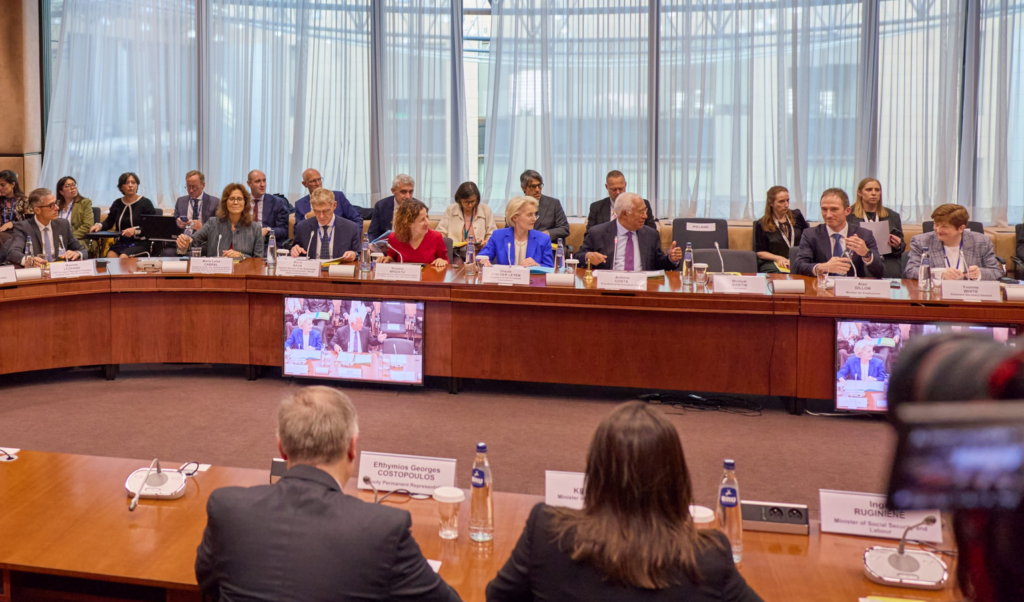
EU leaders and representatives of employers and trade unions met in Brussels on Wednesday for the EU’s Tripartite Social Summit, with talks centred on competitiveness, jobs and the bloc’s next long-term budget.
The summit is held twice a year and brings together leaders of EU institutions and European-level social partner organisations for dialogue, the Council of the EU announced in a statement.
Discussions focused on “Driving Europe Forward”, including plans for a new Multiannual Financial Framework (MFF) — the EU’s long-term budget — and a Single Market “which delivers for workers and enterprises.”
European Council President António Costa said “completing the single market” was part of the “One Europe, One Market” agenda and described the role of social partners as “vital” in ensuring economic progress translates into benefits for workers and businesses.
European Commission President Ursula von der Leyen pointed out that priorities included “affordable energy”, a strong Single Market that protects workers’ rights, “quality jobs fit for the future”, and a long-term EU budget, adding that dialogue with social partners was “essential”.
Budget talks and calls for regulation changes
Ireland’s Taoiseach Micheál Martin, speaking on behalf of the rotating presidency of the Council of the EU, said work was being advanced on the “One Europe, One Market” roadmap, described as a set of actions agreed by EU institutions to make Europe more competitive and economically resilient.
Martin stated that Ireland had put forward a compromise proposal on the future MFF and would work with partners to secure agreement in negotiations by the end of the year.
BusinessEurope President Maciej Witucki said regulation was “weighing too heavy on enterprises and authorities” and called on EU leaders to “simplify regulation”, deepen the Single Market and preserve spending he said enhances competitiveness, including investment in skills and infrastructure, in the next long-term budget.
Esther Lynch, general secretary of the European Trade Union Confederation (ETUC), said workers were facing wages that did not keep up with housing, energy and food costs, and criticised what she said was a direction of travel in MFF discussions involving “less and less” investment.
Lynch added that the ETUC rejected proposed cuts to the MFF and called for the EU to raise its own resources, including through a European digital tax, and for a “strong, separate European Social Fund with more money”, adding that public funding should come with conditions linked to job quality and collective agreements.
The Council noted that the views quoted were those of the individuals and organisations and did not represent a collective position of the Council or the European Council.
