
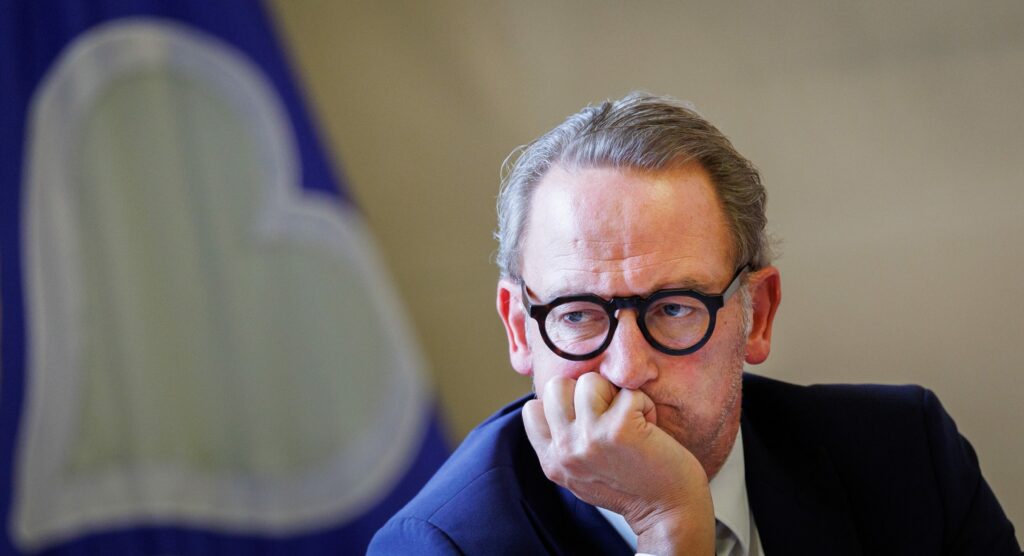
Brussels Minister-President Boris Dilliès (MR) has told university students that even a more progressive government would not reverse soaring tuition fees or unemployment reforms.
Speaking to hundreds of students at UCLouvain in Louvain-la-Neuve on Monday, Dilliès defended the reforms as paramount to safeguarding Belgium's public finances and preserving its social system.
"If a different, more progressive majority comes to power tomorrow, whether in the Fédération Wallonie-Bruxelles or at federal level, don't think for a second that anything will change," he said.
The Brussels liberal politician was invited to speak at the opening lecture of a political science course, attended mainly by first-year students.
During the session, he discussed how Belgian politics works, highlighting the negotiations, compromises, and preparations that take place behind the scenes before governments reach decisions.
Nonetheless, students quizzed him about issues affecting youth, particularly rising university tuition fees and the feeling that their concerns were being ignored.
Tuition fee hikes have ignited fierce protests in recent months and are poised to happen again in the future, if not escalate further.
"We are going through a difficult period in the Fédération Wallonie-Bruxelles", Dilliès acknowledged. "But when you come into office, and the coffers are empty, what do you do?" he asked.
Dilliès also said he was surprised some students were protesting without, in his view, fully understanding the reasons behind the demonstrations.
"In politics, the most popular person is the one who gives. But at some point, someone always has to pay. Always," he said. "There is no such thing as magic money."
Asked whether the Fédération had made poor decisions, Dilliès rejected the statment. "Nothing could be more dishonest than saying that," he replied.
"We have not paid enough attention to taxpayers' money, and at some point we have to make unpopular decisions aimed at preserving the system."
Dilliès stressed that education, from nursery school to university, remained essential, but argued that reforms were sometimes unavoidable.
"Doing nothing is worse," he said. "You cannot give away what is not yours, and you cannot give what you do not have."
