
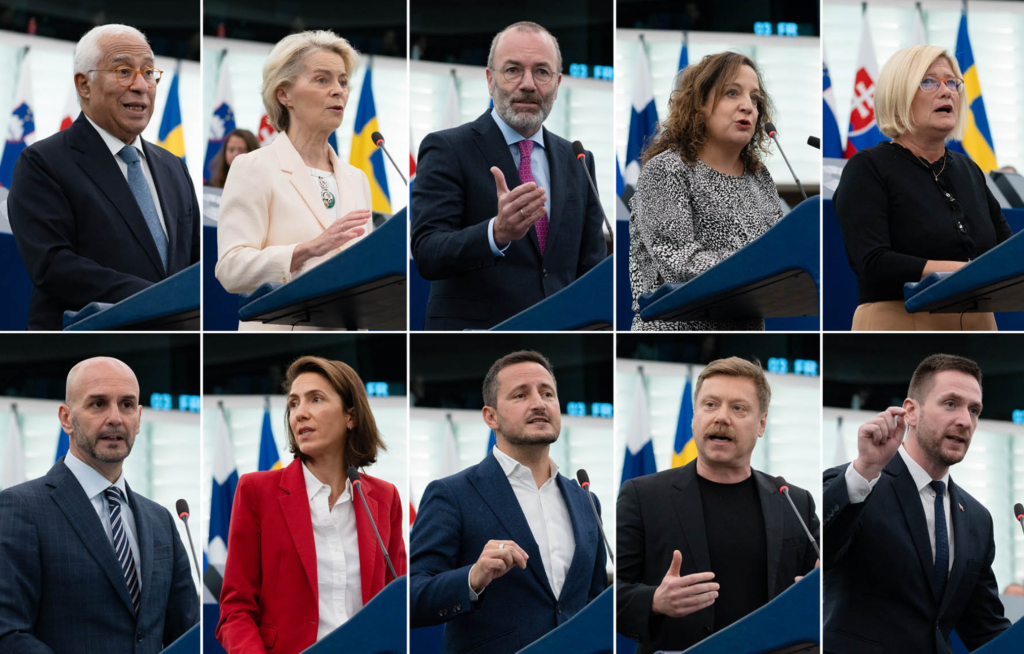
MEPs in Strasbourg debated the outcome of the October EU summit on Wednesday in a session with European Council President António Costa and European Commission President Ursula von der Leyen.
Costa told the chamber EU leaders had held a “fruitful” meeting and said Europe was “reinforcing its competitiveness” while remaining “united in defending its interests and values”, according to the Parliament’s account.
He called for steps including faster work on an “EU Inc.” business regime, lower energy costs, more affordable energy production and modernised electricity grids.
He also said talks on the EU’s next seven-year budget — the 2028-2034 multiannual financial framework, which sets spending limits across EU programmes — were in a “decisive phase”, with leaders “determined to reach an agreement by end of the year.”
Costa stated that an “ambitious budget” was needed while keeping national contributions “at a reasonable level”, and highlighted the need to make progress on an “ambitious package on own resources” — EU-level revenue sources used to fund the budget.
On Ukraine, Costa said EU support was “stronger than ever” and that the Union was providing 80% of the external assistance received by Ukraine.
He emphasised “Ukraine’s security and Europe’s security are inseparable.”
He said migration flows had decreased and that the Pact on Migration and Asylum was now being fully implemented, while calling for stronger border controls, more effective returns and greater preparedness to address the instrumentalisation of migration.
Energy, sanctions and China
Von der Leyen told MEPs it was crucial to complete the single market and referred to the EU Inc. business regime, a public procurement act and simplification efforts to reduce administrative burdens on companies, the European Parliament said.
She said rules agreed at European level should not become “more complex and fragmented” when implemented nationally.
She noted that Europe’s high energy costs were linked to reliance on foreign fossil fuels and gas, and said EU sanctions on Russia “will stay until Russia stops the war.”
Russia had cut off Europe’s gas supply and was weaponising energy, she said.
On migration, she noted that illegal border crossings had fallen by 56% over the last two years and announced a new framework intended to give member states tools to respond quickly to threats at external borders, the European Parliament said.
Von der Leyen also pointed out that Chinese companies receive up to eight times more subsidies than comparable firms in OECD countries, and said the Commission would work to reduce economic dependencies by addressing vulnerabilities, diversifying supply chains and limiting access to the single market when needed.
MEPs warned that “more cannot be done with less money” in the next long-term EU budget and called for funding to reflect challenges including the cost of living, high energy prices, jobs, support for Ukraine, and backing for farmers and regions.
