
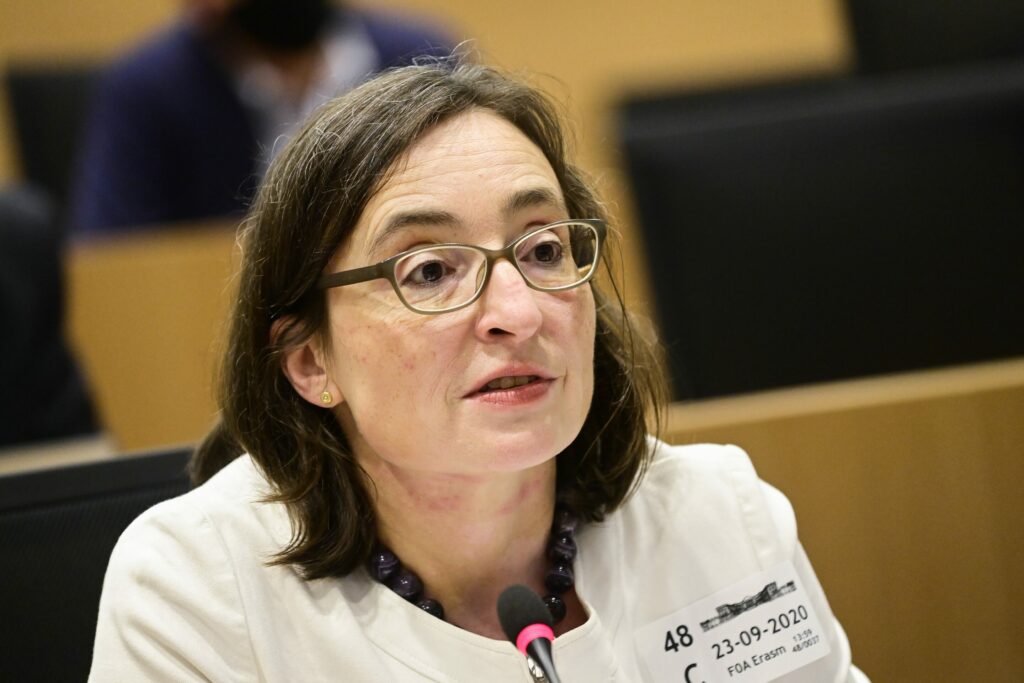
Belgium’s consul-general was forced to flee violent masked Israeli settlers while accompanying Palestinian farmers to their crops.
It was the annual olive harvest season in the occupied West Bank in the city of Taybeh. Belgium's consul-general, Anick Van Calster, was accompanying local farmers on a peaceful morning alongside other diplomats, hoping their presence would deter angry and violent Israeli settlers.
The intent was to engage in “protective presence,” Van Calster explained to VRT, an initiative to make Palestinians feel safer and possibly shield them from attacks, but that was not the case on Saturday 17 October.
Van Calster found herself fleeing seven masked men who arrived on all-terrain vehicles, armed with wooden and metal sticks. Footage shared by public broadcaster VRT NWS, which interviewed the consul-general, shows the attackers demanding IDs and intimidating the delegation to step back. Van Calster described the men as young, with their faces concealed except for their eyes.
The French mayor of Aulnoye-Aymeries was part of the delegation, and was reportedly assaulted and thrown to the ground before he could enter another vehicle. A Belgian diplomatic vehicle was damaged.
“It was a very violent morning,” she told VRT in an interview following the attack. “We are diplomats, and we do not seek confrontation,” Van Calster said.
The Belgian Foreign Ministry subsequently confirmed to The Brussels Times that the seven masked settlers were preparing to enter a Belgian diplomatic car, and also clarified that Van Calster was not personally attacked.
Though she escaped unharmed, the confrontation offered a stark illustration of the escalating violence facing Palestinian communities in the occupied territory.
Even Israeli activists were threatened
After escaping the confrontation and returning to the village, the delegation encountered Israeli activists who had also reportedly been targeted by the settlers. According to Van Calster, the activists were visibly shaken and recounted receiving death threats from their attackers.
The incident reinforced her concerns about the aggressive nature of settler violence in the West Bank. “Attacking diplomats is a new escalation,” she told VRT, warning that violence had reached unprecedented levels.
She also said that the number of incidents since the beginning of this year’s olive harvest had already exceeded the total recorded during the previous season. For Palestinian farmers, the consequences go beyond isolated confrontations.
Many families depend on the olive harvest for their livelihoods. Repeated attacks and intimidation have left some too frightened to access their own land.
Who was responsible for protecting the delegation?
According to an investigation by Israeli newspaper Haaretz, the military failed to act accordingly on repeated alerts concerning the approaching settlers. The Israeli military has reportedly launched an investigation, though it nonetheless maintains that the diplomatic visit should have been coordinated beforehand.
"Under international law, there is no obligation to coordinate," the Belgian Foreign Ministry told The Brussels Times, disputing that position.
The ministry stressed that Israel is responsible for security in Area B of the West Bank, where the attack took place, and that visitors should be able to travel safely without prior security coordination.
Foreign Minister Maxime Prévot (Les Engagés) reiterated Belgium's demand for European sanctions against those responsible for settler violence and those who support them. The EU has also condemned the attack on the diplomatic delegation.
"Our peaceful presence is intended to show how dramatic the situation there really is," Van Calster told VRT.
