
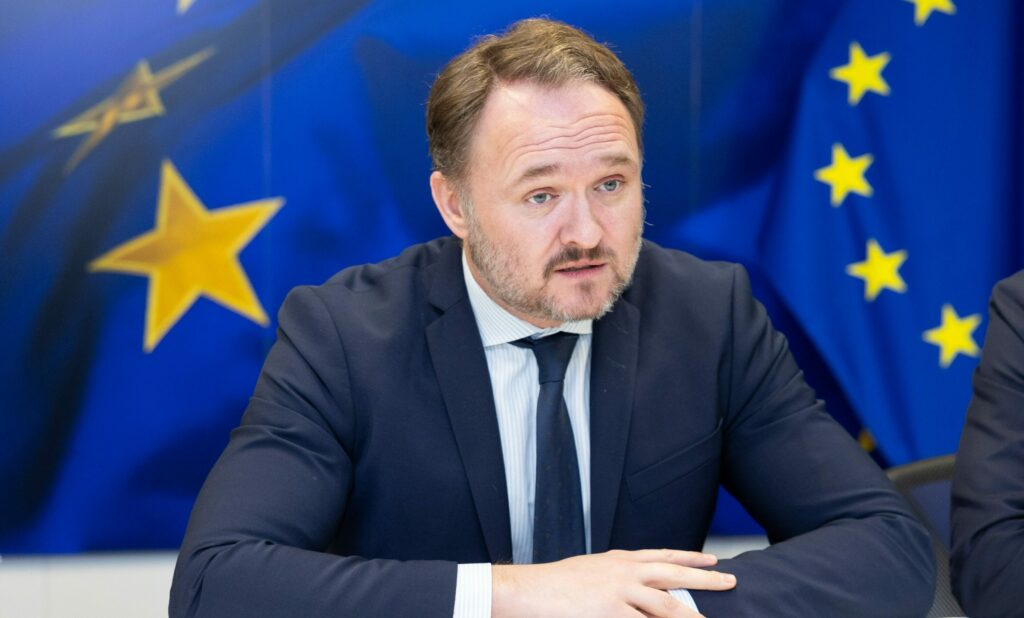
Europeans are paying twelve times more for natural gas than Americans as prices return to levels unseen since 2022. EU Energy and Housing Commissioner Dan Jørgensen warned that the situation could deteriorate further during the winter, putting households and energy-intensive industries under growing pressure.
European gas prices have climbed to their highest since December 2022, rising above €97 per megawatt-hour (MWh) on Monday on the Dutch TTF exchange, Europe's main benchmark. Before the war in the Middle East began in late February, prices stood around €32/MWh.
"It's quite a serious situation we're in, and unfortunately it will only become more serious in the coming months," Jørgensen said in a briefing to journalists in mid-October, when prices were still below Monday's peak.
"We are now paying twice as much for diesel as we did before February, and gas prices have risen by 140%. So this is certainly not something we take lightly. Add to that, there's not much to suggest it will get better over the winter," he added.
The financial toll is already substantianal. Speaking after the EU summit in Brussels on 16 October, Commission President Ursula von der Leyen said the EU had paid €106 billion more than usual for fossil fuel imports since the war began.
A price crisis, not a supply crisis
Despite rising prices, Jørgensen said Europe is not at risk of running out of gas. The EU has diversified its imports, increased its capacity to receive liquefied natural gas (LNG), and reduced gas consumption by around 17% compared with 2022. It has also lowered its gas storage filling target from 90% to 80%.
"It is not a security of supply problem yet, and we don't expect it to become one," he said. "But prices will remain high, perhaps go even higher."
But with European storage still below 75% full as the heating season begins, prices remain under pressure.
For households, the distinction between supply and affordability offers little comfort. For everyday people who can't heat their living room, Jørgensen said, "it hardly matters whether in principle there was gas they could buy if they can't afford to buy it."
Even in an average winter, around 47 million Europeans struggle to heat their homes adequately, he said, warning that this winter could be considerably worse.
Europe pays twelve times the US price
The contrast with the United States is stark. At Henry Hub, the US benchmark, wholesale prices have fallen to the equivalent of around €7.6/MWh, according to Het Nieuwsblad, leaving European prices twelve to thirteen times higher.
The gap is putting further pressure on European industry, which was already struggling to compete before the latest surge.
"We've always had higher prices than in the US, and we used to offset that with greater efficiency," Gert Verreth, spokesperson for Belgian chemicals federation Essenscia, told Het Nieuwsblad. "But now the price difference has become so great that it's impossible to bridge."
Gas prices have returned to levels last seen during the 2022 energy crisis, while electricity for delivery in 2027 is already trading above €150/MWh, more than double pre-war levels.
Short-term relief, long-term dependence
The European Commission is setting up a task force with refineries, and exploring joint purchasing of oil products. Jørgensen has also proposed delaying by one year parts of the EU's methane rules covering imported oil and gas after several member states warned that the requirements could constrain supplies.
He said national governments could offer temporary, targeted support to households and businesses. Cutting electricity taxes would be another immediate option, particularly in countries where electricity is taxed more heavily than gas.
But Jørgensen argued that emergency measures cannot solve Europe's underlying vulnerability: its dependnece on imported fossil fuels.
"We are too dependent on gas, whether it comes from the US, Nigeria, or Canada," he said. "As long as we depend on imports of gas and oil products, we will be far too vulnerable to shocks of all kinds," he added.
He said Europe must accelerate its transition towards domestically produced energy rather than retreat from it.
"We must stop importing expensive, polluting energy and instead produce our own cheaper, homegrown energy," he said.
