
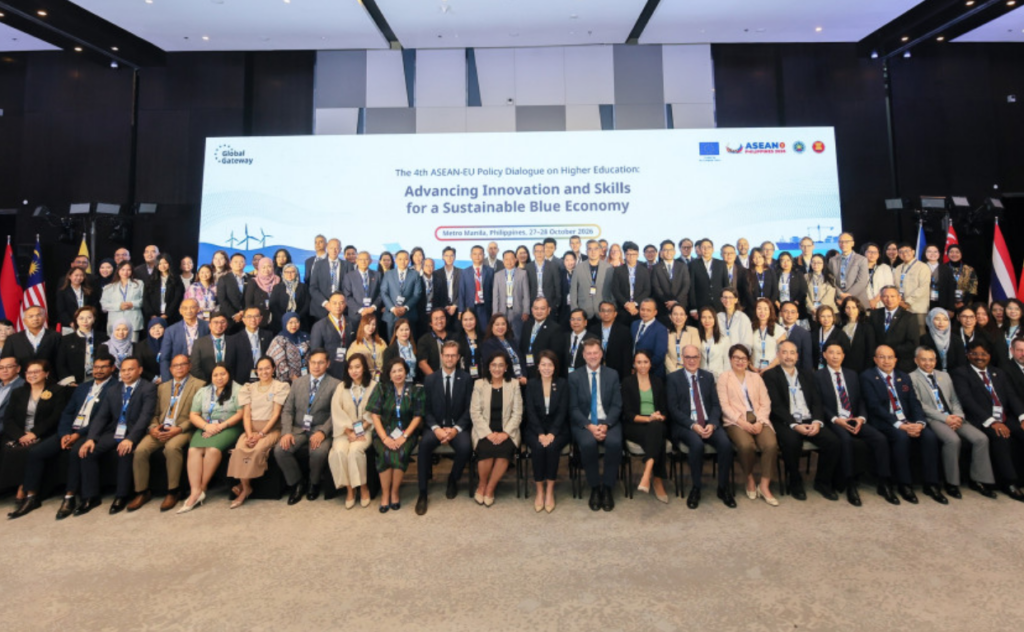
The EU and the Association of Southeast Asian Nations (ASEAN) met in Manila on Monday for a two-day policy dialogue on higher education, focusing on skills and innovation linked to a “blue economy” — economic activity connected to oceans and coasts.
The 4th EU–ASEAN Policy Dialogue on Higher Education is being held on 27–28 October and is organised under the EU-funded Sustainable Connectivity Package – Higher Education (SCOPE-HE), in collaboration with the Philippines’ Commission on Higher Education (CHED), the European External Action Service (EEAS) informed on Tuesday.
Policymakers, higher education providers, Technical and Vocational Education and Training (TVET) institutions, and industry representatives are taking part, with discussions centred on how education systems can respond to changing skills needs.
ASEAN Secretary-General Dr Kao Kim Hourn said the success of the blue economy would be reflected in oceans’ resilience, stronger communities, and young people having “real prospects”, adding that education could help connect policy with practice, research with industry, and talent with opportunity.
Skills for fisheries, transport and offshore energy
Talks include how universities and TVET programmes can support sectors linked to the blue economy, including fisheries, maritime transport, coastal tourism and offshore renewable energy, the EU Delegation to ASEAN said.
Dr Radomir Jansky, Deputy Head of the EU Mission to ASEAN, said the dialogue forms part of the EU–ASEAN Sustainable Connectivity Package – Higher Education Programme under the EU’s Global Gateway strategy, which he described as supporting “reliable, sustainable, and inclusive connections” and backing blue economy-related investment in maritime sectors, skills, research and innovation.
CHED chairperson Dr Shirley C. Agrupis said higher education and TVET systems play a central role in equipping learners with skills for sustainable development and described the meeting as a platform to strengthen cooperation and translate shared priorities into action.
Participants are expected to work on practical steps to strengthen links between education and industry, promote inclusive mobility, and expand cross-regional cooperation.
The dialogue will feed into a “Manila Policy Brief” intended to provide recommendations for policymakers and stakeholders.
