

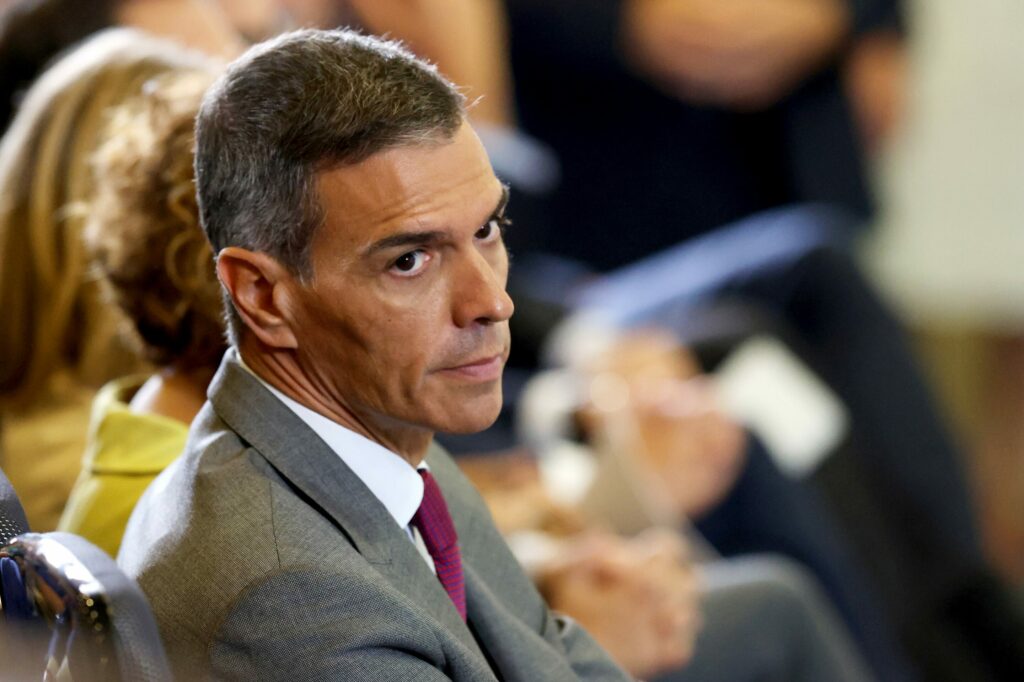
On 5 October, Pedro Sánchez called a snap election.
Three days earlier, Spain's Congress rejected two housing decrees introduced in response to widespread protests over the country's housing crisis, following opposition from the Partido Popular (PP), VOX and Junts per Catalunya (Junts), a centre-right Catalan party.
Making the housing crisis the starting point of the election campaign could work in Sánchez’s favour. If he fails, he will leave office as a leader who tried to address a problem but was blocked by political opponents, but if he succeeds, he could defy political expectations once again, overcoming political gridlock and regaining public support.
As populism and far-right parties gain ground across Europe, Sánchez’s decision has fuelled debate over the future of Spain’s political landscape, the possibility of a PP–VOX coalition and the challenges of addressing the country’s growing social inequalities.
Spain’s 'wrong patriotism'
Spain faces a range of pressing social challenges such as housing affordability, poverty and inequality, gaps in access to healthcare and youth unemployment, which remains among the highest in the EU. Yet its far right, with parties like VOX, tends to shift the focus away from these structural problems towards national identity and immigration.
Echoing the rhetoric of far-right movements across Europe and the United States, its narrative prioritises the interests of nationals over those of immigrants, promoting the idea that Spaniards should come first. This approach frames social issues around national belonging rather than the deeper inequalities affecting Spanish society.
VOX, which is led by Santiago Abascal, is gaining support nationwide. It already has partner coalitions in four of Spain’s autonomous communities, and polls predict an increase in its vote share on 29 November. However, it’s not the only far-right party, although the largest, that is gaining support in Spain.
Smaller parties such as Se Acabó la Fiesta (SALF, 'The Party Is Over'), Aliança Catalana and the newly registered Noviembre Nacional have also gained visibility in Spain's political landscape. These movements illustrate the diversity and evolution of the country’s far-right landscape: although they differ in their political approaches and conceptions of national identity, several promote exclusionary nationalism and anti-immigration rhetoric.
Aliança Catalana is a particularly interesting case because it combines Catalan independence with anti-immigration and anti-Islam positions. Noviembre Nacional, which emerged from the radical-right group Núcleo Nacional and registered as a political party in February 2026, represents a more openly extremist ideology. Beyond the immediate electoral context, with only SALF participating in the 29N election, these parties offer a broader picture of Spain’s evolving far-right landscape.
A new generation in the past
One of Spain’s biggest problems is its failure to come to terms with its past. Although Sánchez’s government passed the Democratic Memory Law in 2022—which preserves the memory of victims of the Spanish Civil War and Franco’s dictatorship through education, a register of victims and the removal of Francoist symbols—Spain remains divided on this issue.
While some autonomous communities are moving forward with these policies, others are repealing them and replacing them with legislation that downplays or relativises Franco’s dictatorship. These developments have contributed to differences in how Spain's authoritarian past is addressed across the country, amid renewed expressions of nostalgia for Franco's dictatorship.
According to Fundación SM’s Jóvenes Españoles 2026 report, a survey of more than 5,000 people aged 15–29 found that 68% expressed little or no satisfaction with the functioning of democracy and almost half believed that authoritarian rule could sometimes better maintain social peace, even at the expense of civil liberties.
Over the past five years, the proportion of young people identifying with the left or centre-left has fallen by approximately 12 percentage points, while those identifying with the centre-right or right have increased by nearly 14 percentage points. In 2025, 50 years since Franco’s death, surveys highlighted concerns about historical memory: around 17% of young Spaniards expressed a preference for authoritarian rule under certain circumstances, while around 21% of the population considered the years of Franco’s dictatorship good or very good for Spain.
Working for democracy
These insights are part of Spain’s broader political context ahead of the next general election. A potential coalition between PP and VOX could bring the far right into Spain’s central government for the first time since the country’s return to democracy following Franco’s death in 1975. Although VOX has already participated in regional governments, its entry into power in the national government would represent a significant shift in Spain’s democratic history. It has implications for public policy, democratic institutions and the country’s political direction.
At the same time, centre-left and left-wing parties enter the election facing not only public discontent over housing, but also a crisis of political cohesion. Their internal divisions and failure to agree on a common electoral strategy risk leaving voters without a credible, united alternative to the right. Liberalism remains marginal, despite Democracia 21 running for the first time, and only in Madrid and Barcelona, while the left remains fragmented.
In an increasingly polarised country, with growing far-right support among young voters, progressive parties face mounting pressure to offer a credible alternative that addresses public concerns. Although Vox’s growing support could help Sánchez mobilise voters around the prospect of a PP–Vox government, polling suggests that some former PSOE voters are shifting directly towards the right rather than simply becoming undecided.
For progressive parties, the challenge is to overcome internal divisions and rebuild public trust through a coherent political strategy. Without a credible alternative, the fragmentation of the left risks further weakening the progressive camp as Spain faces a potential shift to the right.
Yet beyond the electoral outcome, the broader challenge for Spain's democracy remains the same: restoring confidence in political institutions and demonstrating that political parties can effectively address the social and economic concerns driving public discontent.
