
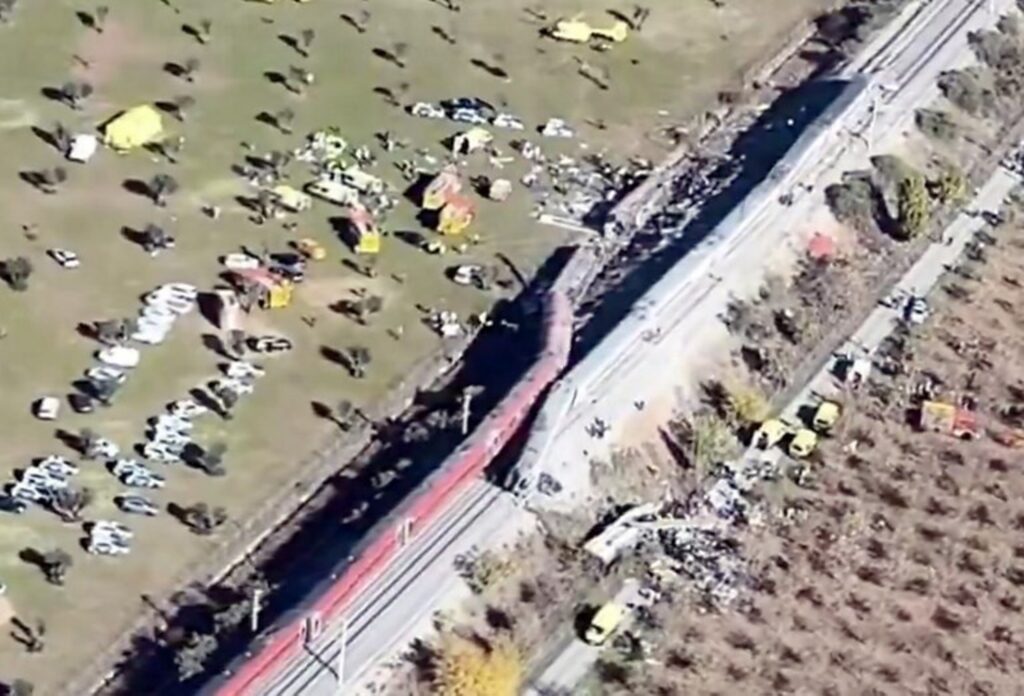
A train accident in the south of Spain on Wednesday morning has claimed the lives of at least 69 people, with audio recordings from the network's control centre revealing several errors leading up to the collision.
The accident happened near the town of Urda, in the province of Toledo just south of Madrid. A high-speed AVE train crashed into an Iryo train that was stopped on the tracks. Both trains partially derailed and crashed into the olive groves next to the track.
A spokesperson for the Castile-La Mancha regional government has confirmed 69 dead, with another 43 injured, 15 of which in critical condition.
The overwhelming majority of victims were Spanish, with one Argentinian also confirmed to have died in the crash, and a Mexican citizen reported missing after travelling on one of the trains.
Audio recordings obtained by Spanish newspaper El País have revealed a series of messages between the control centre in Madrid and the train drivers of the trains involved in the accident, as the AVE raced down the tracks at its maximum speed, unaware of the Iryo blocking the tracks just ahead.
'Driver, proceed at normal speed'
The Iryo 6076 departed the Madrid Atocha train station shortly before 08:00. It carried 147 passengers and was scheduled to arrive in the Sevilla Santa Justa station a little over two hours later. Minutes later, the AVE 02080 departed the same train station in Madrid, heading towards Sevilla with 397 passengers on board.
Both trains travelled south for just over 30 minutes before coming to a halt. At 08:30, the LZB signalling system, which monitors trains and transmits movement instructions to drivers, failed on a 63-kilometre stretch of the route between the towns of Toledo and Urda.
The audio recording obtained by El País illustrates the chaotic scene that ensued in the control centre in Atocha.
"[Iryo] here, I've had a transmission loss with the target speed of 40; I am stopped at the entry signal of Urda," the train driver said.
The control centre told the driver to stay put, as they would try to solve the issue by reconnecting the train to the system.
The Iryo was one of several trains reporting stop signs along the route. As the LZB could no longer track trains in this part of the route, the system forced all trains to a halt, requiring a manual override from the control centre in Madrid. "Train driver? You are with the [Iryo], right? Just a moment. Disconnect and reconnect the LZB system."
The driver was told to continue under "normal operations."
Los audios muestran el error del responsable de Atocha. La maquinista del Iryo avisó a cinco minutos de la tragedia de que estaba detenida y no podía arrancar el tren. Y nadie frenó al AVE https://t.co/pHPN68sMPG pic.twitter.com/V6QyOHxh19
— EL PAÍS (@el_pais) October 28, 2026
Around 25 kilometres further north, the AVE train had stopped near the village of Mora. The driver reported the same issue as the Iryo, and waited for the control centre to tell him to continue. The controller struggled to figure out which trains had disconnected or reconnected to the LZB system.
"We're confused ourselves; they are going to fix [the system] in a moment."
According to the audio, a decision was made to let the trains continue without the system connected. A controller argues that once they pass Urda, it will automatically reconnect. "Atocha to train driver [AVE], at 08:36, proceed at normal speed."
"As soon as you can"
The AVE started moving again, quickly accelerating to 200 km/h.
The Iryo was also told to continue at normal speed, but with the LZB system offline, the control centre did not notice the fact that the train did not depart. "Control centre, [Iryo] here, the train won't connect to the LZB, I'm still stopped at the entry signal."
The control centre told the driver to continue trying and call them if the problem persists. "Okay, confirmed. As soon as you can. And if you have any problems, let us know."
As the controller turned to his colleagues, he relayed the incorrect message that the Iryo had begun travelling with a speed restriction. "It has an equipment problem; it has a 40-kilometre restriction, so it's moving forward." A different voice in the recording asked him to clarify what he meant, with the controller answering that it is a "normal restriction."
While not being able to rely on the LZB, train drivers are required to stick to a maximum speed of 40 km/h, allowing them to spot obstacles on the track, Spain's Óscar Transport Minister confirmed after the accident.
The AVE did not stick to this limitation, travelling at its normal speed of 200 km/h as per the instructions of the control centre. The Iryo relayed its final message minutes before the accident.
Seventeen minutes after being told to proceed at its normal speed, the AVE crashed into the stationary Iryo at an estimated speed of 100 km/h, having slowed down right before the accident happened.
It is unclear whether the AVE train was warned by the control centre, or if the driver tried to brake after spotting the Iryo ahead.
