
The European Commission and the EU’s High Representative have published their first joint report on how the EU Maritime Security Strategy has been put into practice since it was revised in 2023.
The strategy is intended to align civilian and military efforts to protect EU and member state maritime interests and support international law, including the United Nations Convention on the Law of the Sea, the Commission said in a release on Tuesday.
The report lists a series of actions taken since 2023, including new naval activity, more joint exercises, agreements with international partners, and measures to protect infrastructure such as undersea cables.
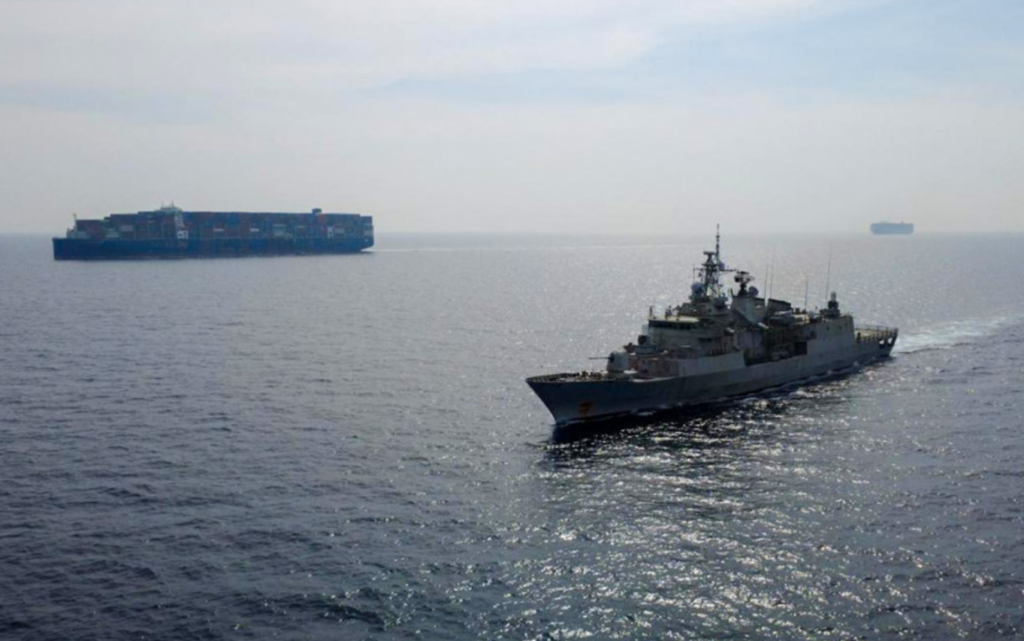
One of the biggest operational steps was the launch of EUNAVFOR ASPIDES in February 2024, a naval operation in the Red Sea and the Gulf of Aden.
The operation protected more than 800 merchant vessels and monitored more than 2,000, with a 100% success rate.
The EU has also set up an annual live maritime security exercise bringing together national navies and coastguards with EU bodies including the European Maritime Safety Agency, the European Fisheries Control Agency and Frontex — the EU’s border agency — to test cooperation and information-sharing in real-life conditions.
Cables, “shadow fleets” and information sharing
Work to improve what the EU calls “maritime domain awareness” — essentially, tracking and understanding activity at sea — included the launch of the operational phase of the Common Information Sharing Environment (CISE) in July 2024, the Commission said.
It added that the system is designed to help civilian and military authorities share maritime information.
On critical infrastructure, the EU adopted an Action Plan on Cable Security in February 2025 and later a Cable Security Toolbox, according to the Commission.
It said it funded two regional cable and maritime surveillance hubs in June 2026, one in the Baltic and one in the Mediterranean.
The report also refers to action against so-called “shadow fleets” — a term used for ships that operate to avoid restrictions such as sanctions — including sanctions on more than 700 vessels and about 100 “enablers.”
It added that EU countries and the EU naval mission EUNAVFOR IRINI have carried out “flag verification” boardings of numerous vessels in line with the UN Convention on the Law of the Sea.
The Commission and the High Representative said maritime threats have intensified since 2023, citing sabotage of critical infrastructure, drone attacks against merchant vessels, piracy, cyberattacks and drug trafficking.
