
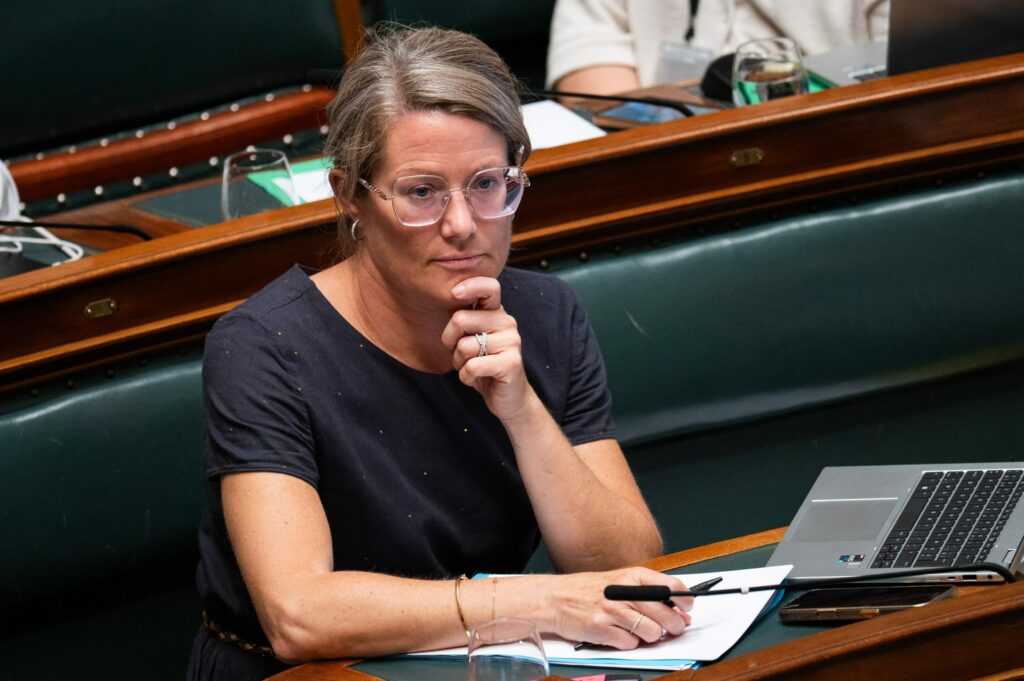
Belgium's Chamber of Representatives is expected to approve a controversial bill on Thursday allowing police to enter private homes to arrest certain undocumented migrants, despite persistent concerns over fundamental rights.
The legislation, championed by Asylum and Migration Minister Anneleen Van Bossuyt (N-VA), would allow the Immigration Office to request authorisation from an investigating judge to enter a private residence alongside police officers.
The measure would apply to undocumented migrants who have been ordered to leave Belgium but refuse to comply and are considered a threat to national security or public order.
According to Le Soir, the governing coalition is determined to push the legislation through despite the ongoing political crisis.
The proposal was first introduced in 2017 under then-State Secretary for Asylum and Migration Theo Francken (N-VA), but was eventually shelved following strong opposition from NGOs, legal experts, magistrates and politicians. Revived by Belgium's Arizona coalition in the summer of 2025, the legislation once again attracted criticism, including from the Council of State, which warned of a particularly serious infringement of fundamental rights.
Additional safeguards fail to silence critics
Following pressure from civil society and coalition partner Les Engagés, several amendments were introduced to strengthen safeguards. Among the changes, investigating judges will now have seven days instead of five to decide whether to authorise a home visit.
Any subsequent request in the same case must also be supported by new information, while judges will be able to impose specific conditions when minors are present.
Les Engagés has defended the revised legislation, arguing that it differs fundamentally from the 2017 proposal, particularly because it only targets individuals considered dangerous to national security or public order.
However, Koen Dewulf, director of Belgium's Federal Migration Centre Myria, told Le Soir that the definition of such a threat remains vague and open to interpretation. He acknowledged that the legislation now includes additional safeguards and targets a narrower group of people, but maintained that its fundamental purpose remains unchanged.
The Association of Investigating Judges has also reiterated its opposition. Its co-president, Jean-Louis Doyen, argued that authorising entry into a private home for an administrative deportation is fundamentally different from conducting a criminal investigation, which is the purpose of an investigating judge's role.
Concerns over fundamental rights
Andrea Rea, professor emeritus at the Université libre de Bruxelles (ULB) and chair of the board of director of migrant rights organisation CIRÉ, questioned the necessity of the legislation.
He also raised concerns about the absence of legal remedies for undocumented migrants and people hosting them, warning that the legislation could face challenges before Belgium's Constitutional Court.
Rea suggested that the procedural requirements imposed on investigating judges, combined with reservations expressed by police services, could make implementation more complicated than anticipated.
Dewulf warned that the law could ultimately serve a largely symbolic purpose, allowing the government to demonstrate a tougher stance on migration without necessarily delivering significant practical results.
