

This summer’s extreme heatwave has transformed how people view the climate crisis.
Though muted concern has long existed, new data show that climate is gradually climbing the political agenda in Europe, currently ranking as a top four issue in countries like Hungary, Sweden, the Netherlands, France, Great Britain and Germany.
Yet, as voters look out across a continent shaken by record temperatures, energy insecurity and an unrelenting cost-of-living crisis, they feel disillusioned by past frameworks used to mobilise climate action. The many arms of the polycrisis have strangled moralistic arguments, and ‘Net Zero’ communications have failed to marry the planetary with the personal.
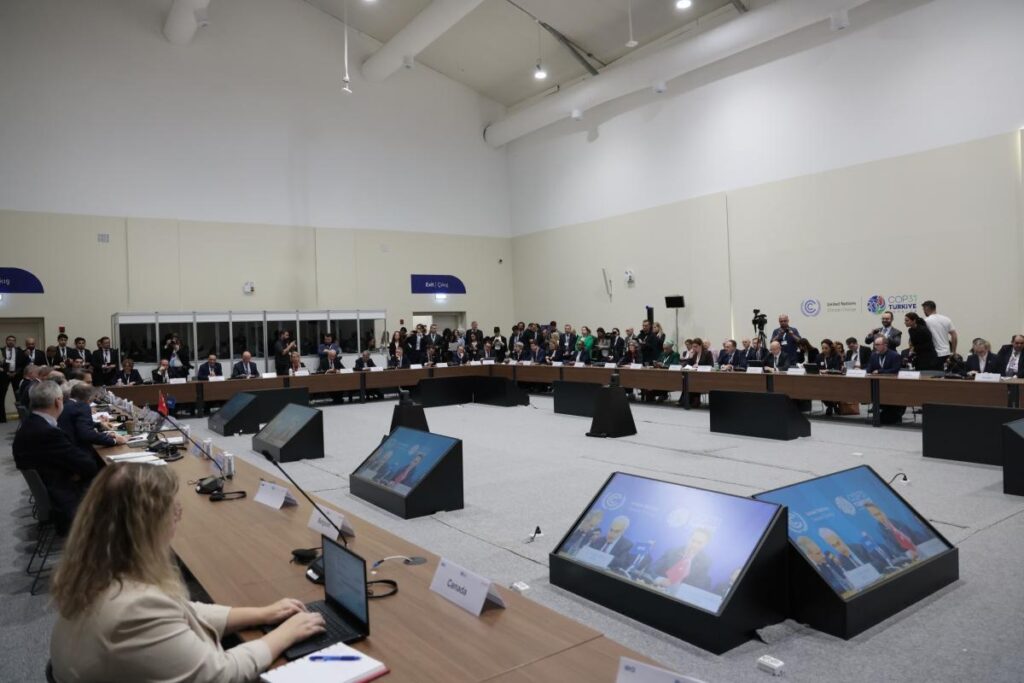
As world leaders and climate experts gather this week for COP31, they have an opportunity to capitalise on renewed public concern. However, they cannot do so by telling the same old stories. If increased public concern is to create a renewed political mandate, the climate movement must fit its goals within voters’ present realities.
For years, the climate debate was primarily framed in terms of a moral duty. In 2019, climate action was a bipartisan issue, with traction across the political spectrum as the European Commission set a course towards Net Zero by 2050 and Greta Thunberg challenged world leaders at the United Nations.
However, much has happened since then: a pandemic, wars, inflation, energy crisis, and a punishing squeeze on household budgets. Opponents on the right of the political spectrum have used that pressure to argue that green policies raise prices and that abandoning them is the answer. Their argument travels because it starts with an experience voters recognise.
Overcoming this challenge will require more than repeating the scale of the climate threat. It will require communicating about policies in ways that make people feel safer and more secure in their daily lives. Fortunately, a major multi-country poll covering Sweden, the Netherlands, Germany, Spain, Italy, France, Hungary, Poland, as well as the US and Great Britain offers cause for optimism.
The poll, which provides a robust cross-section of European attitudes, looking at the largest countries from North, East, South, and West Europe, as well as the continent's biggest economies, reveals that after a summer of crippling temperatures, hitherto latent fears about the future of the planet are crystallising into a demand for political attention.
Change in European attitudes
In Sweden, the Netherlands, France, and Great Britain, roughly a fifth of voters rank the environment and climate change among their top two issues facing their country. In contrast, climate came out as the second most important issue overall to Hungarians. This is a phenomenal increase: just 3% of Hungarians listed the issue in their top two concerns just a few months earlier in Spring.
Whilst a fifth may not seem like much, few issues ever achieve genuine ‘salience’ in polling (i.e. featuring in the top two or three concerns for voters) and change is usually incremental. So, a sharp reversal in the downward trend in climate salience deserves our attention.
Even more surprising, the polling dispels the longstanding assumption that climate concern is felt acutely only by voters on the left.
In France, Hungary and Italy, where right-wing framings have dominated the conversation in recent history, there is a surprising consensus on concerns towards climate change between supporters of Marine Le Pen’s National Rally, Viktor Orban’s Fidesz Party, and Giorgia Meloni’s Brothers of Italy, and their counterparts on the left.
Yet the data makes one thing abundantly clear: 2019’s climate communication models no longer work. When asked to rank environmental policy goals from highest to lowest priority, 'achieving Net Zero emissions' ranked dead last across every single country surveyed.
The good news? The data shows a more effective framing: building clean energy, protecting nature and wildlife, and reducing energy costs are all messages that resonate with respondents. Whilst these outcomes are proposed goals of Net Zero, the Net Zero banner is itself not effective. Voters prefer tangible, immediate objectives framed in non-technocratic language.
This is the narrative battleground to fight on now. Currently, the far-right political narrative is persuasive. Almost half of Europeans surveyed agree that pro-environmental policies have left ordinary people in their country worse off.
Years of agonisingly slow-moving progress, coupled with a relentless far-right framing that depicts environmentalism as technocracy, seems to have convinced people that green policy is often synonymous with sacrifice and elite control.
New climate story
Voters do want a green future, but they want food on the table for their families in an order of magnitude more. A new climate story must therefore create new links between climate and close-to-life issues.
The convergence of climate extremity, geopolitical volatility, and rising utility bills creates a unique opening to reframe clean energy as a practical, necessary alternative. It’s easy to say that green policies are necessary to “protect the climate”, but it might just be more effective to tell a story about green policies easing the cost-of-living crisis.
When riverbeds run dry and ship traffic breaks down, transport costs for everyday goods go up. When power plants are shut down during heat waves because they can’t be cooled (as seen in Hungary), energy prices increase. Remaining dependent on imported fossil fuels, and on the political decisions of the countries that supply them, makes energy expensive and less secure.
The potential buy-in for such a story can be measured. Clear majorities across Europe agree that transitioning to renewable energy will lower energy bills and reduce dependence on volatile fossil fuel markets, including 64% of Hungarians, 55% of Italians, 53% of Spaniards and 46% of French citizens. Furthermore, expanding renewable capacity is consistently ranked by voters as the single most effective action governments can take to lower energy costs.
Their confidence has a basis in fact. Spain’s energy resilience during the Iran war due to its expanded renewables infrastructure serves as a case in point. Spain has doubled its wind and solar capacity since 2019, so gas now sets the electricity price in only a small share of hours. As a result, when gas prices spiked after the Iran war began, Spanish households were better shielded from price hikes than those in many other European countries.
European voters have not abandoned the green transition. Most recognize that drastic change is needed to avoid the worst impacts of climate change, and they believe that green growth can help make their lives easier.
However, voters are skeptical of how the normative arguments framed and delivered over the past decade. And despite the fact that heatwaves and floods have broken the salience downturn, hoping that extreme weather will shock electorates back to reason is bad politics. The climate movement must meet voters where they are.
Civil society and climate movements can continue to highlight immediate threats from extreme weather to maintain emotional urgency. But political parties competing for government must ground their vision in tangible economic benefits.
By dismantling the abstract vocabulary of Net Zero, confronting corporate profiteering, and presenting renewable energy as a tool for bill reduction and sovereign security, there is space for policymakers to begin rebuilding a majority for climate action.
