

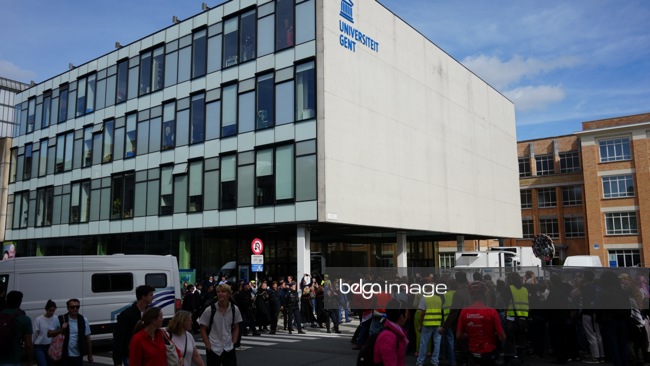
Since the first reports of Nathan Cofnas’s affiliation with Ghent University, the controversy has attracted the sort of attention universities normally reserve for campus occupations, Nobel Prizes and asbestos.
Students and staff protested, newspapers filled their pages, and even the American ambassador weighed in, no small thing for a diplomat already busy with Belgian local affairs, from circumcision and alcohol labels to the occasional improvised redecoration of Brussels monuments with firework soot.
So, what is so controversial about Cofnas? In a nutshell, he identifies as a philosopher of biology and ethics, describing himself as a 'race realist.' His most controversial claim is that average differences in measured intelligence between racial groups, particularly Black and white Americans, may have a substantial genetic component.
He draws stark conclusions from this view. In his 2024 blog post A Guide for the Hereditarian Revolution, Cofnas advanced claims that under a genuinely color-blind meritocracy, Black students would make up around 0.7% of Harvard’s student body, Black professors would 'approach 0%,' and Black people would 'disappear from almost all high-profile positions outside of sports and entertainment.' He also argued that Black Americans had failed to develop a culture of homework, respect for the law and strong nuclear families, while endorsing forms of social segregation and calling for a 'hereditarian revolution' against what he calls 'wokism.'
When people, including scientists specialised in genetics, anthropology, race and intelligence, challenged the scientific foundations of his claims, academic freedom quickly became a favourite buzzword. Ghent University’s leadership, a few academics, and our increasingly invested friend at the American embassy all stressed the need to protect Cofnas’ s right to pursue and express controversial claims because … you know … academic freedom.
Universities, the argument goes, must remain places where unpopular or seemingly offensive ideas can be scientifically investigated rather than suppressed because they provoke outrage. Fair enough, in my view, the principle is correct. Yet, there are tricky questions that have not been sufficiently discussed here: What does academic freedom mean? What does it require? Should it automatically protect every opinion made by an academic? If not, where do we draw the line?
These questions go far beyond Cofnas because science and universities are increasingly pulled into public controversy. Trust in science is an increasingly growing issue, and people are often asked to decide when a claim is simply an opinion and when it deserves the added authority of science. This article both reflects on the Cofnas problem, as well as these more general and increasingly pressing questions.
I approach this wearing two hats. The first is that of a social scientist interested in how we distinguish serious science from ideas that merely borrow the language of science. The second is more personal. Admittedly, I may also belong, broadly speaking, to one of the groups whose academic merit and intelligence Cofnas appears skeptical about.
He writes most explicitly about Black academics; yet, I have not yet established where 'brown' academics such as myself fall in his hierarchy of suspicion. For present purposes, I shall classify myself as permanently tanned, caramelised or, more romantically, 'sun-kissed,' and hope those categories have not yet entered the colour palette of his race realism.
Okay, here we go. To make sense of the Cofnas issue, we need to ask three fairly simple but tricky, and related questions: What makes something scientific? What does academic freedom protect? And how do Cofnas’ s arguments look against those standards?
So, what makes something scientific?
Without wading too far into boring specifics, science is a disciplined attempt to understand how and why the world works. Strip away the fancy words, and it comes down to three habits: knowing your subject well enough to study it carefully, or specialisation; being suspicious of your own explanations, or self-suspicion; and letting other qualified people try to prove you wrong, or scrutiny.
Specialisation is critical because the deeper we dig into genetics, medicine, economics, psychology or almost anything else, the easier it is to miss something important. Scientists don’t have to stay trapped inside disciplinary boxes, but crossing into another discipline still means understanding evidence, methods and accumulated knowledge, and that is very hard work.
This hard work is necessary since we humans are spectacularly good at seeing what we wish or expect to see. For millennia, healers and doctors drained blood from patients to restore the supposed balance of the body, often sending them on one-way trips to discover what happens after death. Also, for decades, stress and lifestyle were blamed for peptic ulcers until Barry Marshall and Robin Warren showed the central role of Helicobacter pylori, research that eventually earned them a Nobel Prize. Earlier healers and doctors were not idiots. They had experience, plausible explanations and confidence, but they were also very wrong about some things.
Social science is even messier. Richer people tend to be healthier. Educated people tend to earn more, unfortunately not quite as much as they would like. Neighbourhoods differ in crime, schooling and life expectancy. Finding these patterns is so easy yet explaining them properly is where the trouble begins.
So, then comes self-suspicion. What else could explain what I am seeing? Who or what did I really study? Am I measuring what I think I am measuring? What evidence would change my mind? To answer these questions well, a good scientist metaphorically leaves their muddy shoes at the door and washes their hands. They try not to force their politics, prejudices or preferred conclusions into their work. Intuition and pre-fabricated opinions are dangerously misleading, which is why scientists endure the sweet torture of scientific research methods, even if they are experienced specialists in something, because again simple observation often tricks our minds.
Then comes scrutiny. Scientific claims are not validated by enthusiasm or conviction. A claim about genetics does not become true because someone feels strongly about genes, any more than a cancer treatment works because someone once saw a patient, or even a thousand, recover. Scientists who know the field examine each other’s evidence, methods and conclusions. Think of it as the world’s most boring slow-motion boxing match. Scientific consensus is eventually what remains standing after enough qualified people have taken a swing at the evidence.
This brings us to one of Cofnas’ recurring arguments: that ideological and moral pressures have made scientists unwilling to seriously consider genetic explanations for differences between racial groups. Put less delicately, he argues that science disagrees with him because science has become too political and too 'woke.'
The most awkward part of that story is that scientists have been seriously studying intelligence, genetics, sex, race and group differences for decades. These questions did not disappear because the answers might be uncomfortable, nor should they. Researchers have long studied differences between people and groups, from pain and treatment responses in women and men to intelligence across social and demographic groups, including competing explanations for those differences. This research has improved medicine, education, mental healthcare and our broader understanding of human behaviour.
So, the real question is not whether science should be allowed to ask uncomfortable questions. It already does, academic freedom protects this, and we fiercely defend that principle. However, what exactly qualifies for such protection is perhaps the more real and pressing question.
So, what does academic freedom protect?
'Publishing in an academic journal makes you an authority on everything you say to roughly the same extent that visiting the zoo makes you a panda bear.'
In simple terms, academic freedom protects scientists’ ability to properly research, teach, publish, criticise and challenge established ideas without being forced to conform to political or institutional beliefs. Knowledge would advance rather poorly if governments, university boards or angry crowds could decide in advance which conclusions scientists may reach.
That protection extends to uncomfortable questions and uncomfortable findings. But 'properly' is the key word here. So, this protection does not extend to smuggling a preferred answer into a scientific question, leaping from observation to explanation, or making claims beyond one’s expertise and then calling criticism 'woke' censorship. Simply put, academic freedom has never meant freedom from academic standards.
Scientists are not a special aristocracy permitted to say whatever they like. In daily life, we have the same freedom of expression as everyone else. But when we invoke academic credentials to give a claim extra authority, those credentials come with obligations. Otherwise, 'Professor', 'Doctor' and 'PhD' become shiny badges pinned onto personal opinions, sometimes with very real and devastating consequences for society.
Good science may offend existing beliefs, but being offensive does not make something good science. A PhD, university affiliation or published article does not make every claim made by a scientist correct or worthy of academic protection either. Publishing in an academic journal makes you a credible authority on everything you say to roughly the same extent that visiting the zoo makes you a panda bear.
So, what about Cofnas’ arguments?
The three standards above, and what they imply for academic freedom, give us a better way to approach the Cofnas saga than simply asking whether we like him or find his conclusions offensive.
Start with specialisation. Cofnas is mainly trained as a philosopher, particularly in the philosophy of biology and ethics. Yet his claims range across a dazzling number of specialized fields, from intelligence and human genetics to doubting against vegetarian diets for children and guidelines on lowering red-meat consumption.
These are very different areas, many well beyond his own core expertise and not fields in which he has conducted original empirical research. Also, rather ironically, for someone who argues that science has become too political, the clearest thing linking his views across these very different subjects is not scientific specialisation, but a remarkably consistent and thinly veiled political and ideological outlook that seems to keep searching for a 'scientific appearance' in as many fields as possible.
Then comes self-suspicion. Across several fields outside his core expertise, Cofnas repeatedly arrives at scientific looking conclusions that fit neatly within that consistent political and ideological outlook. That does not – by default- make those conclusions wrong, but it should, at least, provoke the kind of question that scientific practice requires scientists to direct at themselves: am I following the evidence wherever it leads, or does the evidence keep arriving suspiciously close to where I already wanted to go?
Finally, and based on the above two points, scrutiny provides quite the final blow. Cofnas’ claims have not merely been met with outrage or censorship. Many scientists who have spent their careers working on race, genetics, anthropology and intelligence have taken his arguments seriously enough to challenge his assumptions and conclusions in detail. This is evidence showing that science didn’t refuse to hear him. If anything, it shows that experts have been quite generous, spending considerable time explaining where his arguments fall short, even when those experts knew that those arguments come from someone who does not specialize in fundamental research in those fields.
Okay, now where does this leave us with academic freedom?
Academic freedom deserves very strong protection. Scientists should be free to ask uncomfortable questions and report findings that offend our politics, beliefs or assumptions about how the world works. This is how progress is made, and this is why Europe recognizes academic freedom as fundamental.
Serious protection, however, requires serious standards. Academic freedom cannot become a shortcut through which anyone who publishes an article, gains a university affiliation or puts 'Dr.' before their name turns opinions, fringe claims or arguments far outside their expertise into protected scientific inquiry. This becomes even more critical when such claims can directly or indirectly affect how groups of people are treated, their wellbeing or their rights. If society gives academic research this unusual level of protection, it is reasonable to expect unusually demanding standards in return.
The formula should not be as easy as publishing an article about something, calling yourself a scientist, make sweeping claims about groups of people in fields you don’t specialise in, and when specialists object, or when people try to hold you accountable, you cry 'academic freedom,' and declare yourself a victim of censorship or ostracisation. At that point, academic freedom stops protecting good science and becomes an expensive costume for ordinary political speech. This is critical to understand in Europe where freedom of expression is strongly protected but not limitless.
Lowering that bar risks giving pseudoscience, prejudice or political opinion the borrowed authority of science. So, universities should be very careful before being blackmailed by the academic-freedom card into treating every controversial claim as serious science.
When that happens, the public gets hurt because academic and professional titles carry weight. People may start believing that raw milk is safe to consume, that swimming in polluted water is harmless, or that animal deworming drugs are sensible treatments for respiratory illness, just because a widely discredited 'doctor,' a public official, or a professor of psychology says so. These are all very real things, with very real consequences, that we see in the world today.
Now, what?
Cofnas, I, and every other academic are free, as individuals, to hold and express opinions, subject to the same rights and limits that apply to everyone else in society. A university title does not give us a larger freedom of expression than our neighbors.
Academic freedom, however, is something more specific. It protects our ability, as scientists, to ask difficult questions and pursue answers wherever serious research takes us. That protection carries the standards that give academic work its authority in the first place: expertise, evidence, method, self-suspicion and scientific community scrutiny.
Confusing these two freedoms cheapens both. An academic can have a political opinion without pretending it is science. A scientist can properly investigate an offensive hypothesis without apologizing for where the evidence leads. Yet, trouble begins when ordinary opinions acquire the authority of science simply because the person expressing them has published papers or works at a university.
This is where the Cofnas case becomes useful as a case far beyond Cofnas himself. Academic freedom cannot become an upgrade button that turns controversial opinion into protected science. The more powerful the protection, the more seriously we should think about whether the argument has earned it.
Let academics speak freely as citizens. Let scientists ask dangerous questions as scientists. And when someone asks society to treat a claim as scientific, let us insist on the inconvenient part: it still must be good science.
Academic freedom gives science room to follow the evidence wherever it leads. Yet, it should not give anyone permission to choose the destination first and borrow science for the journey.
Note: The content of this article reflects the author’s personal views and do not represent the opinions and positions of their employer.
