

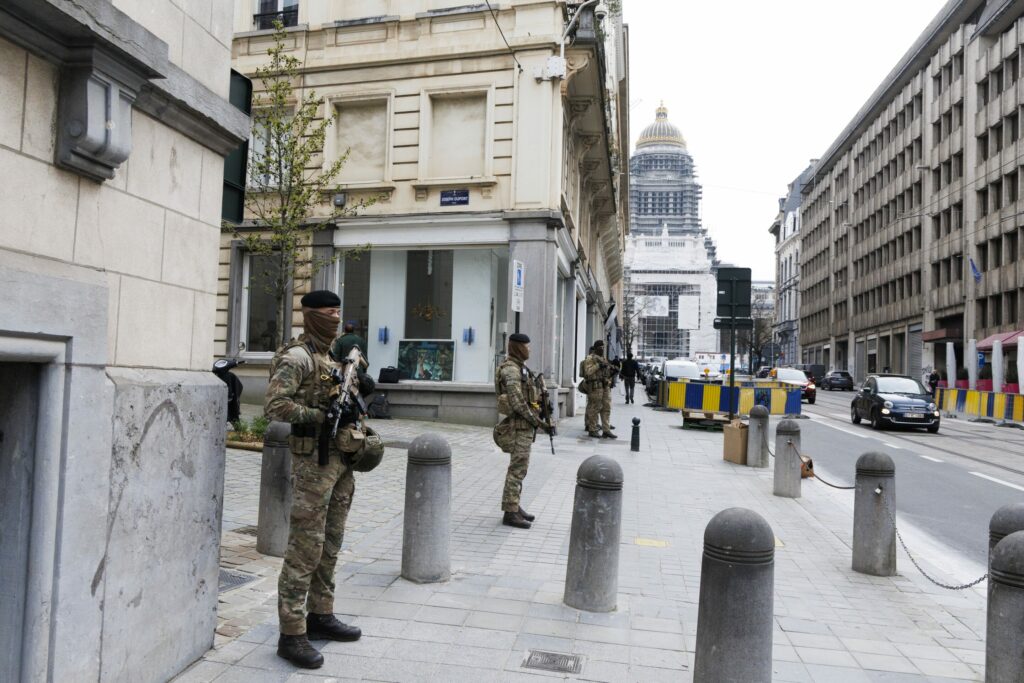
Against the backdrop of protests in France, Defence Minister Theo Francken (N-VA) called for a 'Gendarmerie 2.0': a militarily trained reserve force placed at the disposal of the Federal Public Service (FPS) Home Affairs to support the police.
This proposal, for predictable reasons, sparked a great deal of reaction. The former gendarmerie was disbanded in 2001 and is, after all, associated in the national collective memory with scandals and corruption.
The terrorist attacks of the previous decade, however, led to the return of military personnel to the streets to support the police. Through Operation Vigilant Guardian (OVG), the military assisted in guarding sensitive locations and carried out patrols.
The operation ran from 2015 to 2021. Although the military support was justified as a temporary emergency measure, its duration shows that it proved difficult to bring the operation to a swift conclusion. There was also no firm legal framework regulating the military’s internal security role. Furthermore, OVG had a negative impact on the morale and readiness of the involved operational units.
Despite these 'lessons learnt', a decision was taken in 2026 to resume the provision of military support to the police under Operations Green Shield and Urban Shield in Antwerp and Brussels. The task of securing nuclear sites was also resumed in July 2025 under Operation Vigilant Protector. The Belgian Defence is, therefore, once again being called upon to contribute to internal security. However, the problem is that the units which are being deployed for this purpose should be focusing on collective defence and deterrence within NATO.
A new role for the military
The establishment of a Gendarmerie-style unit could help in this regard. Neighbouring countries such as the Netherlands and France have similar organisations: the Royal Marechaussee and the Gendarmerie Nationale, respectively.
While there are legitimate democratic concerns regarding the militarisation of the police or military personnel taking over policing roles, Belgium’s neighbouring countries demonstrate that re-establishing such a unit can be useful in supporting the police – provided there is a clear legal framework. Furthermore, synergies between the military and the police are already being utilised today, such as illustrated by the procurement of Airbus H145-family helicopters for both the Belgian Defence and the Federal Police.
The creation of a Gendarmerie-style unit could also be a way of having the military take over a part of the cost of internal security, as in the Dutch and French models. At the NATO Summit in The Hague in June 2025, a new defence spending pledge was approved.
Allies committed to spending at least 3.5% of GDP on core defence requirements and up to 1.5% on broader defence- and security-related expenditure by 2035. However, the current De Wever government has decided to keep the core defence budget at 2% for this legislative term. By taking over tasks from the police, the Belgian government can further increase the defence budget through a reallocation of resources.
It is important, however, that such an initiative does not stand in the way of the modernisation of combat capabilities. Given the geopolitical situation, this must remain the number one priority. The development of a 'Gendarmerie 2.0' must therefore take place alongside the ongoing efforts of the Belgian Defence.
Beyond policing
Another type of unit with a domestic remit is the so-called 'territorial reserve'. On 10 June 2026, for example, the 1st Fusiliers Battalion was established. Four other battalions will follow later. According to the Belgian Defence, the main mission of this territorial reserve is to 'support the freedom of movement of NATO troops' within the country.
In addition, these battalions will also be deployed for 'aid to the nation' missions, such as in the event of disasters. Belgium is also increasingly confronted with the threat of hybrid warfare, such as the drone incidents over military bases and Zaventem Airport in 2025.
A Gendarmerie-style unit could therefore be beneficial if adapted to the current situation. Ideally, it should be a unit with a primarily military character, capable of carrying out the following tasks on Belgian territory: defending critical infrastructure, supporting the deployment of NATO troops, countering hybrid threats, combating terrorism, and carrying out other 'assistance to the nation' tasks in support of the police, fire service, and civil protection.
In short, Belgium does not need a narrowly defined 'Gendarmerie 2.0', but rather a more broadly conceived 'National Guard'.
