
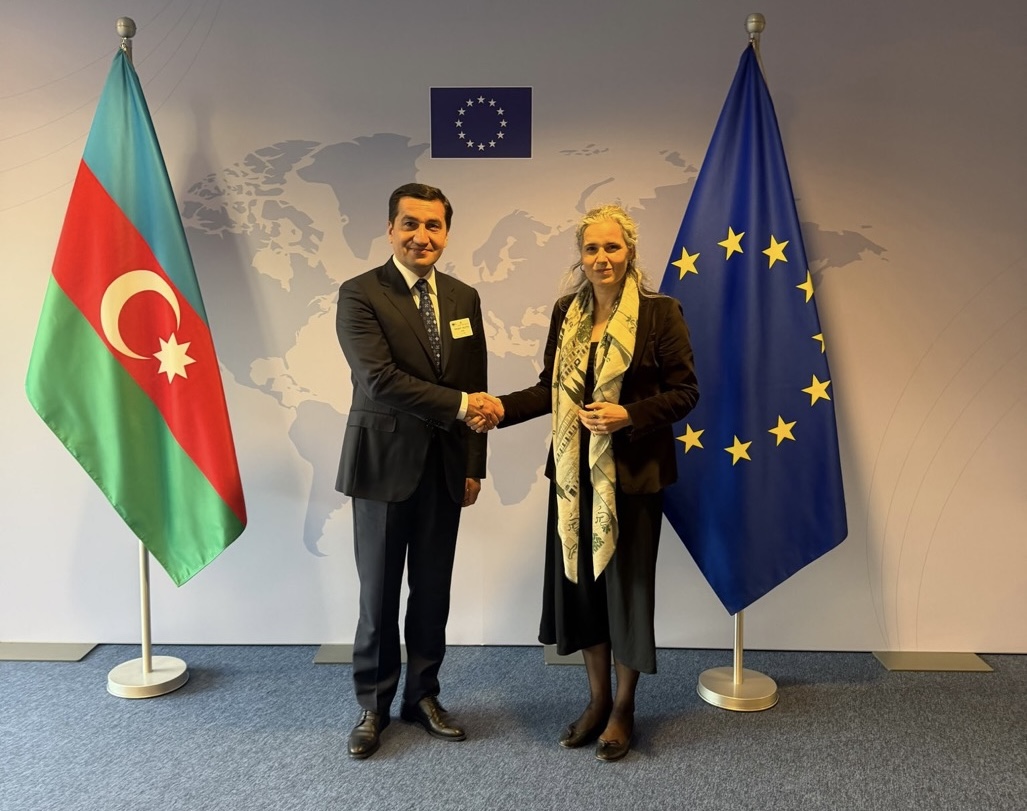
Azerbaijan's focus is now on "winning the peace," Hikmat Hajiyev told an audience of journalists, analysts and think-tank representatives at the Embassy of the Republic of Azerbaijan in Brussels on 16 November. Hajiyev, Assistant to the President of Azerbaijan and Head of the Foreign Policy Affairs Department of the Presidential Administration, was in Brussels for meetings with EU institutions and NATO. He said the South Caucasus should now be seen as a region of peace and cooperation.
Building on the peace agenda
Hajiyev said there is now a "new status quo" in the region, based on international law and historical reality.
He described Azerbaijan as the initiator of the peace agenda with Armenia. Taking that initiative, he said, required "diplomatic and political courage".
To put the pace of the process in perspective, he pointed to European history, noting that Germany and France signed the Élysée Treaty only in 1963. Azerbaijan and Armenia, he argued, have moved much faster.
He went through the steps Baku has taken since 2023. Azerbaijan drew up five principles for peace, which he said form the backbone of the agreement. The draft text was written in Baku. Azerbaijan then sought the support of the United States, which responded positively. The process ended with the initialling of the peace agreement and the Washington statement in August 2025.
Since then, he said, Azerbaijan has not simply waited for a signature. Trade and transit with Armenia have started, along with confidence-building contacts between civil society groups. Armenia now uses Azerbaijani territory to reach markets including Russia and Kazakhstan. He said hundreds of thousands of tonnes of cargo have already been delivered, along with fuel exports that support Armenia's energy security.
"There are many nice declarations with very rich language," he said. "But in our case, it's a real peace. It's a tangible peace, and both countries can feel it."
The last step: Armenia's constitution
The only remaining obstacle to signing the final peace agreement, Hajiyev said, is the territorial claim on Azerbaijan in Armenia's constitution. He stressed that this is an internal matter for Armenia and that Baku does not want to interfere in Armenian politics.
He compared the situation to the Good Friday Agreement, when Ireland changed the articles of its constitution relating to Northern Ireland. He also pointed to the constitutional arrangements between Poland and Germany.
Citing statements in the Armenian parliament and media, he said Armenia plans to start a public debate on a new constitution soon. He said he expects a referendum in 2027. "Afterwards, we will not see any problem for signing the final peace agreement between the two countries," he said.
One participant asked whether Armenia could instead revoke its 1989 declaration on Karabakh through the Constitutional Court, if a referendum proved too difficult. Hajiyev said that would not be enough. A Soviet-era document has a different legal standing from the constitution of the independent Republic of Armenia, he said. He added that Baku wants peace with the Armenian people, not only with the government. "A referendum that puts an end to territorial claims will be the guarantee of long-lasting peace," he said.
Another participant warned that the current momentum could be lost if the forces of peace in Armenia lacked domestic support. He asked what more Azerbaijan could do to help. Hajiyev said Baku has limited influence over Armenian politics. During Armenia's election period, he said, Azerbaijan avoided commenting on domestic matters and focused on keeping the border calm. He described Baku's current approach as "strategic patience": not prolonging the process, but waiting for Armenia's internal process to finish.
Azerbaijan as a middle power
Hajiyev summed up Azerbaijan's role in four words. It is a peacemaker in the South Caucasus. It is a connector between regions and between the Caspian, Black, Mediterranean and Adriatic seas, through transport, pipelines, renewable energy and fibre-optic links. It is an energy security provider for Europe. And it is a convener, bringing parties together through dialogue platforms and quiet diplomacy.
He described Azerbaijan as acting as a "middle power". For him, the term is less about size, military strength or economic weight, and more about a country's ability to build partnerships and contribute to a positive agenda.
He also spoke of Azerbaijan's "multiple geopolitical identity". The country belongs to the South Caucasus and the wider Caspian region. It has been admitted as a full member of the Central Asian consultative format. It shares Islamic culture with the Middle East and belongs to the Organization of Turkic States. As a secular country, it also has strong links with Europe. "We are not in search of a new geopolitical identity," he said. "We are simply exploring our existing one."
He listed partnerships across these regions: an allied relationship with Kazakhstan, strategic partnerships with Uzbekistan, Kyrgyzstan and Tajikistan, and a special relationship with Turkmenistan. Azerbaijan has a comprehensive strategic partnership with China and a strategic partnership with the United States. He also pointed to Azerbaijani gas supplies to Syria. He thanked the current US administration for supporting the peace agenda and hosting the Washington summit.
Gas, transparency and the re-export question
On energy, Hajiyev said Azerbaijan is a reliable partner for Europe, supplying gas to ten EU member states. He said Baku is ready to do more. Last year, Azerbaijan exported around 25 billion cubic metres of gas, of which around 13 billion went to Europe.
Whether more gas reaches Europe, he said, depends on long-term contracts and investment commitments from the EU side. He said private companies are very interested, pointing to recent deals with Austria and Germany. But EU financing institutions such as the European Investment Bank can no longer invest in fossil fuel projects. He said Baku respects that decision, but argued that the market still needs stable gas as a transition fuel. That need will grow, he said, with the EU's digital and artificial intelligence plans.
A journalist referred to the EU ban on Russian gas imports and asked whether Azerbaijan might be re-exporting Russian gas. Hajiyev firmly rejected the claim and called it disinformation. He said Azerbaijan's gas is produced by an international consortium operated by BP and carried through the internationally owned Southern Gas Corridor. "Everybody sees how much gas has been produced, how much has been used internally and how much has been exported," he said. He added that there was no need for additional safeguards. "Gas business in Azerbaijan is full of transparency."
A transformative year for EU–Azerbaijan relations
Hajiyev opened the evening with criticism of the European Parliament. He noted that it has adopted 17 resolutions related to Azerbaijan since 2020. In his view, these resolutions are one-sided, influenced by narrow lobby groups, and harmful to both the peace agenda and EU–Azerbaijan relations. He said the Parliament should be a platform for dialogue and should focus on the concerns of EU voters.
He was much more positive about the other EU institutions. He called 2026 "quite transformative" for relations. He highlighted visits to Azerbaijan by European Council President António Costa, High Representative Kaja Kallas and Enlargement Commissioner Marta Kos, and a further meeting with Costa on the sidelines of the European Political Community. He said both sides now see eye to eye on many issues. The new strategic language in recent EU–Azerbaijan documents, he said, shows a shared will to take the relationship to a higher level.
After the Washington summit, he said, Azerbaijan invited the EU to take part in rebuilding the railway in Nakhchivan. The EU responded positively, and the feasibility study is nearly complete. The line would connect with the TRIPP route through Armenia and form part of the Middle Corridor between Europe and Asia.
Asked whether Azerbaijan might seek EU membership, as Georgia and Armenia have, Hajiyev said Baku has no such ambition, while respecting the choices of its neighbours. He said Azerbaijan sees itself as a "natural partner" of the EU. He added that the Eastern Partnership can no longer play its former role, because its members now have very different ambitions.
On France, Hajiyev said there has been some normalisation in relations. He said Baku is open to dialogue and keeps regular contact with the Élysée. In his view, bilateral disagreements should not affect Azerbaijan's relations with the EU or NATO. Asked whether Azerbaijan plans to build its own lobby in Europe, he said it does not. Baku prefers open dialogue with governments, media, think tanks and academics.
The TRIPP route and the Middle Corridor
Asked about reported delays to the TRIPP connectivity route through Armenia, Hajiyev said Baku continues to receive "full assurances" from the US administration. He said Armenia has also given strong assurances and recently sent a new technical team to the site.
He was frank about the pace, however. "Real construction will start when you put brick on brick," he said, adding that Azerbaijan is already laying railway on its side. "Quite frankly, we don't see it on the other side."
Asked about the Russian concession over Armenia's railways, he said the TRIPP section is separate. The Soviet-era line belonged to the Azerbaijani SSR, he said, and was later dismantled. Only the track bed remains.
On the Middle Corridor, he agreed with a participant that Azerbaijan's role had not always been fully recognised in Brussels. He said that has now changed. With harmonised customs and border procedures, he said, high-value goods could travel from Asia to Europe in two weeks or less. He described the route as a land-based complement to maritime trade, which has faced disruption in the Red Sea.
Russia, Ukraine, Iran and regional security
Hajiyev said he had met NATO allies earlier that day. He recalled that Azerbaijan has been a NATO partner since the early 1990s and noted that Azerbaijani troops served alongside allies in Kosovo and Afghanistan. In the 1990s, he said, Azerbaijan was a consumer of security. Today it contributes to Euro-Atlantic security through energy, connectivity and the protection of critical infrastructure.
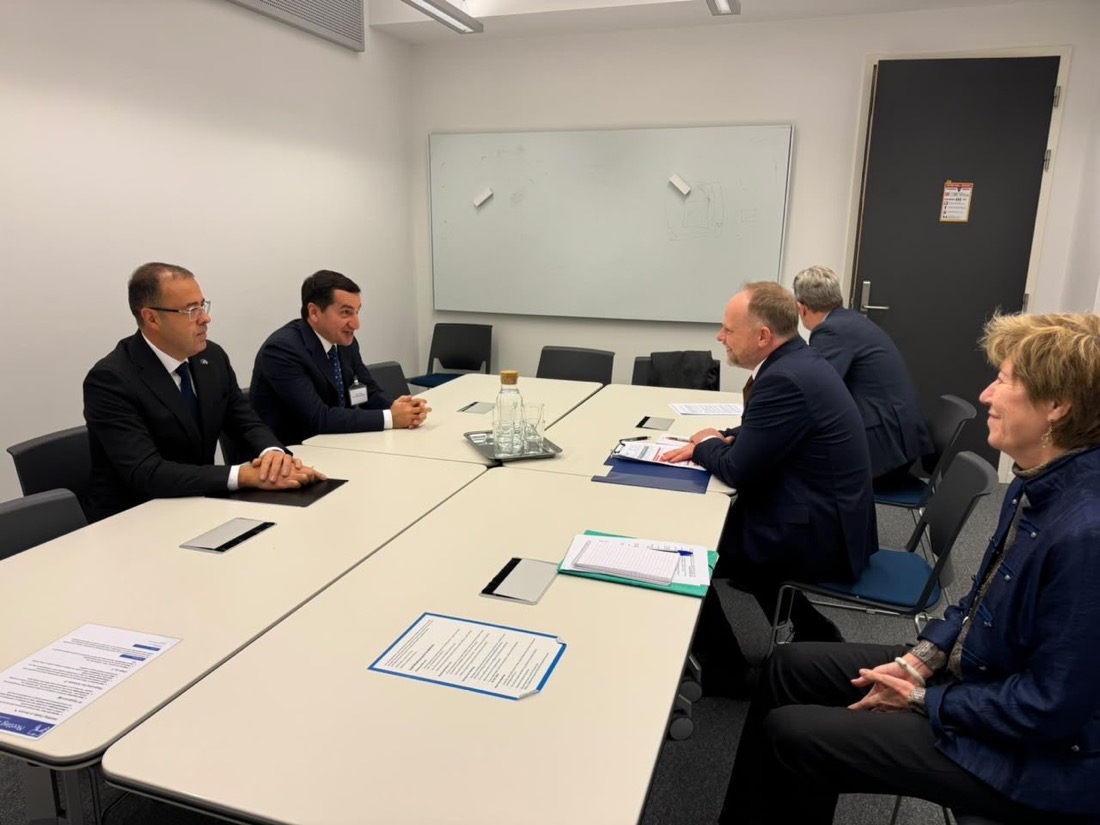
Hikmat Hajiyev (Assistant to the President of the Republic of Azerbaijan), second from left, meets Ambassador Kevin Hamilton (NATO Special Representative for the Caucasus and Central Asia), right, at NATO Headquarters in Brussels, 16 November 2026.
On Ukraine, he called the conflict a tragedy for both countries. He said Azerbaijan supports territorial integrity as a core principle, given its own experience. He said a ceasefire is the most important first step. Baku keeps open channels with both Kyiv and Moscow, provides humanitarian aid to Ukraine, and does not supply weapons to either side. If both parties wished, he said, Baku could host talks. "We are not imposing ourselves," he said.
He described relations with Russia as "stable and normal" again. Relations had been strained after an Azerbaijan Airlines passenger jet crashed near Aktau, Kazakhstan, in December 2024, killing 38 people. At the time, The Brussels Times reported that the crash was probably caused by Russian anti-aircraft fire, and that Baku demanded a public apology from Moscow. Baku expected an apology, compensation for the victims' families and an investigation, and he said these issues have since been addressed.
On Iran, he noted that the Russian and Iranian borders are each about 200 kilometres from Baku. He said Azerbaijan has normal relations with Tehran and does not host any foreign military presence. He urged a diplomatic solution between the United States and Iran based on the memorandum of understanding mediated by Pakistan. "Diplomatic resources aren't exhausted yet," he said.
Beyond hydrocarbons
Hajiyev said Azerbaijan is investing heavily in renewable energy, with partners from Saudi Arabia, the United Arab Emirates, China and BP, including in the Karabakh and East Zangezur regions. He said European companies are also showing growing interest. Azerbaijan expects to have around two gigawatts of green energy export capacity within a few years, rising sharply after 2030. He put the offshore wind potential of Azerbaijan's section of the Caspian Sea at more than 180 gigawatts, comparing it to the North Sea.
He listed several projects linking the region to European markets. These include the Black Sea electricity cable with Georgia, Romania and Hungary, which the EU has listed as a Project of Common Interest. They also include an agreement with Georgia, Türkiye and Bulgaria on an overland route, and a green energy corridor with Kazakhstan and Uzbekistan.
Asked about China, he said the relationship is mutually beneficial and he sees no threats in it. He said Chinese solar technology has proven cost-efficient in Azerbaijan's experience.
On investment, he said more than $350 billion has been invested in Azerbaijan since independence, over $250 billion of it foreign direct investment. New investment is increasingly coming from the Gulf and going beyond the energy sector. He also noted that Azerbaijan has its own space agency and satellites.
He closed the energy discussion with a familiar line: "The Stone Age did not end because the world ran out of stones."
The briefing ended with further questions from attendees on the Middle Corridor and European security.
