
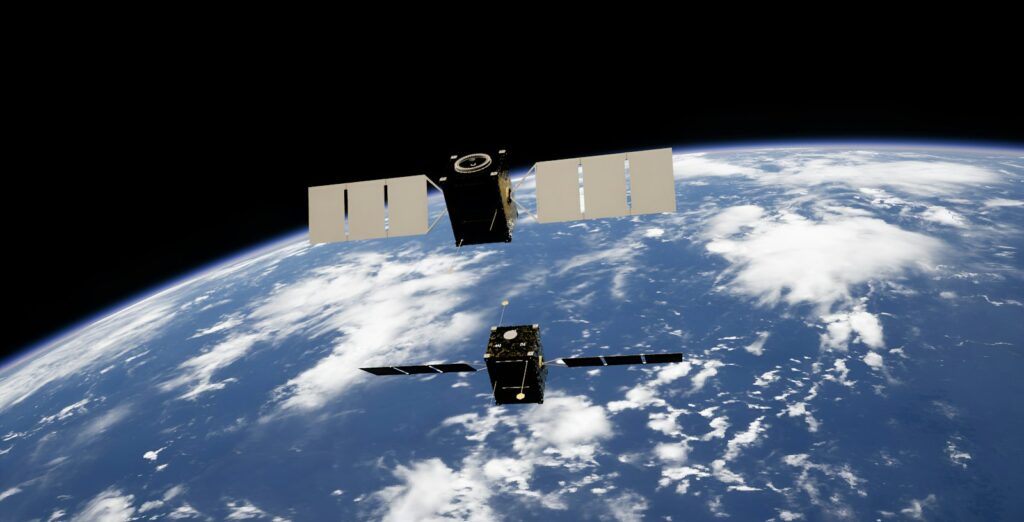
MEPs on the European Parliament’s Industry, Research and Energy Committee have backed plans for an EU “Space Act” designed to create a single market for space-based activities.
The proposed rules focus on three areas: safety — including managing congestion in space and the risk of orbital collisions — security and resilience of space assets, including cybersecurity, and sustainability, such as reducing space debris and light pollution, the Parliament explained in a release on Thursday.
MEPs also supported setting up an EU space resilience network to share information on threats and best practices.
The committee wants the measures integrated into the scope of the EU’s existing NIS2 Directive, which sets cybersecurity requirements for a range of organisations.
Support for smaller space companies
The committee’s position includes creating a common methodology to calculate the environmental footprint of space missions on Earth and in space across their full life cycle, the Parliament said.
MEPs proposed exempting small and medium-sized enterprises (SMEs) from those measures, and asked the European Commission to publish a study on the climate impacts of the space sector and options to reduce them.
MEPs also suggested creating a space sector competitiveness support helpdesk within the EU Agency for the Space Programme (EUSPA).
On competition with non-EU operators, the committee proposed tighter rules for “equivalence decisions” — a mechanism allowing operators from non-EU countries to access the EU market if their rules are considered comparable — by limiting them to four years and allowing a one-year renewal.
The committee also proposed making equivalence conditional on reciprocal market access for EU operators.
The committee adopted the draft report by 72 votes to one, with two abstentions, and backed opening negotiations with EU member states in the Council with the same majority.
Space services are increasingly affected by congestion, with the number of operational satellites in orbit doubling between 2020 and 2023 to more than 9,000.
More than 12,400 tonnes of space objects are orbiting Earth, the European Space Agency estimates.
