
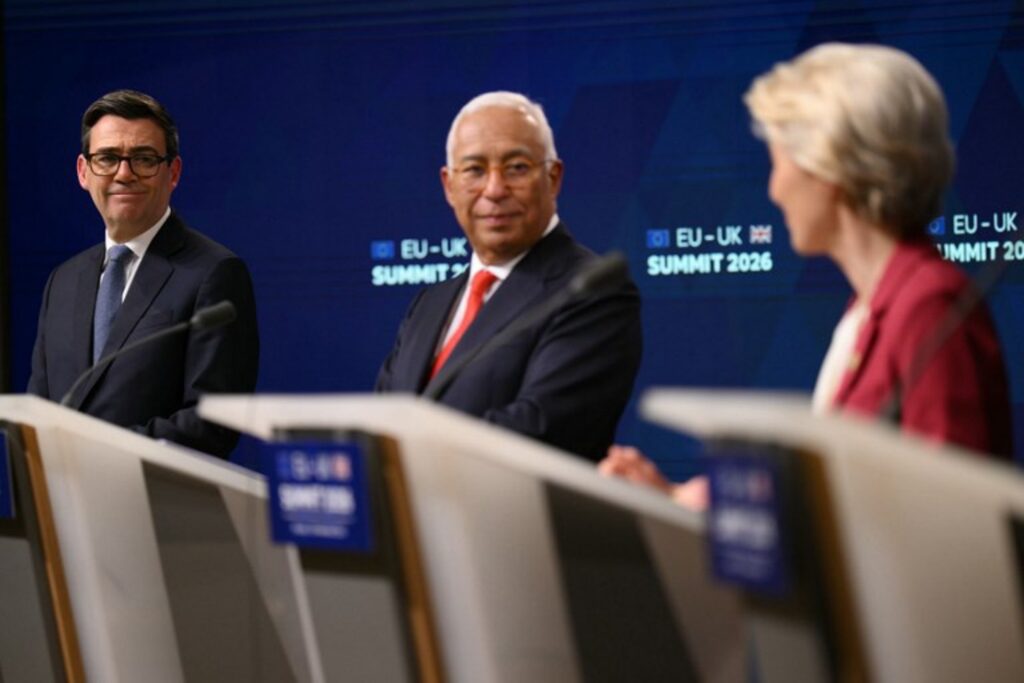
The European Union remains open to building “the closest possible relationship” with the United Kingdom after the two sides agreed a series of new measures aimed at easing post-Brexit ties, European Council President António Costa said on Friday.
The agreement was announced after an EU-UK summit in Brussels.
UK Prime Minister Andy Burnham said the package marked “a line under a decade of uncertainty and division.”
Easier mobility for young people
The deals include simpler export rules for animal and plant products from March 2028, alignment of the two sides’ emissions-trading systems from 2028, and easier mobility for young people.
Under the youth mobility plan, both sides will issue up to 100,000 visas a year for young people who want to work, study, travel or volunteer in the EU or the UK for up to three years.
Burnham said the new arrangements would increase UK GDP by 0.5%.
Strategic dialogue on migration
The two sides will also work towards integrating the UK into the European electricity market, deepen security co-operation and launch a “strategic dialogue” on migration.
Neither side would say how far the relationship could develop in future. Burnham said Friday’s package was “probably the limit of what we can achieve in this parliament” and confirmed that his government would present legislation next week to secure parliamentary approval.
He said the priority now was to consider what more might be possible,adding that the EU and the UK of today are not the same as they were 10 years ago.
EU ready for gradual strengthening of ties
European Commission President Ursula von der Leyen said the EU was ready to pursue a gradual strengthening of ties and was also open to discussing the broader picture.
Costa said both sides should now focus on their shared political will to build the closest possible relationship, adding: “What that will become, we will see.”
Costa said the EU was following “with great interest” the debate Burnham had started in the UK on a renewed rapprochement with the bloc. He added that the UK could count on the EU to act with an open mind once Britain decided what kind of relationship it wanted.
“In the meantime, we must work hard on solutions for our businesses and citizens,” Costa said.
Deal on tuition fees within six months
The EU and the UK also agreed to reach a deal within six months on tuition fees for EU students studying in Britain. At present, they pay more than UK students, and Brussels wants fees to be brought back into line, as they were before Brexit.
Von der Leyen and Burnham both said they were confident an agreement could be reached.
An EU source said on Friday morning that those talks were running in parallel with implementation of the wider agreement. Another source said the tuition fee dispute did not put Friday’s deals at risk.
Even so, several Member States are said to be withholding final approval until there is an agreement on fees. Burnham insisted there was no issue on the British side, saying: “The deal is done, it is here in black and white before us.”
'Made in Europe' policy
Another sensitive issue remains whether the UK will be included in the EU’s future 'Made in Europe' policy.
Under the planned Industrial Accelerator Act, the EU wants to link public procurement to production in Europe in order to protect industry from unfair competition from third countries.
However, it has not yet decided whether that should apply only to EU Member States or also to partner countries.
No agreement has yet been reached on that point. Burnham nevertheless said he was pleased that the text included references to 'Made in Europe,' adding that it states both sides will work together when facing shared economic threats.
